The Erebus and Terror in the Antarctic
James Clark Ross · 1839 CE – 1843 CE · Earth
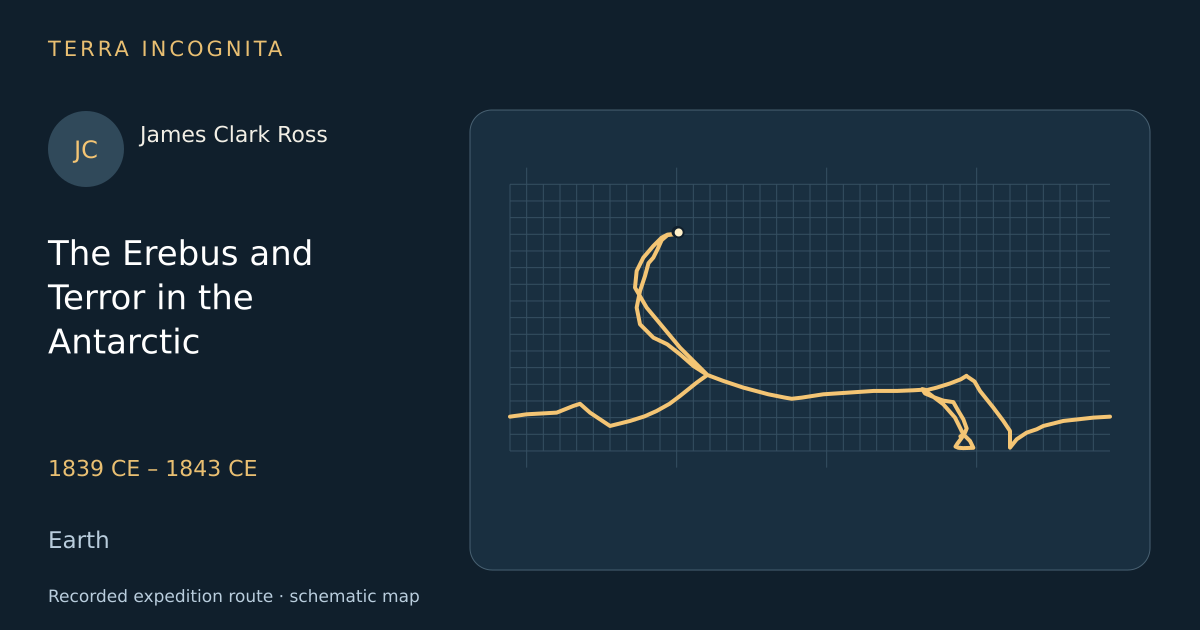
Find the South Magnetic Pole and build a worldwide record of magnetic observations.
Historical context
A worldwide campaign of magnetic observation, the “magnetic crusade”, sent British, French and American ships south in the same seasons to find the southern magnetic pole. Ross had the only two ships strengthened for ice, and used them to do what his rivals thought impossible: sail straight into the pack.
The voyage, step by step
Erebus and Terror sail
September 1839
In September 1839 two bomb vessels, rebuilt for ice, leave the Thames for four years in the Southern Ocean.
Sixty-eight days at Kerguelen
May 1840
From May 1840 the ships lie at Christmas Harbour taking hourly magnetic readings through almost continuous gales.
Franklin’s welcome
August 1840
At Hobart in August 1840 the governor, Ross’s old Arctic commander John Franklin, builds him an observatory in a fortnight.
Into the pack
5 January 1841
On 5 January 1841 Ross drives his ships straight into the ice, and four days later comes out into an open sea.
Victoria Land
11 January 1841
On 11 January a range of snow mountains rises to the west; boats land on an offshore island to claim the coast.
A volcano in the ice
28 January 1841
On 28 January the ships find a smoking mountain 3,800 metres high at 77° south, and name it for the Erebus.
The Great Ice Barrier
1841 CE
East of the volcano the ships meet a vertical cliff of ice 50 metres high and follow it 450 kilometres without finding an opening.
Collision among the bergs
13 March 1842
In a gale on 13 March 1842 the two ships collide in a field of icebergs and lock together, rigging in rigging.
Outcome
Broke through the pack into a new sea, discovered Victoria Land, Mount Erebus and the Great Ice Barrier.
James Clark Ross
British polar navigator who reached the North Magnetic Pole and then broke into the Ross Sea, sighting Mount Erebus and the Great Ice Barrier.
Sources
- James Clark Ross — Wikipedia
- A Voyage of Discovery and Research in the Southern and Antarctic Regions, during the Years 1839–43James Clark Ross · John Murray · 1847
Continue exploring
- Voyage to the South Pole and OceaniaJules Dumont d’Urville · 1837 CE – 1840 CE
- Lost Arctic expeditionJohn Franklin · 1845 CE – 1848 CE
- The circumnavigation of AustraliaMatthew Flinders · 1801 CE – 1803 CE
- Survey of the Pacific NorthwestGeorge Vancouver · 1791 CE – 1795 CE