Lost Arctic expedition
John Franklin · 1845 CE – 1848 CE · Earth
Complete the Northwest Passage.
Historical context
Britain's Admiralty offered a reward for finding the Northwest Passage, and Franklin's well-equipped expedition was the most confident attempt yet. Its disappearance triggered one of the largest search efforts in history.
The voyage, step by step
Departure from the Thames
May 1845
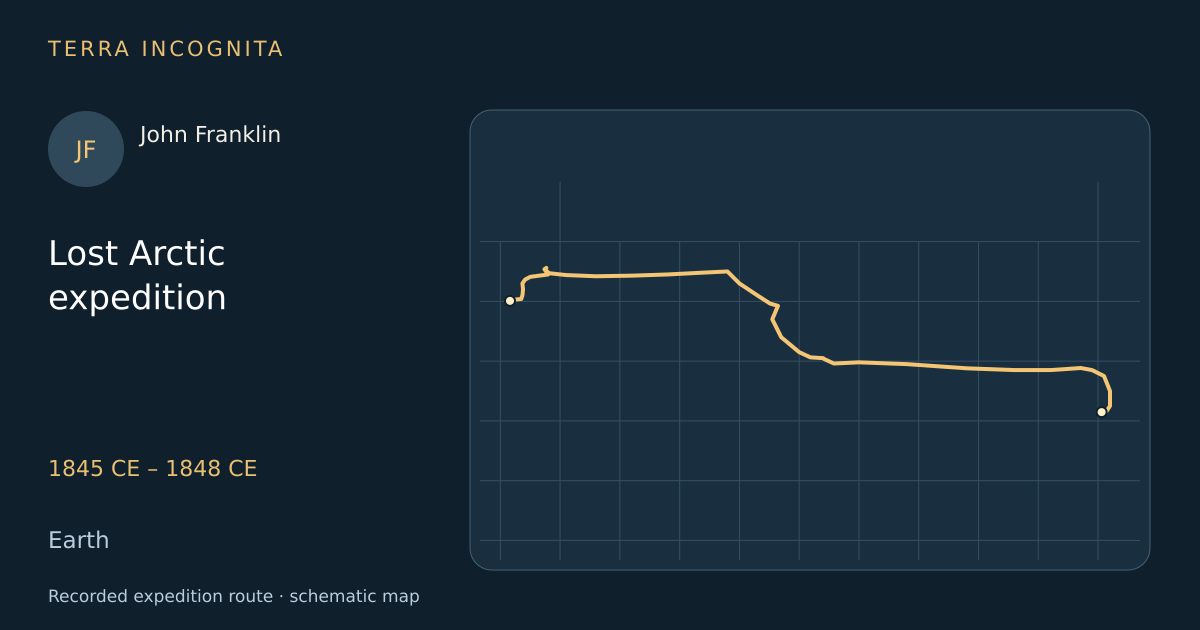
HMS Erebus and Terror sail in May 1845 with 129 men and three years of provisions.
Baffin Bay
July 1845
The ships cross Baffin Bay and are last seen by whalers in July 1845.
Winter at Beechey Island
1845 CE
The expedition winters at Beechey Island, where three men are buried.
Beset off King William Island
September 1846
In September 1846 the ships are trapped in the ice and begin to drift helplessly south.
Franklin dies
11 June 1847
A cairn note records that Franklin died on 11 June 1847 and that 24 men had already died.
The ships are abandoned
April 1848
In April 1848 the survivors abandon the ships and set out on foot; none would return.
Outcome
Both ships were lost and all 129 men died.
John Franklin
British naval officer whose lost Arctic expedition became the most famous disaster in exploration history.
Sources
Continue exploring
- The Erebus and Terror in the AntarcticJames Clark Ross · 1839 CE – 1843 CE
- Voyage to the South Pole and OceaniaJules Dumont d’Urville · 1837 CE – 1840 CE
- The circumnavigation of AustraliaMatthew Flinders · 1801 CE – 1803 CE
- Survey of the Pacific NorthwestGeorge Vancouver · 1791 CE – 1795 CE