Voyage to the South Pole and Oceania
Jules Dumont d’Urville · 1837 CE – 1840 CE · Earth
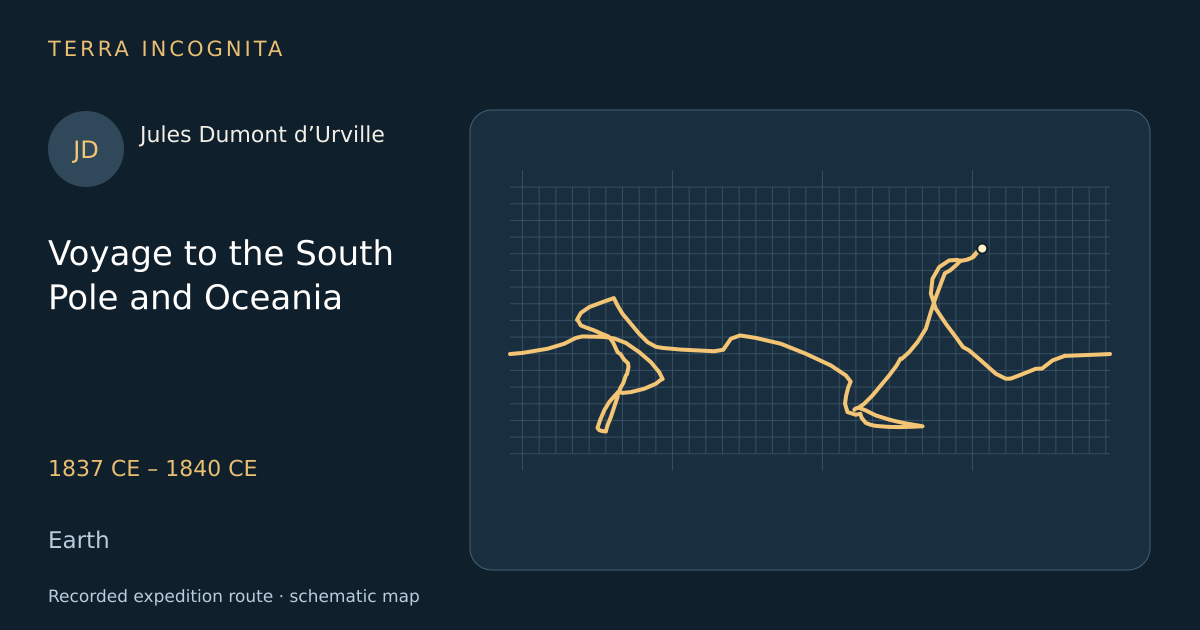
Push as far south as the ice allows, and survey the islands of Oceania on the way.
Historical context
The July Monarchy wanted an Antarctic success to match the British and American expeditions sailing the same summers, and offered the crews a bounty for every degree south of 75°. Dumont d’Urville, ill and past fifty, spent two tropical years between two attempts on the ice before finding a coast where the maps showed nothing.
The voyage, step by step
Orders from the king
September 1837
In September 1837 the Astrolabe and the Zélée leave Toulon with orders to sail further south than anyone.
Stopped by the pack
February 1838
In February 1838 the two corvettes are held for five days in the pack ice of the Weddell Sea and barely warp themselves out.
Louis Philippe Land
March 1838
In March 1838 the ships chart a long mountainous coast at the tip of the Antarctic Peninsula and name it for the king.
Refitting at Hobart
December 1839
In December 1839 the ships reach Tasmania after two years in the tropics, burying their dead and taking in coal and stores.
Land under the ice cap
19 January 1840
On 19 January 1840 the lookouts see rock beneath the ice: a continental coast at 66° south.
A flag on an islet
21 January 1840
On 21 January boats land on a rocky islet, chip off granite specimens and claim the coast for France.
Ships that did not speak
30 January 1840
On 30 January 1840 the Astrolabe and the American brig Porpoise pass within hailing distance and each sheers away.
Return to Toulon
November 1840
In November 1840 the two corvettes come home after three years, with a new Antarctic coast on the charts.
Outcome
Beaten back by the Weddell pack in 1838, he found and claimed Adélie Land from Hobart in January 1840.
Jules Dumont d’Urville
French officer, botanist and linguist who found the wreck of La Pérouse and claimed Adélie Land for France.
Sources
- Jules Dumont d’Urville — Wikipedia
- Voyage au Pôle Sud et dans l’Océanie sur les corvettes l’Astrolabe et la ZéléeJules Dumont d’Urville · Gide · 1841
Continue exploring
- The Erebus and Terror in the AntarcticJames Clark Ross · 1839 CE – 1843 CE
- Lost Arctic expeditionJohn Franklin · 1845 CE – 1848 CE
- The circumnavigation of AustraliaMatthew Flinders · 1801 CE – 1803 CE
- Survey of the Pacific NorthwestGeorge Vancouver · 1791 CE – 1795 CE