The transpolar flight of the Norge
Umberto Nobile · 1926 CE · Earth
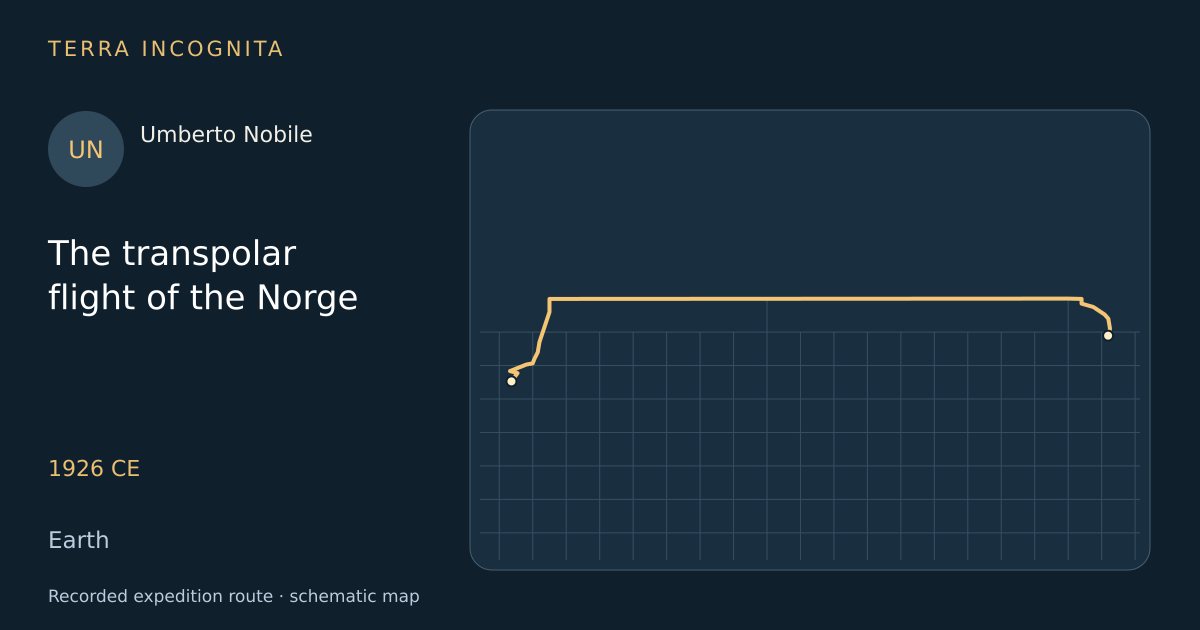
Fly from Svalbard across the North Pole to Alaska and see whether any land lies in the unexplored polar basin.
Historical context
By 1926 nobody could say what lay in the Arctic Ocean between the North Pole and Alaska: many scientists and explorers, Nobile recalled, supposed there was extensive land there. In 1925 Amundsen, Ellsworth and Riiser-Larsen had flown two Dornier Wal flying boats from Svalbard toward the pole and been forced down near 88 degrees north. For the next attempt the Norwegian Aero Club, with Ellsworth’s money, bought the Italian semi-rigid airship N-1, renamed it Norge, and engaged its designer, Umberto Nobile, as its captain. The flight succeeded, and a public quarrel between Amundsen and Nobile over who deserved the credit followed at once.
The voyage, step by step
Out of the roofless hangar
11 May 1926
At 9:55 on the morning of 11 May 1926 by the local clock, 8:55 by Greenwich time, the Norge rises from King’s Bay at Ny-Ålesund on Svalbard with sixteen men and a dog aboard, bound across the pole for Alaska.
North along the King’s Bay meridian
11 May 1926
North of Svalbard the pack ice closes into an unbroken white plain, and the crew keep watch for the land some geographers still expect between the pole and Alaska.
Three flags over the pole
12 May 1926
At 1:25 in the morning of 12 May, Greenwich time, the Norge reaches the North Pole and circles low over it, and Amundsen, Ellsworth and Nobile each drop a flag onto the ice below.
Ice fog over the polar sea
12 May 1926
On the way from the pole toward Alaska the Norge runs into fog and snow that last for most of the way; ice forms on every metal part, and ice flung by the propellers tears the fabric of the keel.
The coast at Wainwright
13 May 1926
At 6:45 on the morning of 13 May, Greenwich time, Riiser-Larsen calls land ahead; the Norge crosses the coast just west of Point Barrow and follows it to the Iñupiat village of Wainwright, which Amundsen knows at once.
Lost off Kotzebue Sound
13 May 1926
Past Cape Lisburne the fog closes down and a northerly gale drives the Norge off her course, perhaps as far as the Siberian coast, before she finds Alaska again near the Iñupiat village of Kivalina.
Down at Teller
14 May 1926
Early on 14 May 1926 by Greenwich time, the evening of 13 May by the Alaskan clock, the Norge comes down on the ice beside the small settlement of Teller, ending the first flight across the Arctic Ocean.
Outcome
Crossed the Arctic Ocean from Svalbard to Alaska, some 5,000 km in Nobile’s reckoning and about 70 hours in the air by the expedition’s Greenwich times, sighted no land on its track, and came down at Teller in Alaska on 14 May 1926 by Greenwich time, the evening of 13 May by the Alaskan clock.
Umberto Nobile
Italian aeronautical engineer who designed and piloted the airship Norge across the Arctic Ocean and the North Pole in 1926.
Sources
- Umberto Nobile — Wikipedia
- Norge (airship) — Wikipedia
- First Crossing of the Polar SeaRoald Amundsen and Lincoln Ellsworth · George H. Doran · 1927
- My Life as an ExplorerRoald Amundsen · Doubleday, Page & Company · 1927
- Land or Ocean? Umberto Nobile Explores the North Pole Terrain (excerpt of a 1960 interview by Kenneth Leish, Columbia University Oral History Research Office)Umberto Nobile · Fathom Knowledge Network · 1960
- The 100th Anniversary of the First Flight Over the North PoleThomas Paone · Smithsonian National Air and Space Museum · 2026
- Luftskipet NorgeKetil G. Andersen and Tone Rasch · Norsk Teknisk Museum · 2026
Continue exploring
- New York to Paris, aloneCharles Lindbergh · 1927 CE
- Around-the-world flightAmelia Earhart · 1937 CE
- The last march towards ZPercy Fawcett · 1925 CE
- The third Everest expeditionGeorge Mallory · 1924 CE