New York to Paris, alone
Charles Lindbergh · 1927 CE · Earth
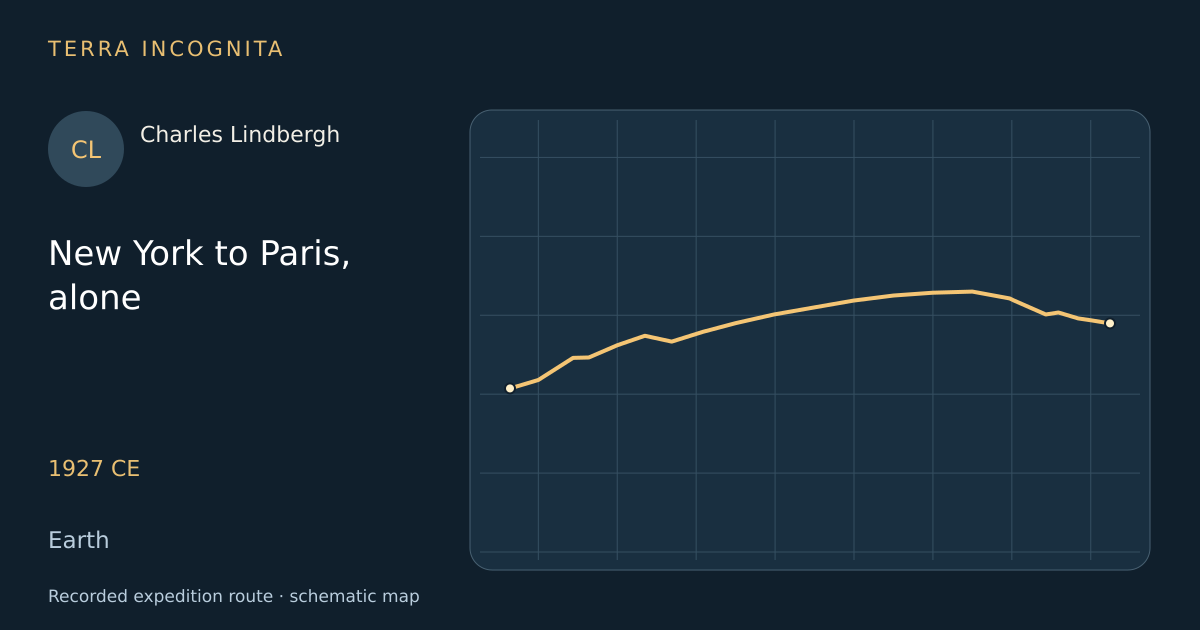
Fly non-stop from New York to Paris alone and win the Orteig Prize.
Historical context
The hotelier Raymond Orteig had offered 25,000 dollars for a non-stop flight between New York and Paris, and by the spring of 1927 six men had died or disappeared trying for it in large multi-engined machines. Lindbergh reversed every assumption — one engine, one man, no radio — and took off two weeks after two French aces vanished over the Atlantic on the same errand.
The voyage, step by step
A muddy, overloaded take-off
20 May 1927
At dawn on 20 May 1927 the Spirit of St. Louis, loaded far beyond its rated weight with fuel, struggles down the rain-soaked runway at Roosevelt Field and barely clears the telephone wires at the far end.
Checking the great circle
1927 CE
Four hours out, Lindbergh crosses the coast of Nova Scotia almost exactly on the great-circle line he had drawn on his map, his first proof that dead reckoning alone would work.
The last land for nineteen hours
1927 CE
Crossing the coast near St John's, Newfoundland, Lindbergh takes his last sight of land before more than 3,000 kilometres of open ocean.
Fog, ice and sleep
1927 CE
Deep over the Atlantic, Lindbergh climbs to avoid storm clouds, finds ice forming on the wings in the moisture, and fights off hallucinations brought on by exhaustion.
Ireland, dead ahead
1927 CE
After twenty-eight hours over open water, fishing boats and then the cliffs of Dingle Bay appear almost exactly where his dead-reckoning course predicted landfall.
Across the Channel by dusk
1927 CE
Lindbergh crosses southern England and the English Channel in the last hour of daylight, now flying over some of the most familiar airspace in Europe after a day above empty ocean.
Le Bourget, a hundred thousand strong
21 May 1927
At 10:22 p.m. on 21 May the Spirit of St. Louis lands at Le Bourget airfield after 33 hours 30 minutes in the air, to a crowd that breaks through the barriers before the propeller stops.
Outcome
Landed at Le Bourget on 21 May 1927 after 33 hours 30 minutes and 5,800 km, to a crowd of more than 100,000.
Charles Lindbergh
American airmail pilot who made the first solo non-stop flight from New York to Paris in 1927, alone in a single-engined monoplane.
Sources
- Charles Lindbergh — Wikipedia
- The Spirit of St. LouisCharles A. Lindbergh · Charles Scribner’s Sons · 1953
- LindberghA. Scott Berg · G. P. Putnam’s Sons · 1998
Continue exploring
- The transpolar flight of the NorgeUmberto Nobile · 1926 CE
- Around-the-world flightAmelia Earhart · 1937 CE
- The last march towards ZPercy Fawcett · 1925 CE
- The third Everest expeditionGeorge Mallory · 1924 CE