Around-the-world flight
Amelia Earhart · 1937 CE · Earth
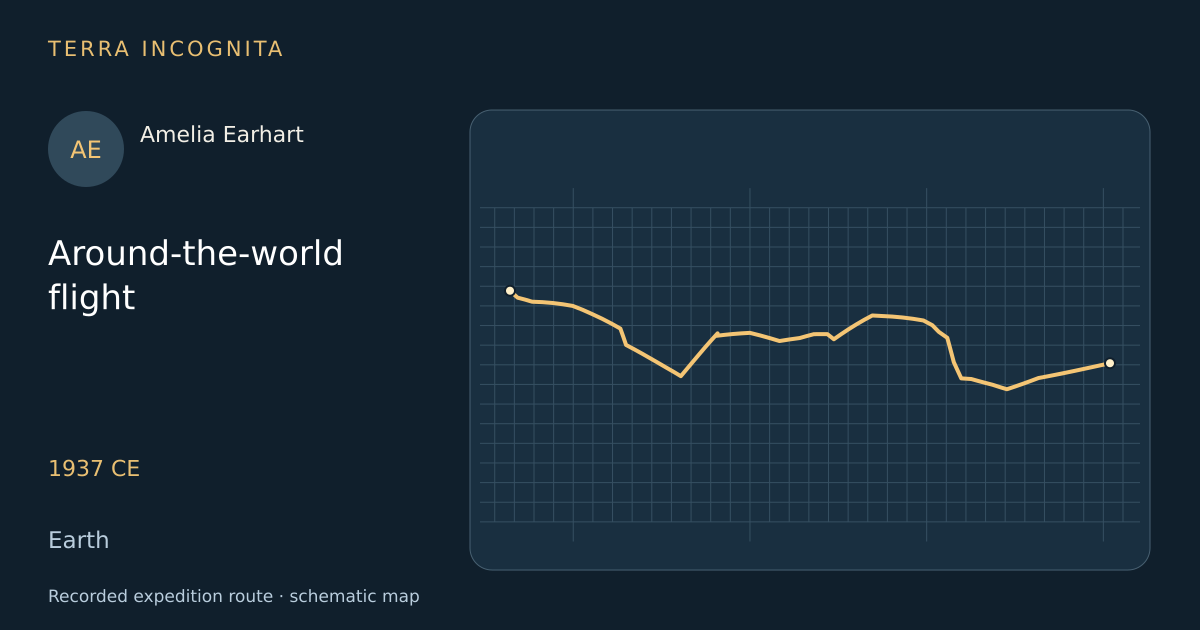
Fly a Lockheed Electra around the world as near the equator as possible, some 27,000 miles by Earhart’s count, with Fred Noonan navigating.
Historical context
Amelia Earhart, the first woman to fly the Atlantic alone, in 1932, set out in 1937 to fly around the world as near the equator as possible, in a Lockheed Electra the press called a flying laboratory, with Fred Noonan, a former Pan American navigator, finding the way. Each stage was reported in her own dispatches to the New York Herald Tribune. The flight depended on radio as much as on navigation, and on 2 July 1937, close to tiny Howland Island, the radio link with the cutter Itasca never worked as planned; their fate remains one of aviation’s most argued mysteries.
The voyage, step by step
Round the world
17 March 1937
On 17 March 1937 Earhart leaves Oakland for Honolulu on a first, westbound attempt to fly around the world near the equator; three days later it ends in a ground loop on take-off at Luke Field.
Eastbound from Miami
1 June 1937
The second attempt starts on 1 June, flying east so the worst weather comes at the end.
The South Atlantic
7 June 1937
On 7 June they leave Natal before dawn and cross about 1,900 miles of the South Atlantic to Africa, landing at Saint-Louis instead of Dakar.
Karachi
15 June 1937
On 15 June they fly non-stop from Assab on the Red Sea to Karachi, keeping over the sea along the coast of Arabia.
Lae, New Guinea
2 July 1937
Twenty-two thousand miles done, seven thousand to go, all of it over the Pacific.
Across the Pacific
2 July 1937
At 5:18 in the afternoon, Lae time, Lae hears her last position: 4.33 south, 159.7 east, at 8,000 feet over cumulus clouds.
Lost
2 July 1937
Near Howland the Itasca hears her loud and clear but cannot guide her in; after 8:43, ship’s time, its log records no more messages from her.
Outcome
A first attempt ended in a ground loop at Luke Field, Pearl Harbor, on 20 March 1937. The second, eastbound from Miami on 1 June, reached Lae in New Guinea; on 2 July 1937 Earhart and Noonan vanished near Howland Island after radio calls that the cutter Itasca heard but could not answer usefully. The costliest air and sea search in United States history to that date found nothing, and their fate is still debated.
Amelia Earhart
American aviator who was the first woman to fly solo across the Atlantic and vanished attempting a flight around the world.
Sources
- Amelia Earhart — Wikipedia
- Dispatches to the New York Herald Tribune, March–July 1937, and press clippings, in Amelia Earhart scrapbook 18Amelia Earhart · Purdue University Libraries, George Palmer Putnam Collection of Amelia Earhart Papers · 1937
- Radio log, USCGC Itasca, 1–2 July 1937 (Treasury Department, U.S. Coast Guard, Form 2614 A)L. G. Bellarts, G. E. Thompson and W. L. Galten, radiomen · U.S. Coast Guard; facsimile reproduced at the National Archives and hosted by TIGHAR · 1937
- Letter to M. E. Griffin on Amelia Earhart’s stay at Lae and her departureEric H. Chater, Guinea Airways Ltd · Lae, 25 July 1937; transcription hosted by TIGHAR · 1937
- Letter to the Civil Aviation Board on Amelia EarhartJames A. Collopy, District Superintendent of Civil Aviation · Salamaua, 28 August 1937; transcription hosted by TIGHAR · 1937
- They Couldn’t Stop Amelia EarhartMichael Quentin Morton · Air & Space Magazine, Smithsonian, December 2021 · 2021
- Speculation on the disappearance of Amelia Earhart and Fred Noonan — Wikipedia
Continue exploring
- New York to Paris, aloneCharles Lindbergh · 1927 CE
- The transpolar flight of the NorgeUmberto Nobile · 1926 CE
- The half-mile dives off BermudaWilliam Beebe and Otis Barton · 1930 CE – 1934 CE
- Thesiger’s first crossing of the Empty QuarterWilfred Thesiger · 1946 CE – 1947 CE