The third Everest expedition
George Mallory · 1924 CE · Earth
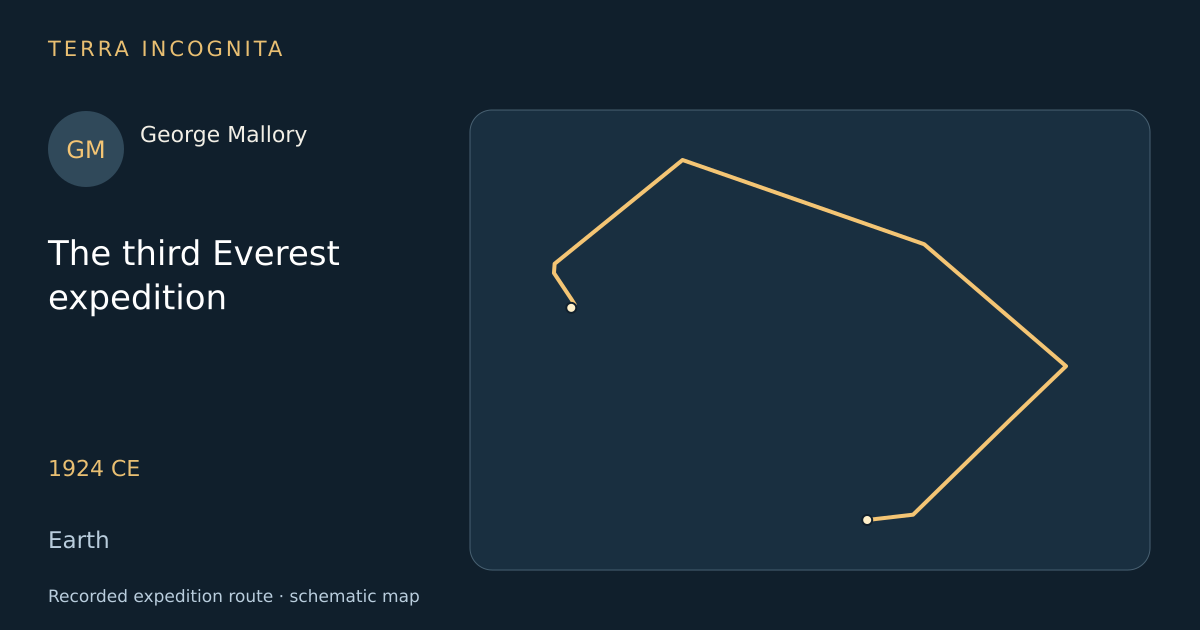
Climb Everest from Tibet by the North Col and the north-east ridge, with or without the new oxygen apparatus.
Historical context
Everest could only be approached from Tibet, through a country the British had entered by force in 1904, and every attempt began with a march of more than a month from Darjeeling through Sikkim and across the plateau. The 1921 reconnaissance had found the North Col, the 1922 attempt had reached about 8,300 metres and lost seven porters to an avalanche below the col, and 1924 was meant to finish the job. It ended instead with two of its climbers vanishing into cloud high on the north-east ridge, and the question of whether they reached the top has been asked for a hundred years.
The voyage, step by step
Darjeeling
March 1924
In March 1924 the third British expedition to Everest sets out from Darjeeling under General Charles Bruce: George Mallory on his third Everest expedition, Andrew Irvine as oxygen officer, Edward Norton, Howard Somervell, Noel Odell and the photographer John Noel among them. Ahead lies a march of more than a month through Sikkim and onto the Tibetan plateau.
Onto the plateau
April 1924
In April the caravan climbs out of Sikkim onto the Tibetan plateau by Phari, reached on 6 April. General Bruce, travelling ahead by another road, is struck down by malaria at Tuna and carried back to Phari; the column, held at the fortress of Kampa Dzong from 11 to 15 April waiting for transport, hears on 13 April that he has gone back to India. Edward Norton takes command, and Mallory becomes leader of the climbing.
Rongbuk monastery
28 April 1924
On 28 April the expedition reaches the Rongbuk monastery, in the valley that runs up to the north face of Everest; its head lama is ill and cannot receive them. The next day base camp goes up at 16,800 feet, about 5,120 metres, half a mile below the snout of the Rongbuk glacier.
The North Col
21 May 1924
On 20 May Norton, Mallory and Odell, with the porter Lhakpa Tsering, reach the North Col at about 7,000 metres; on 21 May Somervell, Irvine and Hazard bring up twelve porters with loads in steadily falling snow, and Camp IV is made on the col.
Norton's 8,573 metres
4 June 1924
On 4 June Norton and Somervell climb from Camp VI without oxygen. Somervell stops at about 28,000 feet, some 8,530 metres; Norton goes on alone into the great couloir and reaches 28,126 feet, about 8,573 metres, before turning back.
Camp VI
7 June 1924
Mallory and Irvine leave Camp IV on 6 June and reach Camp VI, about 8,170 metres, on 7 June, climbing with oxygen; they send their porters down with two notes, one to Odell, coming up in support to Camp V, apologising for leaving things in such a mess, and one to the photographer John Noel.
Going strong for the top
8 June 1924
At 12:50 on 8 June the cloud clears from the summit ridge and Odell, on a little crag at about 26,000 feet, some 7,900 metres, sees two figures climb a rock step on the north-east ridge before the cloud closes again; it is the last sight of Mallory and Irvine.
Outcome
Norton reached about 8,573 metres without oxygen on 4 June, the highest anyone is known to have climbed until 1952, unless Mallory and Irvine went higher; Mallory and Irvine were last seen by Odell at 12:50 on 8 June climbing a rock step high on the north-east ridge, and never came down. Whether they reached the summit is unknown. Two of the expedition's men, the cobbler Man Bahadur and Lance-Naik Shamsher, died in May.
George Mallory
The schoolmaster who went to Everest three times and vanished with Andrew Irvine into a cloud near the summit on 8 June 1924, leaving the oldest question in mountaineering.
Sources
- 1924 British Mount Everest expedition — Wikipedia
- George Mallory — Wikipedia
- The Fight for Everest 1924E. F. Norton and other members of the expedition · Edward Arnold, London; Longmans, Green, New York · 1925
- Mount Everest Dispatches (Irvine, Mallory, Norton, Odell, Macdonald and others)The Alpine Journal, vol. 36, pp. 195–241 · 1924
- The Journey through Tibet and the Establishment of the High CampsGeoffrey Bruce · The Alpine Journal, vol. 36, pp. 251–260 · 1924
- The Climb with Mr. Somervell to 28,000 FeetE. F. Norton · The Alpine Journal, vol. 36, pp. 260–265 · 1924
- The Last ClimbN. E. Odell · The Alpine Journal, vol. 36, pp. 265–272 · 1924
- The Problem of Mount EverestE. F. Norton · The Alpine Journal, vol. 37, pp. 1–22 · 1925
- Sandy Irvine's Biography (exhibition Sandy Irvine: Everest 1924–2024)Merton College, Oxford · Merton College Library and Archives · 2024
- Sandy Irvine: Everest 1924–2024Merton College, Oxford · Merton College Library and Archives · 2024
- A last message from Mallory (Everest timeline)Merton College, Oxford · Merton College · 2024
- Mallory and Irvine disappear (Everest timeline)Merton College, Oxford · Merton College · 2024
- No sign of Mallory and Irvine (Everest timeline)Merton College, Oxford · Merton College · 2024
- Letter from George to Ruth Mallory, 27 May 1924George Mallory · Magdalene College Archives, Cambridge · 1924
- Everest mountaineer's letters digitised for the first timeUniversity of Cambridge · University of Cambridge · 2024
- Far More Than Being FirstWade Davis · The Explorers Journal, The Explorers Club
- See Photos From the 1924 Mount Everest Expedition That Led to the Vanishing of Two ExplorersSmithsonian Magazine · 2024
- Edward F. Norton — Wikipedia
- 1952 Swiss Mount Everest expedition — Wikipedia
- First ascent of Mt Everest without supplementary oxygenGuinness World Records
- Through Tibet to EverestJ. B. L. Noel · Edward Arnold, London · 1927
- Everest 1933Hugh Ruttledge · Hodder and Stoughton, London · 1934
- Andrew Irvine (mountaineer) — Wikipedia
- Mallory and Irvine Research Expedition — Wikipedia
- Remains of Sandy Irvine believed found on Everest after 100 yearsNational Geographic · 2024
- Partial remains of Sandy Irvine found on Mount EverestMerton College, Oxford · Merton College · 2024
Continue exploring
- The first ascent of DenaliHudson Stuck · 1913 CE
- Annie Peck's conquest of HuascaránAnnie Smith Peck · 1908 CE
- Nun Kun and Pinnacle PeakFanny Bullock Workman · 1906 CE
- The French Annapurna expeditionMaurice Herzog · 1950 CE