The last march towards Z
Percy Fawcett · 1925 CE · Earth
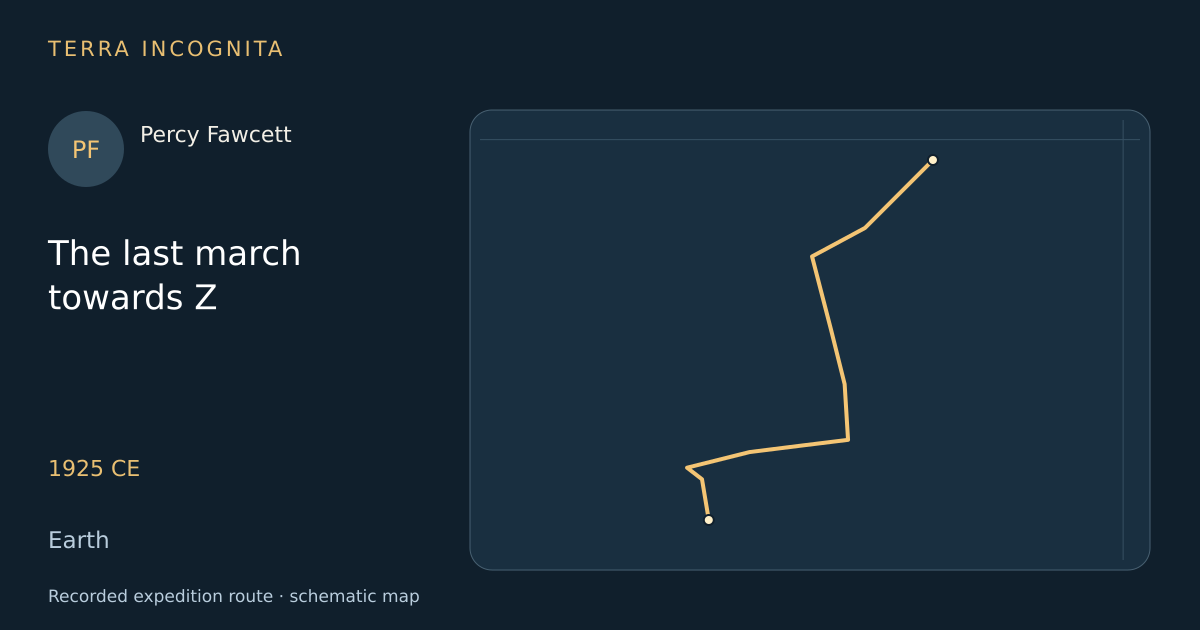
Cross the Mato Grosso from Cuiabá to the headwaters of the Xingu and find the ruined city Fawcett called Z.
Historical context
By 1925 the Royal Geographical Society had run out of blanks that could be filled by a gentleman with a compass, and Fawcett offered it one last blank: a ruined city in the Mato Grosso, argued from an eighteenth-century manuscript and from his own conviction that the forest had once held cities. A syndicate of newspapers paid for a party of three, chosen small on the theory that three men would be taken for travellers rather than invaders. Everything up to Dead Horse Camp is documented by his own letters; everything after it is testimony, rumour and the ninety years of searching that followed.
The voyage, step by step
Cuiabá, April 1925
April 1925
Three men and eight mules leave the last railhead town for the Mato Grosso.
The ox-cart road
1925 CE
North through cattle country, scrub and rivers still on the Brazilian map.
The Bakairi post
1925 CE
The last administered place on the road, on a headwater of the Xingu.
Into the Upper Xingu
1925 CE
Twelve days north-east through scrub forest towards the headwaters, with three mules left.
Dead Horse Camp, 29 May
29 May 1925
The last letter is written and sent back: a latitude, a longitude and a promise.
Beyond the last confirmed point
1925 CE
East into forest nobody surveyed, on a course that exists only in his own notes.
The Kalapalo account
1925 CE
Three white men pass a village heading east, against advice, and their smoke is watched for five days.
Outcome
The party was last confirmed at Dead Horse Camp on 29 May 1925; everything after that rests on Kalapalo testimony and on thirteen search expeditions that found nothing certain.
Percy Fawcett
British artillery officer and boundary surveyor who mapped the rivers of the Bolivian frontier, then walked into the Mato Grosso in 1925 looking for a lost city he called Z and was never seen again.
Sources
- Percy Fawcett — Wikipedia
- The Lost City of Z: A Tale of Deadly Obsession in the AmazonDavid Grann · Doubleday, New York · 2009
- Exploration FawcettPercy Harrison Fawcett, edited by Brian Fawcett · Hutchinson, London · 1953
Continue exploring
- On foot to LhasaAlexandra David-Néel · 1923 CE – 1924 CE
- Imperial Trans-Antarctic expeditionErnest Shackleton · 1914 CE – 1916 CE
- Damascus to Ha’il and BaghdadGertrude Bell · 1913 CE – 1914 CE
- South Pole expeditionRoald Amundsen · 1910 CE – 1911 CE