The first ascent of Everest
Tenzing Norgay · 1953 CE · Earth
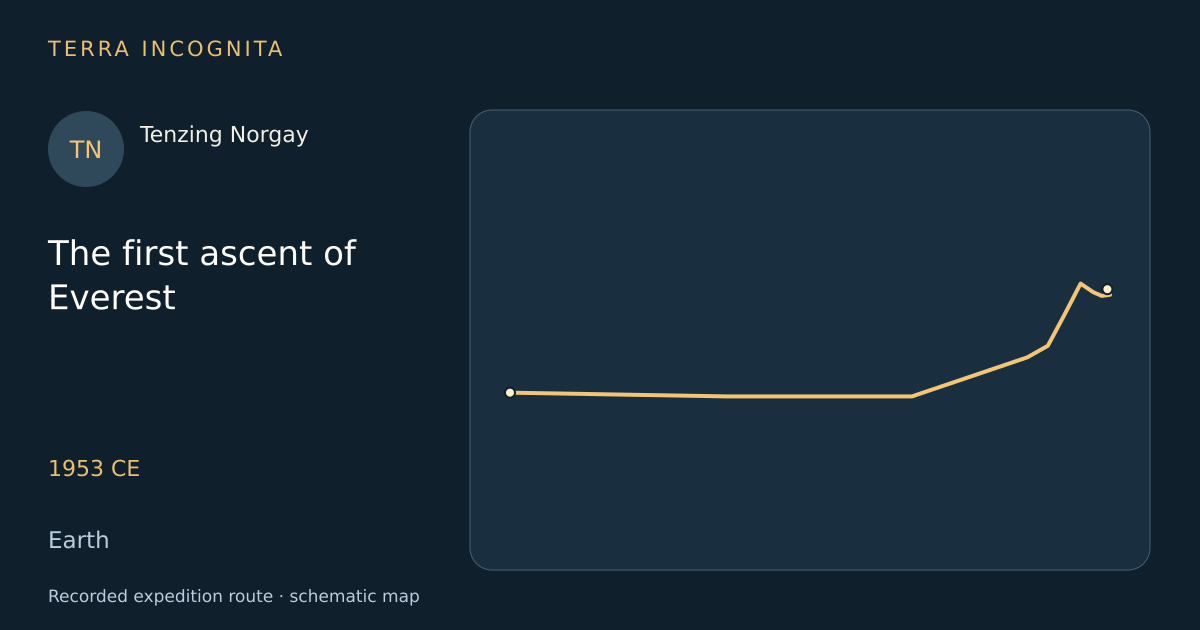
Climb Everest by the South Col and the south-east ridge with oxygen, on Britain's only permit before the French took their turn in 1954.
Historical context
Everest had beaten every expedition since 1921, and the Swiss had come within 250 metres of the top with Tenzing in 1952. Nepal allowed one expedition a year; Britain held the 1953 permit and the French the next, so John Hunt planned the ascent like a military campaign, with thirteen tons of stores, two rival oxygen systems and two summit pairs. The news reached London on the morning of the Queen's coronation, and Tenzing came down the mountain a hero in three countries that each claimed him.
The voyage, step by step
Assembling at Kathmandu
10 March 1953
In March the expedition gathers in the capital with thirteen tons of stores and three hundred and fifty porters, and marches out in two parties on 10 and 11 March.
Namche Bazaar
25 March 1953
The seventeen-day walk in ends in the Sherpa town below the mountain, where the porters are paid off and the Khumbu men take over the loads.
Tengboche
27 March 1953
From 27 March the party acclimatises for three weeks around the monastery that faces the mountain, climbing the peaks nearby and testing the oxygen sets.
Base Camp
12 April 1953
On 12 April the expedition establishes Base Camp at 17,900 feet below the Khumbu Icefall, and Hillary's party starts cutting a route through the ice the next day.
The Western Cwm
1 May 1953
Above the icefall a silent, blinding valley of snow runs up between Everest and Lhotse; the advance base, Camp IV, stands in it at 6,400 metres from 1 May.
From the South Col to the last camp
28 May 1953
Tenzing and Hillary wait out a day of wind on the col at 7 900 m, then on 28 May climb with Lowe, Gregory and Ang Nyima to pitch their own tent higher than anyone has slept.
The summit
29 May 1953
On 29 May 1953 they stand on the highest point on Earth at 11:30, having reached the South Summit at 9:00 and climbed the last ridge in two and a half hours.
The news reaches London
2 June 1953
James Morris of The Times runs down to base camp, sends a coded message by runner to Namche Bazaar and by wireless to Kathmandu, and London prints it on the morning of the Queen's coronation, 2 June 1953.
Outcome
Tenzing Norgay and Edmund Hillary on the summit at 11:30 on 29 May 1953, the first people on the highest point on Earth; the news reached London on the morning of the Queen's coronation.
Tenzing Norgay
The Sherpa who had been higher on Everest than anyone alive when he and Edmund Hillary reached its summit on 29 May 1953, after seven expeditions to the mountain.
Sources
- Tenzing Norgay — Wikipedia
- 1953 British Mount Everest expedition — Wikipedia
- The Ascent of EverestJohn Hunt · Hodder & Stoughton · 1953
Continue exploring
- The Willy Merkl memorial expedition to Nanga ParbatHermann Buhl · 1953 CE
- The Italian K2 expeditionAchille Compagnoni and Lino Lacedelli · 1954 CE
- The French Annapurna expeditionMaurice Herzog · 1950 CE
- The third Everest expeditionGeorge Mallory · 1924 CE