The French Annapurna expedition
Maurice Herzog · 1950 CE · Earth
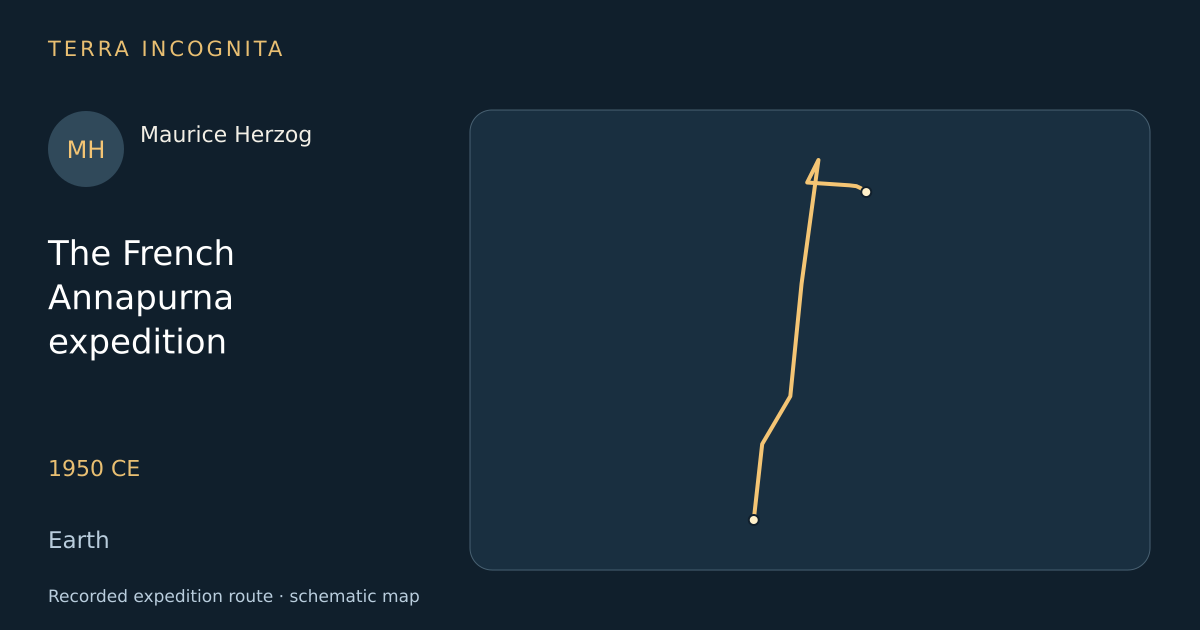
Climb Dhaulagiri or Annapurna, the two mountains for which the French held permits, and so make the first ascent of any of the fourteen mountains above 8,000 metres.
Historical context
In 1950 nobody had climbed any of the fourteen mountains above 8,000 metres. Nepal had only lately opened its mountains to foreigners, and the French held permits for two of the giants, Dhaulagiri and Annapurna. Herzog's party had no bottled oxygen, little time before the monsoon and no idea of the way to Annapurna: they had to find their mountain before they could climb it, and they found it and climbed it in a single season. It cost Herzog his fingers and toes and Lachenal his toes, and for decades the story was told as Herzog, who held the right to tell it, told it.
The voyage, step by step
Into Nepal
April 1950
From the Indian railhead the nine Frenchmen and eight Sherpas walk north through Butwal and Tansen with some two hundred porters, by Herzog's book (160 in his journal account), and six tons of stores.
The council of war at Tukuche
14 May 1950
From Tukuche, a village of prayer flags in the Kali Gandaki valley, the French spend weeks reconnoitring Dhaulagiri and searching for a way to Annapurna; on 14 May Herzog holds a council of war and chooses Annapurna, by the gorge of the Miristi Khola.
Base camp in the Miristi Khola
18 May 1950
Up the gorge of the Miristi Khola the expedition reaches its mountain at last; by 18 May base camp stands in the upper basin of the river, at the foot of Annapurna's north-west spur, at about 4,400 metres, with the monsoon close.
Camp V
2 June 1950
On 2 June Herzog and Lachenal, with the Sherpas Ang Tharkay and Sarki, slip through a notch in the ice cliff called the Sickle, cross a steep and dangerous slope and pitch Camp V beside a broken rock band, at about 7,500 metres; the Sherpas go down.
The first 8,000-metre summit
3 June 1950
At 14:00 on 3 June 1950 Herzog and Lachenal stand on the summit of Annapurna, 8,091 metres, the first people on any of the fourteen mountains above 8,000 metres, reached by the north face without bottled oxygen; Lachenal photographs Herzog holding the French flag tied to his ice axe.
The night in the crevasse
4 June 1950
On 4 June the four men go down from Camp V into the storm, lose their way to Camp IV in the whiteout and spend the night in a crevasse, Herzog and Lachenal with frozen feet, Terray and Rébuffat going snow-blind.
The march out
June 1950
Carried down by the Sherpas and then in litters through the monsoon rain, Herzog and Lachenal are treated on the march by the doctor, Jacques Oudot, who injects their arteries with novocaine and, as their toes and fingers blacken, amputates them, without anaesthetic.
Outcome
Annapurna, 8,091 metres, climbed by its north face without bottled oxygen, by Herzog and Lachenal at 14:00 on 3 June 1950. Both were carried down by the Sherpas and out through the monsoon; Herzog lost his fingers and toes, Lachenal all his toes. For decades the story was told as Herzog told it; Lachenal's notebooks, published in full in 1996, told it differently.
Maurice Herzog
The leader of the 1950 French expedition to Annapurna, the first 8,000-metre peak ever climbed, who came home without fingers or toes and wrote a mountain book that sold millions of copies.
Sources
- AnnapurnaMaurice Herzog, translated by Barbara Tobin · The Himalayan Journal, vol. 16, The Himalayan Club · 1951
- AnnapurnaMaurice Herzog · The Alpine Journal, vol. 58, no. 283, The Alpine Club · 1951
- Annapurna, premier 8000Maurice Herzog · Arthaud · 1951
- Carnets du vertigeLouis Lachenal · Éditions Guérin · 1996
- True Summit: What Really Happened on the Legendary Ascent of AnnapurnaDavid Roberts · Simon & Schuster · 2000
- The 75th Anniversary of The First Ascent Of An 8,000m Peak: Annapurna IExplorersweb · 2025
- An early history of the 8000m peaks: the first ascent of AnnapurnaMark Horrell · 2016
- 1950 French Annapurna expedition — Wikipedia
- Maurice Herzog — Wikipedia
Continue exploring
- The Willy Merkl memorial expedition to Nanga ParbatHermann Buhl · 1953 CE
- The first ascent of EverestTenzing Norgay · 1953 CE
- The Italian K2 expeditionAchille Compagnoni and Lino Lacedelli · 1954 CE
- The third Everest expeditionGeorge Mallory · 1924 CE