The Willy Merkl memorial expedition to Nanga Parbat
Hermann Buhl · 1953 CE · Earth
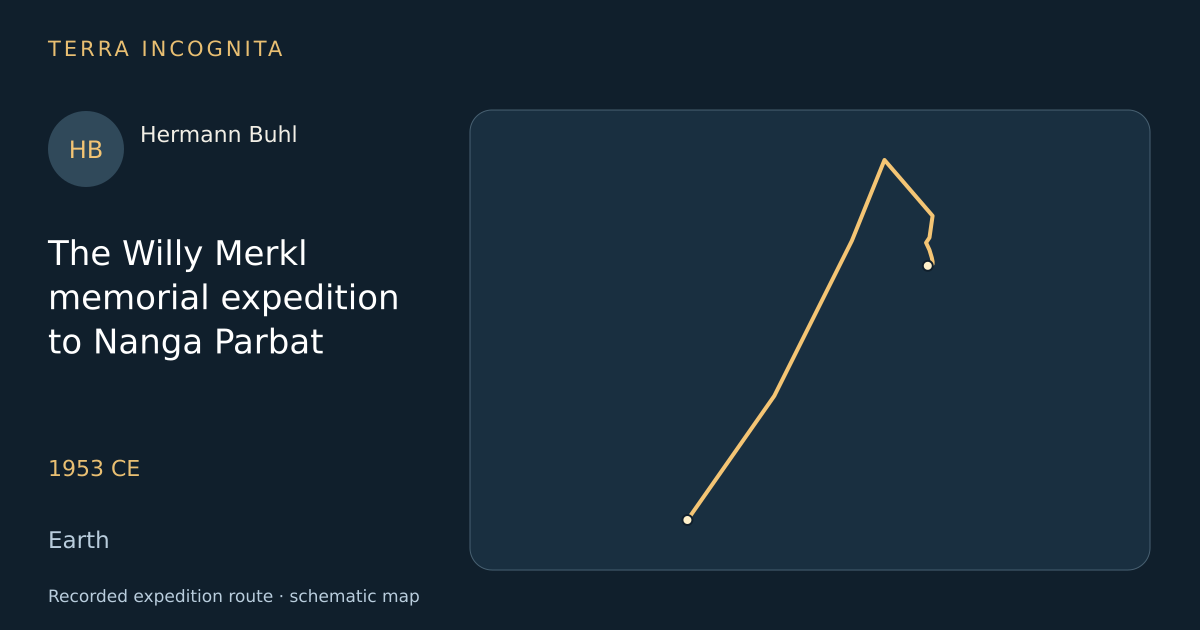
Climb Nanga Parbat by the Rakhiot face, the route on which the German expeditions of 1934 and 1937 had lost twenty-six men.
Historical context
Nanga Parbat was the German mountain, the way Everest was British and K2 Italian, and it had killed thirty-one people since Mummery vanished on it in 1895: nine in the 1934 storm, sixteen in the 1937 avalanche. Karl Herrligkoffer, whose half-brother Willy Merkl had died in 1934, organised the 1953 expedition as a memorial and ran it from base camp by radio. When the weather turned and he ordered everyone down, the strongest climber in the party went up instead.
The voyage, step by step
Gilgit
May 1953
The expedition flies from Rawalpindi to Gilgit in May, then goes by truck down the Indus to Talichi, where the Rakhiot valley opens towards the mountain.
Fairy Meadows
1953 CE
The porters carry the loads up through the pine forest to the alp the Germans of the 1930s named Fairy Meadows, from which the whole Rakhiot face rises 4,500 metres in one sweep.
Base camp on the Rakhiot glacier
25 May 1953
Base camp is established on 25 May at about 4,000 metres on the moraine of the Rakhiot glacier, where the 1934 and 1937 expeditions had camped and where a stone carries the names of their dead.
Camp V at the Moor's Head
2 July 1953
On 2 July Buhl, Otto Kempter, Hans Ertl and Walter Frauenberger reach Camp V at 6,900 metres below the Moor's Head, having ignored Herrligkoffer's radioed order to retreat the day before.
Alone on the Silver Saddle
3 July 1953
Buhl leaves Camp V at 2:30 on 3 July; Kempter, starting an hour later, turns back at about 7,400 metres, and at seven in the morning Buhl crosses the Silver Saddle at 7,597 metres alone.
The summit at seven in the evening
3 July 1953
After the Bazhin Gap and a rock ridge climbed on all fours, Buhl reaches the summit of Nanga Parbat, 8,126 metres, at 19:00 on 3 July 1953, sixteen and a half hours after leaving Camp V, without oxygen.
The night on the ledge
4 July 1953
Overtaken by darkness on the way down, Buhl spends the night of 3 July standing on a ledge the width of his boots at almost 8,000 metres, without a tent, a sleeping bag or gloves, and walks into Camp V at 19:00 on 4 July after forty-one hours.
Outcome
Hermann Buhl reached the 8,126-metre summit alone at 19:00 on 3 July 1953, without oxygen, and survived a night in the open at almost 8,000 metres; he was back at Camp V after forty-one hours.
Hermann Buhl
The Innsbruck climber who walked alone to the top of Nanga Parbat on 3 July 1953, without oxygen, and stood through the night on a ledge at 8,000 metres to come back.
Sources
- 1953 German–Austrian Nanga Parbat expedition — Wikipedia
- Hermann Buhl — Wikipedia
- Nanga Parbat PilgrimageHermann Buhl · Hodder & Stoughton · 1956
Continue exploring
- The first ascent of EverestTenzing Norgay · 1953 CE
- The Italian K2 expeditionAchille Compagnoni and Lino Lacedelli · 1954 CE
- The French Annapurna expeditionMaurice Herzog · 1950 CE
- The third Everest expeditionGeorge Mallory · 1924 CE