Descent of the Amazon
Francisco de Orellana · 1541 CE – 1542 CE · Earth
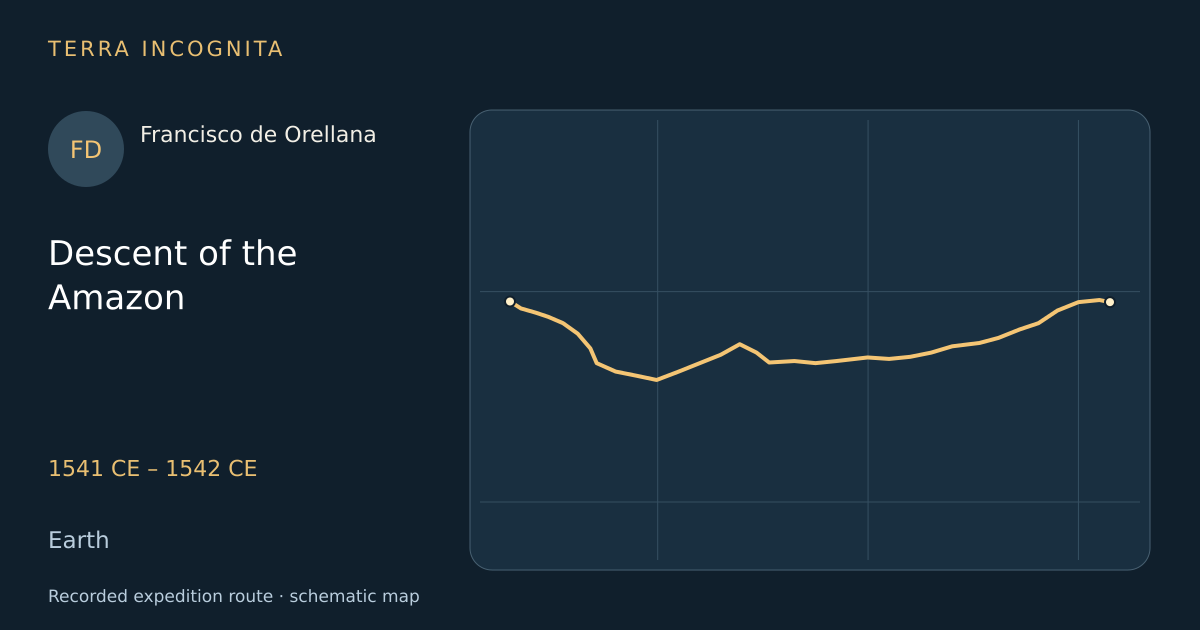
Find food downriver for Gonzalo Pizarro’s starving expedition and bring it back.
Historical context
From Quito, Spanish captains went east over the Andes in search of the land of cinnamon and of El Dorado. Gonzalo Pizarro’s expedition of 1541 found neither, and the descent of the great river by his lieutenant Francisco de Orellana began as a search for food. The story comes chiefly from the Dominican friar Gaspar de Carvajal, who made the voyage, from the notary’s acts the men drew up on the river, and from Pizarro’s letter accusing Orellana of treason; Carvajal’s manuscript was first printed in full by José Toribio Medina in 1894. The peoples of the river, who fed and fought the strangers, are seen only through these Spanish pages.
The voyage, step by step
Into the Amazon
26 December 1541
In February 1541 Gonzalo Pizarro leads more than two hundred Spaniards east from Quito in search of cinnamon and El Dorado; starving on the river by December, his camp builds a brigantine, and on 26 December Orellana takes it downstream to look for food.
No way back upstream
4 January 1542
Swept downstream for nine days without food, the fifty-seven men reach a village on the Napo; on 4 January 1542 forty-nine of them petition Orellana not to lead them back up the river.
Building the Victoria
26 February 1542
From 26 February to 24 April 1542, fed by the people of a lord the Spaniards call Aparia the Great, the men forge nails again and build a second brigantine, the Victoria.
Machiparo and Omagua
12 May 1542
From 12 May 1542 the brigantines fight their way past the provinces of Machiparo and Omagua, where villages line the banks for days on end.
The black river
3 June 1542
On 3 June 1542, beyond the peaceful country of Paguana, the Spaniards see a tributary as black as ink that runs beside the main stream for leagues without mixing; Carvajal names it the Rio Negro.
The fight that named the river
24 June 1542
On 24 June 1542, between the Madeira and the Tapajós, villages that Carvajal says were subject to women rulers fight back hard, with ten or twelve women at the head of the warriors.
The Atlantic at last
26 August 1542
On 26 August 1542 the two brigantines leave the river’s mouth, the first Europeans known to have come down the Amazon to the sea; on 9 and 11 September they reach the Spanish island of Cubagua.
Outcome
Judging a return against the current impossible, Orellana’s fifty-seven men built a second brigantine, traded and fought their way down the Amazon, left its mouth on 26 August 1542 and reached Cubagua in September; Pizarro denounced Orellana as a traitor.
Francisco de Orellana
Spanish conquistador whose company made the first known European descent of the Amazon to the sea, in 1541–42.
Sources
- Descubrimiento del río de las Amazonas según la relación hasta ahora inédita de Fr. Gaspar de Carvajal, con otros documentos referentes á Francisco de Orellana y sus compañeros (Carvajal’s relation, Gonzalo Pizarro’s letter of 3 September 1542, the notary’s acts of the voyage, and Medina’s introduction)José Toribio Medina (ed.) · E. Rasco, Seville · 1894
- Expeditions into the Valley of the Amazons, 1539, 1540, 1639 (including the expedition of Gonzalo Pizarro from the Royal Commentaries of Garcilaso de la Vega)Translated and edited by Clements R. Markham · Hakluyt Society, London · 1859
- Francisco de Orellana — Wikipedia
Continue exploring
- Voyages to CanadaJacques Cartier · 1534 CE – 1542 CE
- CircumnavigationFerdinand Magellan · 1519 CE – 1522 CE
- CircumnavigationFrancis Drake · 1577 CE – 1580 CE
- Voyage to Brazil and IndiaPedro Álvares Cabral · 1500 CE – 1501 CE