Voyage to Brazil and India
Pedro Álvares Cabral · 1500 CE – 1501 CE · Earth
Make peace and friendship with the King of Calicut, set up a factory in his city and instruct the Christians the Portuguese believed lived in India, as the chronicler Castanheda puts the fleet’s three aims.
Historical context
In 1500, after da Gama’s return, King Manuel sent thirteen ships under Pedro Álvares Cabral to make a treaty with the Zamorin of Calicut, set up a Portuguese factory in his city and, in the chronicler Castanheda’s words, instruct the Christians the Portuguese believed lived in India; two caravels were to trade at Sofala. Steering wide into the Atlantic, the fleet came upon the coast of Brazil. Barros says the course was set to avoid the calms off Guinea; whether the Portuguese meant to find land there has been argued since the nineteenth century. The voyage is known from the letters sent home from Brazil by Pêro Vaz de Caminha and Master John, King Manuel’s letter of 1501, an anonymous narrative by a man of the fleet and the later chronicles; its dates are Julian.
The voyage, step by step
The great fleet departs
9 March 1500
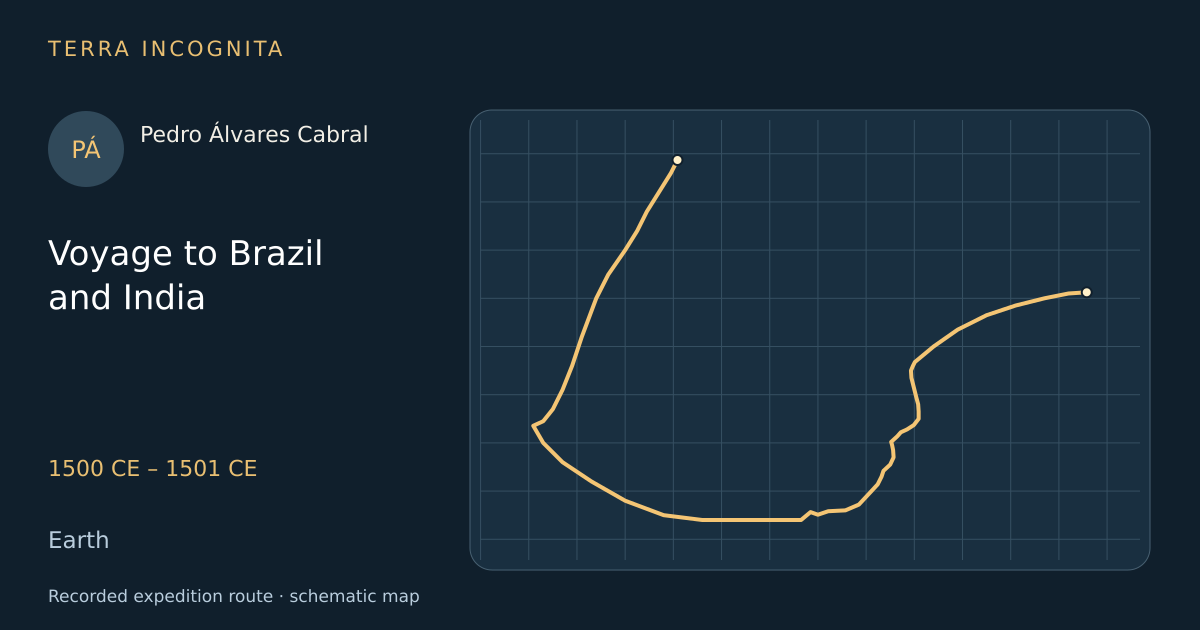
On Monday 9 March 1500 thirteen ships under Pedro Álvares Cabral leave the Tagus for India, the second Portuguese fleet to sail there.
Brazil claimed
22 April 1500
On 22 April 1500, sweeping far west in the Atlantic, the fleet sights a high round mountain and reaches the coast of Brazil, home of the Tupiniquim.
Storms in the South Atlantic
24 May 1500
On 24 May 1500 a sudden head wind sinks four ships with everyone aboard, Bartolomeu Dias’s among them, before the fleet reaches the Cape.
Calicut and Cochin
13 September 1500
On 13 September 1500 six ships anchor before Calicut; three months later the Portuguese factory is stormed, Cabral bombards the city, and the fleet loads its spices at Cochin.
Outcome
Reached the coast of Brazil on 22 April 1500 and Calicut on 13 September; the factory there was stormed in December and Cabral bombarded the city, then loaded spices at Cochin and Cannanore. Of thirteen ships, Greenlee counts five back from India with cargo, two home empty and six lost at sea.
Pedro Álvares Cabral
Portuguese commander who claimed Brazil for Portugal in 1500 while bound for India.
Sources
- The Voyage of Pedro Álvares Cabral to Brazil and India, from Contemporary Documents and NarrativesTranslated, with introduction and notes, by William Brooks Greenlee (includes the letters of Pêro Vaz de Caminha and Master John, King Manuel’s letter of 1501 and the Anonymous Narrative) · Hakluyt Society, London (Second Series, no. 81) · 1938
- Tohfut-ul-Mujahideen: An Historical Work in the Arabic LanguageShaikh Zayn al-Dīn, translated by M. J. Rowlandson, with the translator’s notes · Oriental Translation Fund, London · 1833
- Pedro Álvares Cabral — Wikipedia
Continue exploring
- Indian Ocean pilotageAhmad ibn Mājid · 1498 CE
- The voyage of the MatthewJohn Cabot · 1497 CE
- First voyage to IndiaVasco da Gama · 1497 CE – 1499 CE
- First Atlantic crossingChristopher Columbus · 1492 CE – 1493 CE