Circumnavigation
Ferdinand Magellan · 1519 CE – 1522 CE · Earth
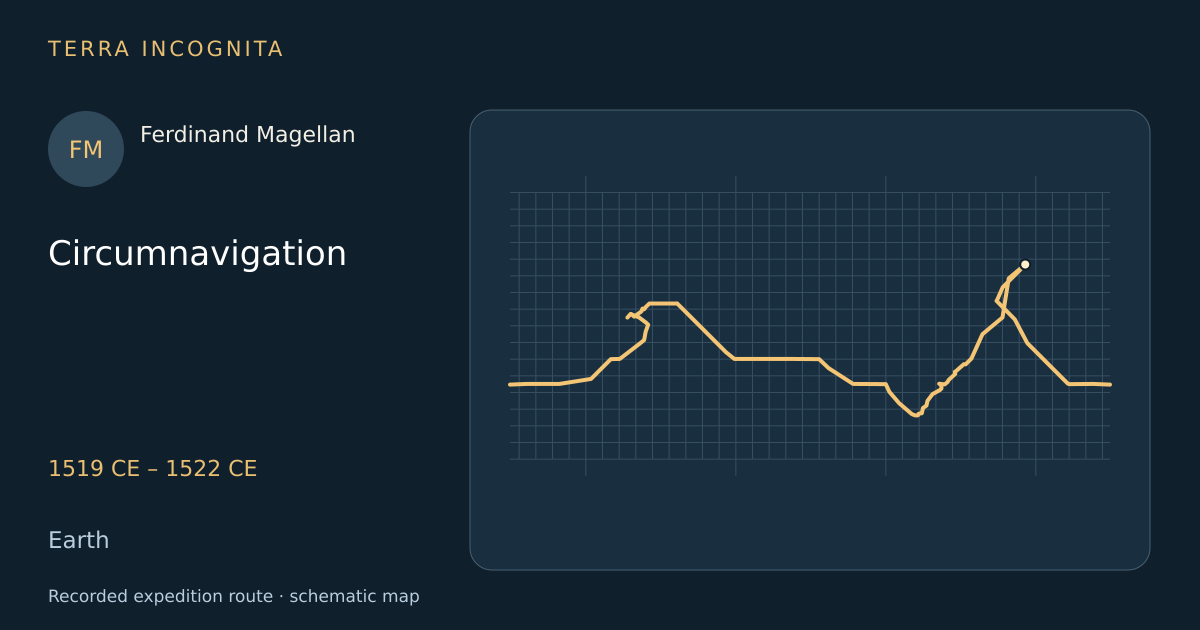
Reach the Spice Islands by sailing west.
Historical context
One voyage finally settled what no map could: the true size of the ocean and the shape of the globe. Its cost was frightful — four ships and most of its men never returned.
The voyage, step by step
Departure from Sanlúcar
20 September 1519
Five ships and about 270 men leave Spain on 20 September 1519 to reach the Spice Islands from the west.
Seeking a passage
1520 CE
The fleet probes the Río de la Plata and the Patagonian coast, searching for a strait to the Pacific.
Mutiny at San Julián
1520 CE
Overwintering in a bleak harbour, three captains seize ships; Magellan crushes the revolt and executes the ringleaders.
The strait found
November 1520
In November 1520 the fleet enters the winding strait that now bears Magellan's name.
Crossing the Pacific
1521 CE
For over three months the fleet sails an empty ocean; the crew eats leather and sawdust before reaching Guam.
The Philippines
March 1521
In March 1521 the fleet reaches the islands, where Magellan makes alliances and converts local rulers.
Death at Mactan
27 April 1521
On 27 April 1521 Magellan is killed in battle on Mactan after wading ashore with a small force.
Elcano brings her home
6 September 1522
On 6 September 1522 the Victoria limps into Sanlúcar with 18 survivors, completing the first circumnavigation.
Outcome
Found the strait and crossed the Pacific; Elcano completed the voyage.
Ferdinand Magellan
Portuguese navigator who led the first expedition to sail from the Atlantic into the Pacific and around the globe.
Sources
Continue exploring
- Voyages to CanadaJacques Cartier · 1534 CE – 1542 CE
- Voyage to Brazil and IndiaPedro Álvares Cabral · 1500 CE – 1501 CE
- Indian Ocean pilotageAhmad ibn Mājid · 1498 CE
- The voyage of the MatthewJohn Cabot · 1497 CE