Circumnavigation
Francis Drake · 1577 CE – 1580 CE · Earth
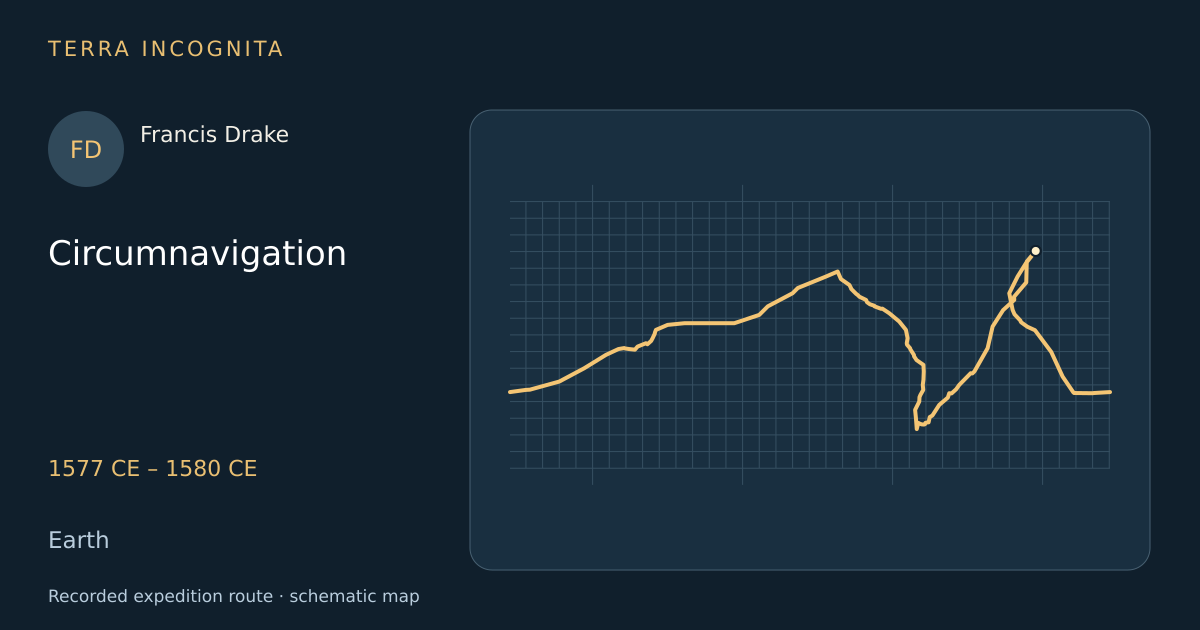
Raid Spanish possessions and find new routes.
Historical context
Drake's voyage mixed exploration, trade and open war against Spain, then Europe's greatest power. Its success made him a national hero in England and a pirate in Madrid.
The voyage, step by step
Departure from Plymouth
December 1577
Drake leaves England in December 1577 with five ships on a voyage of trade and plunder.
Through the Strait of Magellan
1578 CE
Storms scatter the fleet as it enters the Pacific; one ship turns back and is lost in the Atlantic.
Raids on the Pacific coast
1579 CE
Drake plunders Spanish ports and shipping along Chile and Peru, then heads north.
Nova Albion
1579 CE
He claims a stretch of the Californian coast for England and names it Nova Albion.
Across the Pacific
1579 CE
Crossing the Pacific, Drake reaches the Spice Islands and loads cloves before continuing west.
Home after the world
September 1580
The Golden Hind returns to Plymouth in September 1580, the first English circumnavigation.
Outcome
Second expedition to circle the globe.
Francis Drake
English sea captain who circumnavigated the globe and raided Spanish ports and shipping.
Sources
Continue exploring
- Northeast passage voyagesWillem Barentsz · 1594 CE – 1597 CE
- Descent of the AmazonFrancisco de Orellana · 1541 CE – 1542 CE
- Voyages to CanadaJacques Cartier · 1534 CE – 1542 CE
- CircumnavigationFerdinand Magellan · 1519 CE – 1522 CE