Indian Ocean pilotage
Ahmad ibn Mājid · 1498 CE · Earth
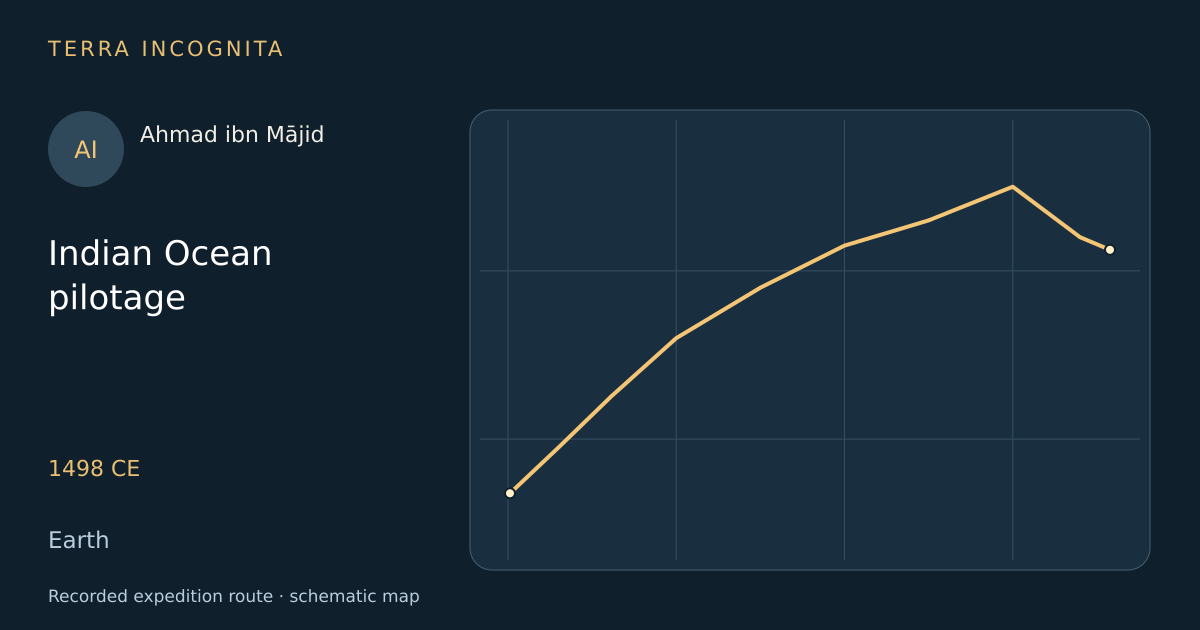
Carry Vasco da Gama’s fleet from Malindi across the Arabian Sea to Calicut on the south-west monsoon, by the pilots’ art that Ibn Mājid wrote down.
Historical context
Ahmad ibn Mājid, son and grandson of pilots, wrote some forty works on the navigation of the Indian Ocean, in prose and verse, among them the Ḥāwiya of 1462 and the Kitāb al-Fawā’id of about 1490. In April 1498 the ruler of Malindi gave Vasco da Gama a pilot, a ‘Christian’ to the journal kept on board and a Muslim from Gujarat to the Portuguese chroniclers, who brought the Portuguese across to India. A chronicle by the Meccan scholar Qutb al-Dīn al-Nahrawālī, who lived from 1511 to 1582, says the Portuguese admiral learned the route from Ibn Mājid; in 1922 Gabriel Ferrand made Ibn Mājid the pilot himself, an identification Sanjay Subrahmanyam and the historians he cites reject. This voyage follows the crossing and the dispute.
The voyage, step by step
Pilot from East Africa
1498 CE
At Malindi, on the Swahili coast, the ruler gives Vasco da Gama a pilot for India: a ‘Christian’ to the journal kept on board, a Muslim from Gujarat to the Portuguese chroniclers.
Leaving the African coast
24 April 1498
On 24 April 1498 the fleet sails from Malindi for Calicut with the pilot the ruler gave it; for a couple of days the African coast stays in sight.
Out of sight of land
1498 CE
Once Africa drops astern, the fleet runs before the wind across the open sea; a chronicle written decades later says who showed the Portuguese this route.
Reading the Pole Star
29 April 1498
On Sunday 29 April, five days out of Malindi, the Portuguese see the North Star again, which they had not seen for a long time.
Riding the monsoon
1498 CE
Before the south-west monsoon the fleet crosses the Arabian Sea; whether the man guiding it was Ibn Mājid has been argued over for a century.
Landfall at Calicut
20 May 1498
On 18 May the fleet sights the mountains of India, and on 20 May the pilot recognises the heights above Calicut.
Outcome
A pilot given by the ruler of Malindi, a Muslim from Gujarat by the Portuguese chroniclers’ account, brought the fleet in sight of India after twenty-three days without land; a chronicle written decades later named Ibn Mājid, an identification Sanjay Subrahmanyam and the historians he cites reject.
Ahmad ibn Mājid
Arab pilot and author whose works on the winds, stars and routes of the Indian Ocean made him its most famous mu‘allim; a later chronicle tied his name to Vasco da Gama’s crossing.
Sources
- A Journal of the First Voyage of Vasco da Gama, 1497–1499Anonymous member of the expedition (the Roteiro), translated and edited by E. G. Ravenstein, with appendices · Hakluyt Society, London (First Series, no. 99); Project Gutenberg eBook 46440 · 1898
- Decada primeira da Asia: dos feitos que os Portugueses fezerão no descobrimento & conquista dos mares & terras do OrienteJoão de Barros (first published 1552) · Jorge Rodriguez, Lisbon; book 3, chapter 4, book 4, chapter 6 and book 5, chapter 3 · 1628
- Arab Navigation in the Indian Ocean before the Coming of the Portuguese, being a translation of Kitāb al-Fawā’id fī uṣūl al-baḥr wa’l-qawā’id of Aḥmad b. Mājid al-NajdīG. R. Tibbetts (read through the archive.org copy’s search-inside excerpts, introduction pp. 7–10) · Royal Asiatic Society of Great Britain and Ireland, London · 1971
- The Career and Legend of Vasco da GamaSanjay Subrahmanyam (read through the archive.org copy’s search-inside excerpts) · Cambridge University Press · 1997
- The Navigator Ahmad Ibn MajidPaul Lunde · Saudi Aramco World 56, 4 (July/August 2005), pp. 45–48 · 2005
- Ibn Mājid, Shihāb al-Dīn Aḥmad ibn MājidS. Maqbul Ahmad · Complete Dictionary of Scientific Biography, Encyclopedia.com (first published in the Dictionary of Scientific Biography, 1970–80) · 2008
- Le pilote arabe de Vasco de Gama et les instructions nautiques des Arabes au XVe siècleGabriel Ferrand (first page read) · Annales de géographie 31, 172, pp. 289–307 (Persée) · 1922
- Arabic External Sources for the History of Africa to the South of SaharaTadeusz Lewicki (read through the archive.org copy’s search-inside excerpts) · Curzon Press, London · 1974
- Ahmad ibn Mājid — Wikipedia
Continue exploring
- The voyage of the MatthewJohn Cabot · 1497 CE
- First voyage to IndiaVasco da Gama · 1497 CE – 1499 CE
- Voyage to Brazil and IndiaPedro Álvares Cabral · 1500 CE – 1501 CE
- First Atlantic crossingChristopher Columbus · 1492 CE – 1493 CE