The voyage of the Matthew
John Cabot · 1497 CE · Earth
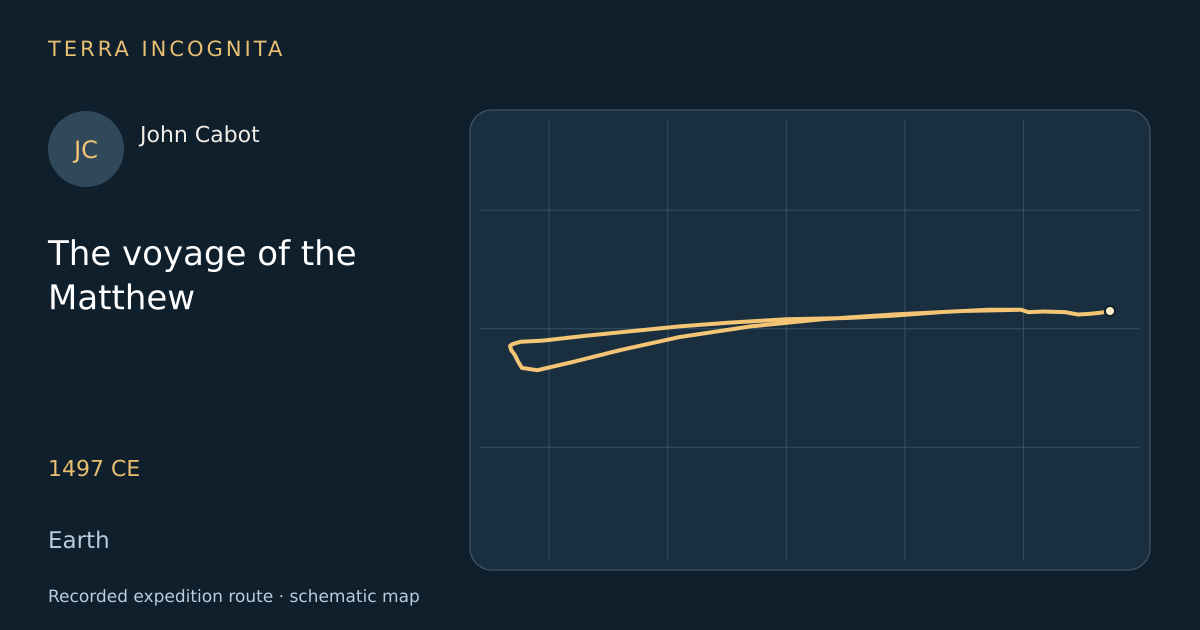
Find a short western route to the spice lands of Asia for English merchants.
Historical context
Bristol merchants had been sending ships west in search of the island of Brasil for a decade before Cabot arrived, and Henry VII wanted a share of what Spain had found in the south. One small ship and eighteen men went out on a rumour and came back with a continent nobody yet understood.
The voyage, step by step
Out of Bristol
May 1497
In May 1497 the Matthew drops down the Avon with a crew of about eighteen and provisions for a season.
Last land at Dursey Head
1497 CE
Rounding the south-west corner of Ireland, the Matthew takes her departure and steers west into open ocean.
Thirty-five days west
1497 CE
A single ship of some fifty tons holds a westerly course through fog and contrary winds for five weeks.
Landfall, 24 June
24 June 1497
On midsummer day a wooded coast rises ahead; Cabot names it the New Found Land and raises the banners of England and Venice.
A snare and a needle
1497 CE
The only landing party stays within bowshot of the ship and finds a fire pit, a snare for game and a bone netting needle.
The cod grounds
1497 CE
Coasting south, the crew find a sea so thick with fish that they can be lifted aboard in weighted baskets.
Ten pounds for a continent
6 August 1497
The Matthew is back in Bristol on 6 August; Cabot rides to court and is granted a pension of twenty pounds a year.
Outcome
Reached a wooded coast, almost certainly Newfoundland, and returned in ten weeks with news of inexhaustible cod.
John Cabot
Venetian navigator who sailed from Bristol in 1497 and made the first documented European landfall in North America since the Norse.
Sources
- John Cabot — Wikipedia
- The Cabot Voyages and Bristol Discovery under Henry VIIJames A. Williamson · Hakluyt Society · 1962
Continue exploring
- First voyage to IndiaVasco da Gama · 1497 CE – 1499 CE
- Indian Ocean pilotageAhmad ibn Mājid · 1498 CE
- Voyage to Brazil and IndiaPedro Álvares Cabral · 1500 CE – 1501 CE
- First Atlantic crossingChristopher Columbus · 1492 CE – 1493 CE