Voyage to the Cape
Bartolomeu Dias · 1487 CE – 1488 CE · Earth
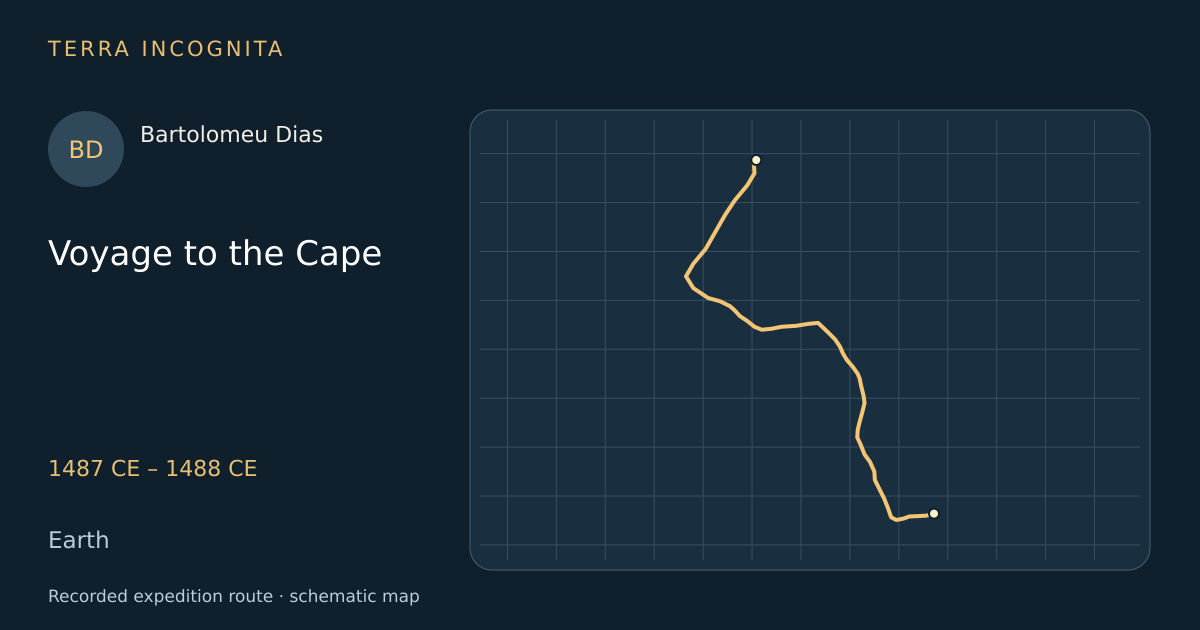
Follow the coast of Africa beyond Diogo Cão’s last pillar, to find a way round the continent and word of Prester John.
Historical context
Since Prince Henry’s time Portuguese ships had crept down the coast of Africa, and in the 1480s Diogo Cão carried the first stone pillars as far as Cape Cross, in present-day Namibia. King John the Second, hoping for India and for the Christian ruler Europeans called Prester John, sent Bartolomeu Dias to go beyond. No official report survives: the voyage is known chiefly from the chronicler João de Barros, writing sixty years later, from early maps and from remarks of men who sailed with Dias, and Ravenstein’s study of 1900 corrected Barros’s dates by a year, to 1487–1488. Ten years later Vasco da Gama followed the route Dias had opened, with a pilot who had sailed with him.
The voyage, step by step
Down the African coast
1487 CE
In the summer of 1487 Bartolomeu Dias leaves Lisbon with two caravels and a supply ship, to follow the coast of Africa beyond the last pillar of Diogo Cão.
Past Cape Verde
1487 CE
The fleet runs south past Cape Verde, which the chronicler Zurara says Dinis Dias had reached in 1445, carrying three stone pillars to mark its discoveries.
São Jorge da Mina and the Congo
1487 CE
The fleet heads for the Congo and the coast Diogo Cão had charted beyond it; Dias had sailed in the fleet that founded São Jorge da Mina, the Gold Coast fort.
A pillar at Angra Pequena
December 1487
Late in December 1487, by Ravenstein’s reckoning, Dias sets up his first pillar, dedicated to Santiago, on the headland now called Diaz Point, beside Angra Pequena.
Landfall in the Bay of Cowherds
February 1488
In February 1488, steering north to find the coast again, the ships anchor in a bay full of cattle, east of a cape they have not seen.
The crews turn back
1488 CE
Beyond Algoa Bay the coast runs north-east at last; the crews demand to go home, and at the Rio do Infante, now the Great Fish River, Dias turns back.
The Cape on the way home
1488 CE
Sailing west again, Dias sights for the first time the great cape the storm had carried him past, sets up his last pillar there and heads home.
Outcome
Carried round the southern end of Africa unseen by a storm, reached the Rio do Infante, now the Great Fish River, and saw the Cape of Good Hope on the way home; back in Lisbon in December 1488, after an absence Barros gives as sixteen months and seventeen days, with some 350 leagues of new coast.
Bartolomeu Dias
Portuguese navigator who became the first European to round the southern tip of Africa.
Sources
- The Voyages of Diogo Cão and Bartholomeu Dias, 1482–88E. G. Ravenstein · The Geographical Journal 16, 6 (December 1900), pp. 625–655; the Dias section pp. 638–649 · 1900
- Decada primeira da Asia: dos feitos que os Portugueses fezerão no descobrimento & conquista dos mares & terras do OrienteJoão de Barros (first published 1552) · Jorge Rodriguez, Lisbon; book 3, chapter 4, book 4, chapter 6 and book 5, chapter 3 · 1628
- A Journal of the First Voyage of Vasco da Gama, 1497–1499Anonymous member of the expedition (the Roteiro), translated and edited by E. G. Ravenstein, with appendices · Hakluyt Society, London (First Series, no. 99); Project Gutenberg eBook 46440 · 1898
- The Voyage of Pedro Álvares Cabral to Brazil and India, from Contemporary Documents and NarrativesTranslated, with introduction and notes, by William Brooks Greenlee (includes the letters of Pêro Vaz de Caminha and Master John, King Manuel’s letter of 1501 and the Anonymous Narrative) · Hakluyt Society, London (Second Series, no. 81) · 1938
- Kwaaihoek — Wikipedia
- Bartolomeu Dias — Wikipedia
Continue exploring
- First Atlantic crossingChristopher Columbus · 1492 CE – 1493 CE
- The voyage of the MatthewJohn Cabot · 1497 CE
- First voyage to IndiaVasco da Gama · 1497 CE – 1499 CE
- Indian Ocean pilotageAhmad ibn Mājid · 1498 CE