Treasure fleet voyages
Zheng He · 1405 CE – 1433 CE · Earth
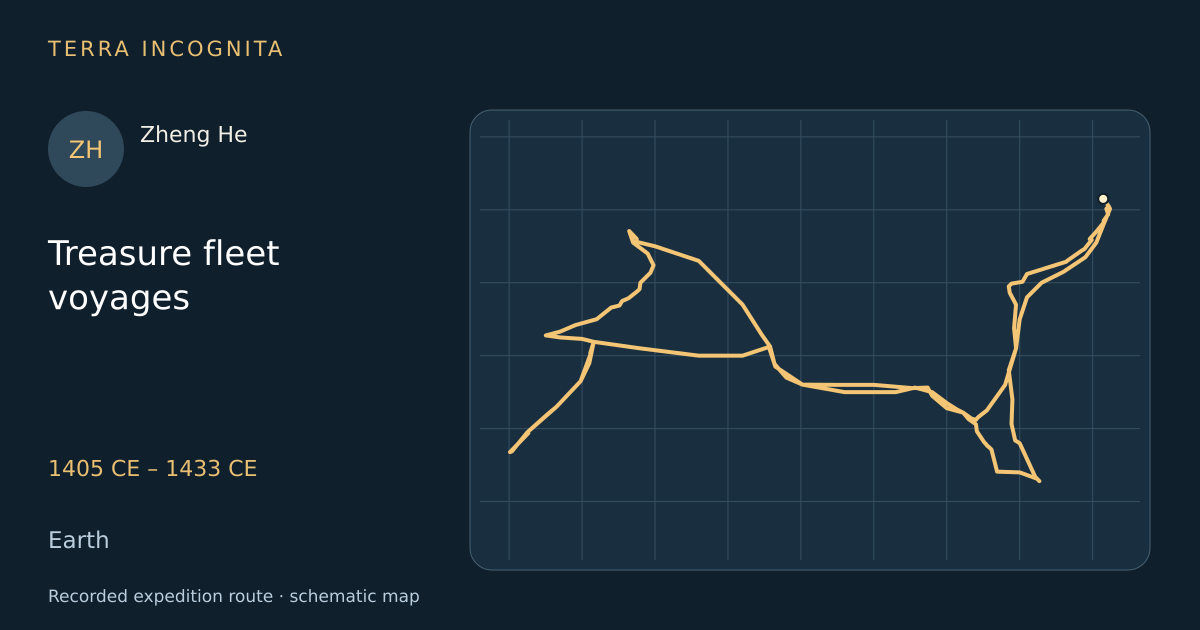
Display Ming power and extend the tribute trade across the Indian Ocean.
Historical context
Ming China projected power across the Indian Ocean with fleets larger than any Europe could build. The voyages were abandoned within a generation, and the ocean passed to other powers.
The voyage, step by step
The fleet assembles
1405 CE
From the Yangtze the treasure fleet sets out in 1405 with hundreds of ships and tens of thousands of men.
Champa and Java
1405 CE
The fleet calls at the ports of Southeast Asia, exchanging silk and porcelain for spices and treasures.
Malacca
1406 CE
Malacca becomes a key base for the Ming fleets controlling the strait between the Indian Ocean and the South China Sea.
Calicut
1407 CE
On the Malabar coast the fleet meets the Indian Ocean trade that Arab pilots had long dominated.
Hormuz
1414 CE
Later voyages reach the Persian Gulf, exchanging envoys with the courts of the region.
Malindi and the giraffe
1418 CE
The fleet reaches the Swahili coast of East Africa and returns with a giraffe for the Ming court.
The last voyage
1433 CE
The seventh and final voyage returns in 1433; the fleets are then abandoned and China turns inward.
Outcome
Seven voyages reached Arabia and the Swahili coast, then were abandoned.
Zheng He
Ming dynasty admiral who commanded seven treasure fleets across the Indian Ocean as far as Arabia and East Africa.
Sources
- Zheng He — Wikipedia
- Pathfinders: A Global History of ExplorationFelipe Fernández-Armesto · Oxford University Press · 2006
Continue exploring
- Voyage to the CapeBartolomeu Dias · 1487 CE – 1488 CE
- First Atlantic crossingChristopher Columbus · 1492 CE – 1493 CE
- The voyage of the MatthewJohn Cabot · 1497 CE
- First voyage to IndiaVasco da Gama · 1497 CE – 1499 CE