Journey to the West
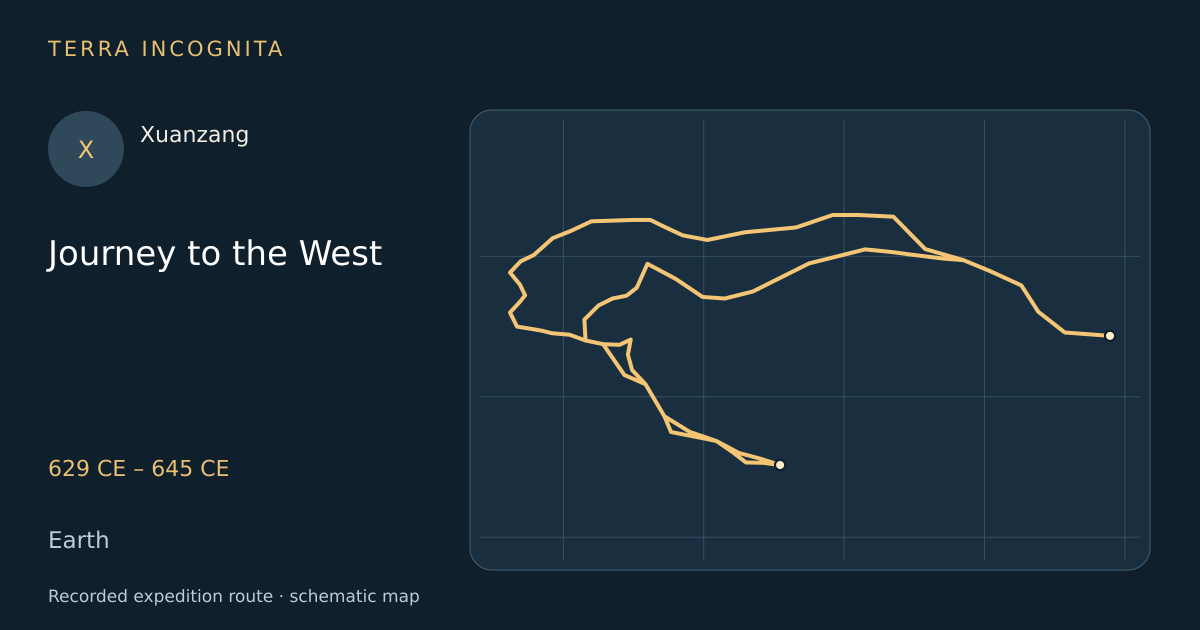
Xuanzang · 629 CE – 645 CE · Earth
Settle his doubts about the Buddhist scriptures by studying in India and bringing back the texts.
Historical context
The Tang dynasty was young when Xuanzang set out: its administration, his biography says, newly arranged, its frontiers not far off, and its subjects forbidden to go abroad. Most basic Buddhist texts already existed in Chinese, but Xuanzang, Tansen Sen writes, distrusted the translations and wanted the originals and India’s teachers. His Record of the Western Regions, edited by the monk Bianji, and the biography begun by his disciple Huili tell the journey; they do not always agree on figures or dates.
The voyage, step by step
Leaving Chang’an against the ban
629 CE
Refused leave to go abroad, Xuanzang sets out alone for India to settle his doubts about the scriptures, and from Liangzhou travels by night, in secret, once the frontier officials are told to stop him.
Past the watchtowers and across the desert
630 CE
Guided past the Yumen barrier by night, Xuanzang slips by the frontier watchtowers, loses his water in the desert and reaches Yiwu, today’s Hami, from where the king of Gaochang has him brought to Turfan.
Nalanda
633 CE
Over the Tian Shan, through the camp of the khan of the Western Turks, Samarkand, Balkh and Bamiyan, Xuanzang reaches the great monastic university of Nalanda and studies there under its head, Shilabhadra, who later has him lecture to the community.
Return with the texts
645 CE
Honoured at Harsha’s assembly at Kannauj, Xuanzang takes the northern road home, loses fifty bundles of manuscripts in the Indus, waits at Khotan for the emperor’s answer and reaches Chang’an in 645 with 657 works carried on twenty horses.
Outcome
Studied five years at Nalanda under Shilabhadra, was honoured at Harsha’s assembly at Kannauj and returned to Chang’an in 645 with 657 works, on which he spent the rest of his life translating.
Xuanzang
Tang monk and traveller whose sixteen-year journey to India shaped Chinese Buddhism and inspired Journey to the West.
Sources
- The Life of Hiuen-Tsiang, by the Shaman Hwui Li, with an Introduction Containing an Account of the Works of I-TsingHuili and Yancong, translated by Samuel Beal · Kegan Paul, Trench, Trübner and Co., new edition 1911, popular re-issue 1914; Internet Archive · 1911
- Da Tang Da Ci’en si Sanzang fashi zhuan (Chinese text of Huili and Yancong’s biography of Xuanzang)Huili and Yancong · Chinese Wikisource
- Si-Yu-Ki: Buddhist Records of the Western World, volume 1 (with the Travels of Fa-hian)Samuel Beal (translator) · Trübner and Co.; Internet Archive · 1884
- The Travel Records of Chinese Pilgrims Faxian, Xuanzang, and Yijing: Sources for Cross-Cultural Encounters Between Ancient China and Ancient IndiaTansen Sen · Education About Asia, volume 11, number 3, pages 24–33 · 2006
- Conversion between Western and Chinese Calendar (722 BCE – 2200 CE)Yuk Tung Liu
- Xuanzang — Wikipedia
Continue exploring
- Mission to the VolgaAhmad ibn Fadlan · 921 CE – 922 CE
- Pilgrimage from Granada to MeccaIbn Jubayr · 1183 CE – 1185 CE
- Journey to CathayMarco Polo · 1271 CE – 1295 CE
- The RihlaIbn Battuta · 1325 CE – 1354 CE