Mission to the Volga
Ahmad ibn Fadlan · 921 CE – 922 CE · Earth
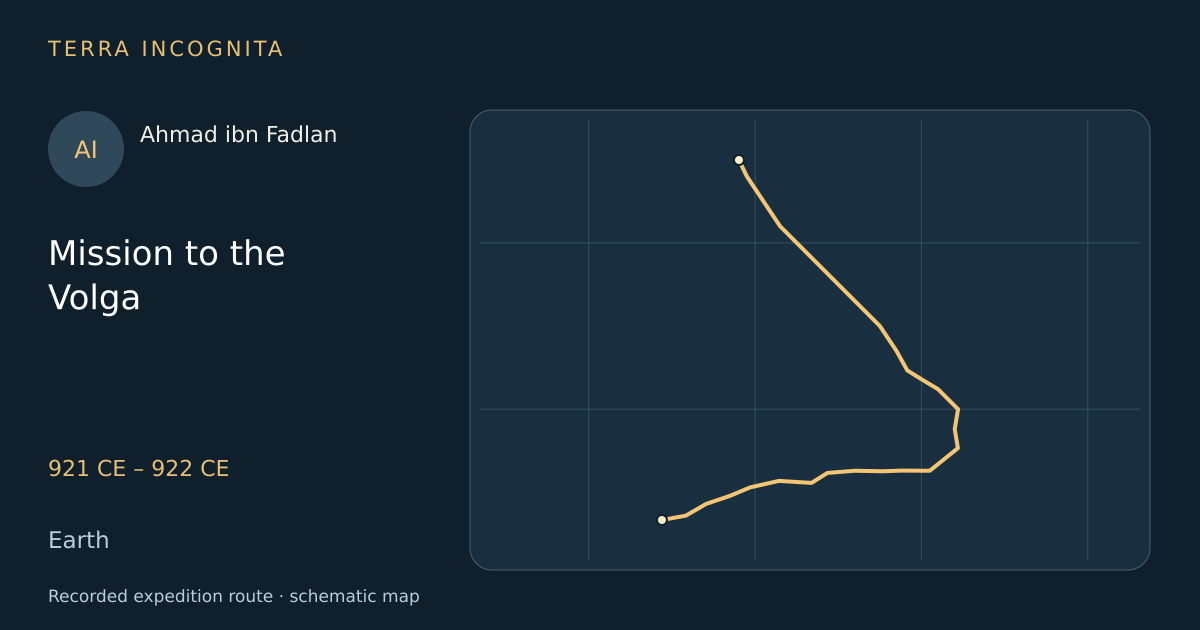
Carry an Abbasid embassy to the Volga Bulgars.
Historical context
The Abbasid caliphate sent embassies far north to secure allies and trade in furs and silver. Ibn Fadlan's report is one of the most detailed outside accounts of the Vikings ever written.
The voyage, step by step
Embassy from Baghdad
21 June 921
The caliph sends Ibn Fadlan north to the king of the Volga Bulgars.
Through Rayy
921 CE
The embassy crosses the Iranian plateau by the great pilgrim road, waiting out a local war at Rayy.
Khorasan and Merv
921 CE
They reach the Samanid cities of the east, the last place where the caliph's name still carries.
Through Khwarazm
921 CE
The caravan crosses the steppe, its journey growing harder with each stage.
Among the Oghuz
922 CE
North of the Ustyurt the party enters Oghuz Turkish country, where the caliph is a rumour and hospitality is the only law.
The Bashghird crossings
922 CE
They ford river after river on inflated camel skins through the country Ibn Fadlan calls the worst of the Turks.
The Rus on the Volga
922 CE
He reaches the Volga and records the Rus traders and their ship burials.
Outcome
Reached the Volga and recorded the Rus and northern peoples.
Ahmad ibn Fadlan
Abbasid envoy who travelled to the Volga and left a vivid account of the Rus, the Khazars and the northern trade.
Sources
Continue exploring
- Pilgrimage from Granada to MeccaIbn Jubayr · 1183 CE – 1185 CE
- Journey to the WestXuanzang · 629 CE – 645 CE
- Journey to CathayMarco Polo · 1271 CE – 1295 CE
- The RihlaIbn Battuta · 1325 CE – 1354 CE