The Rihla
Ibn Battuta · 1325 CE – 1354 CE · Earth
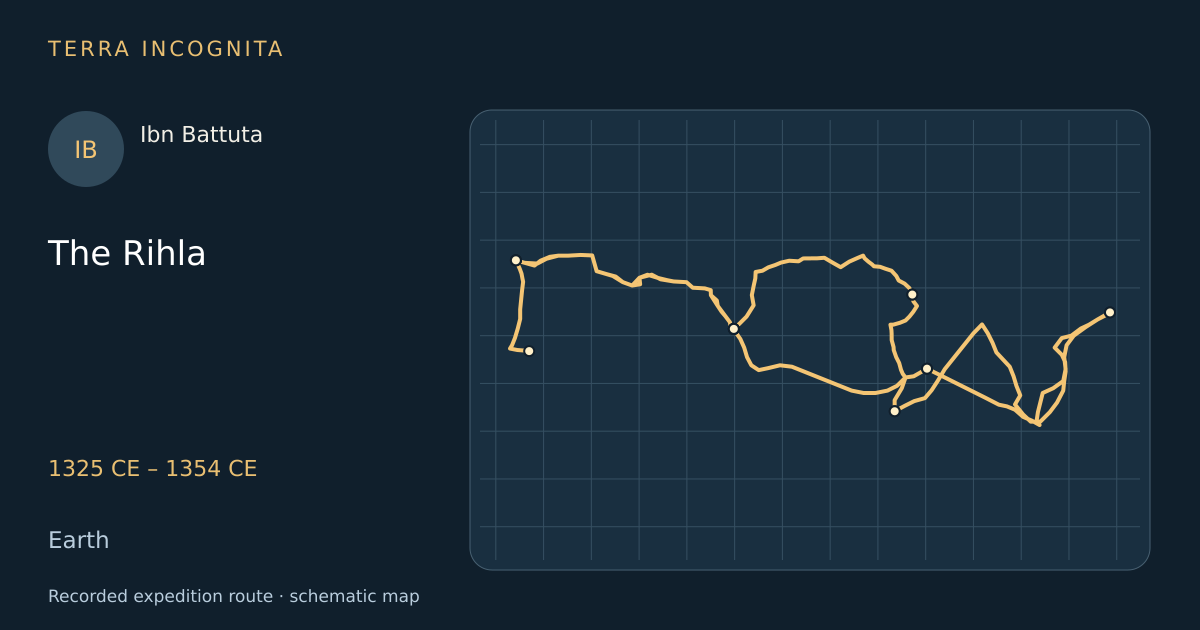
Make the pilgrimage to Mecca and visit the Prophet’s tomb at Medina; the wish ‘to travel through the earth’, as he called it, grew on the way.
Historical context
In the fourteenth century the Islamic world stretched from al-Andalus to Southeast Asia, bound together by pilgrimage, scholarship, trade and a shared law that let a qadi find work far from home. Ibn Battuta moved through it for nearly thirty years. All we know of his journeys comes from the Rihla, which he dictated in Fez to Ibn Juzayy, who shaped it, borrowed from earlier writers and finished it in December 1355.
The voyage, step by step
Setting out from Tangier
1325 CE
A young jurist from a family of qadis, Abu Abdallah ibn Battuta leaves his native Tangier alone on pilgrimage to Mecca and the Prophet’s tomb at Medina, the start of nearly thirty years of travel.
Pilgrimage to Mecca
1326 CE
Turned back from the Red Sea at Aydhab by a war, he goes round by Palestine and Syria, leaves Damascus with the pilgrim caravan and makes his first hajj in November 1326; then, instead of going home, he joins the caravan of Iraq.
Judging in Delhi
1334 CE
After the long way round by Anatolia, the Golden Horde, Constantinople and Central Asia, he reaches the Indus in September 1333; Sultan Muhammad ibn Tughluq makes him qadi of Delhi.
By sea to China
1346 CE
Sent as the sultan’s envoy to China, he loses the embassy in a storm at Calicut, serves as qadi in the Maldives and sails by Ceylon, Bengal and Sumatra to Quanzhou; how much of China he saw is disputed.
Across the Sahara to Mali
1352 CE
His last great journey crosses the desert to the kingdom of Mali, where he spends eight months at the court of Mansa Sulayman before coming home by Timbuktu, Gao and Takedda.
Outcome
Travelled for nearly thirty years through North Africa, Arabia, East Africa, Anatolia, the Golden Horde, Central Asia, India, the Maldives, by his account China, al-Andalus and Mali, then dictated his account in Fez to Ibn Juzayy, who finished it in December 1355.
Ibn Battuta
Moroccan jurist and traveller who, by Ross Dunn’s reckoning, covered some 73,000 miles, about 117,000 kilometres, across Africa, Asia and Europe, and dictated the account known as the Rihla.
Sources
- The Travels of Ibn Battuta, A.D. 1325–1354, volume 1Ibn Battuta, translated with revisions and notes by H. A. R. Gibb · Hakluyt Society, Cambridge · 1958
- The Travels of Ibn Battuta, A.D. 1325–1354, volume 2Ibn Battuta, translated with revisions and notes by H. A. R. Gibb · Hakluyt Society, Cambridge · 1962
- The Travels of Ibn Battuta, A.D. 1325–1354, volume 3Ibn Battuta, translated with revisions and notes by H. A. R. Gibb · Hakluyt Society, Cambridge · 1971
- The Travels of Ibn Battuta, A.D. 1325–1354, volume 4Ibn Battuta, translated by H. A. R. Gibb and C. F. Beckingham, annotated by C. F. Beckingham · Hakluyt Society, London · 1994
- The Adventures of Ibn Battuta: A Muslim Traveler of the 14th CenturyRoss E. Dunn · Croom Helm, London, and University of California Press · 1986
- Voyages d’Ibn Batoutah, tome quatrième (Le retour et l’Espagne)Ibn Battuta, translated by C. Defrémery and B. R. Sanguinetti · Imprimerie impériale, Paris; French Wikisource · 1858
- Ibn Battuta — Wikipedia
- Pathfinders: A Global History of ExplorationFelipe Fernández-Armesto · Oxford University Press · 2006
Continue exploring
- Journey to CathayMarco Polo · 1271 CE – 1295 CE
- Pilgrimage from Granada to MeccaIbn Jubayr · 1183 CE – 1185 CE
- Mission to the VolgaAhmad ibn Fadlan · 921 CE – 922 CE
- Journey to the WestXuanzang · 629 CE – 645 CE