Up the Amazon to Quito and back
Pedro Teixeira · 1637 CE – 1639 CE · Earth
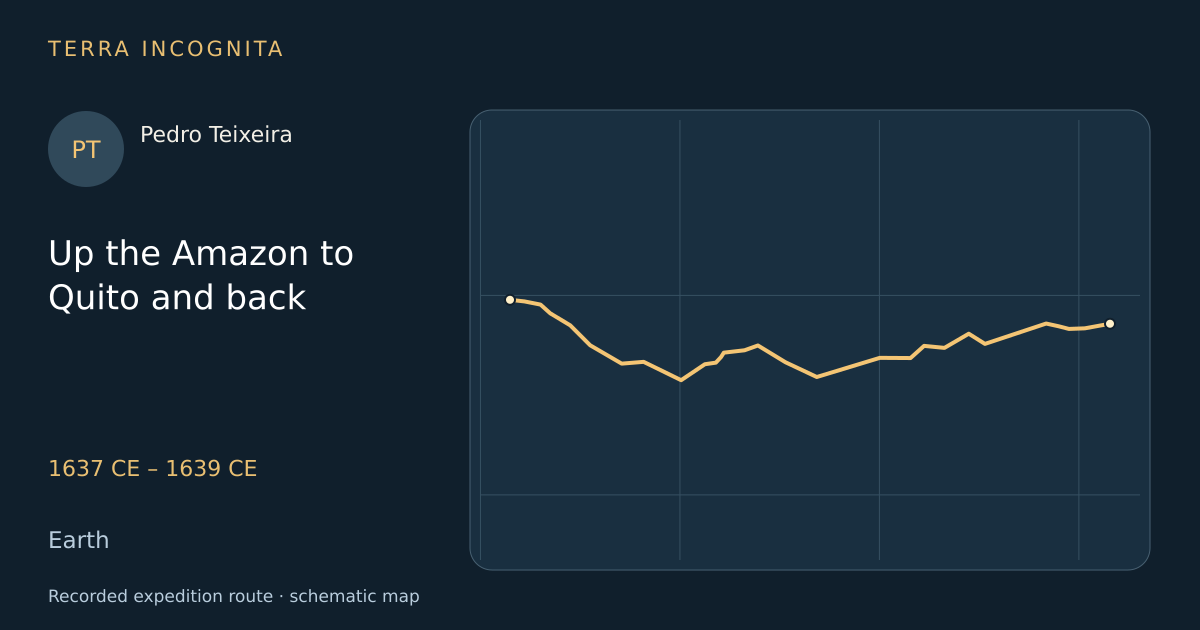
Establish whether the Amazon could carry a force from the Atlantic to the Andes, and fix a Portuguese claim as far upstream as possible.
Historical context
Portugal and Spain had shared a king since 1580, but Portugal kept its own laws, council and officials, and in the late 1630s resentment of Madrid was growing. In 1637 two Spanish Franciscan lay brothers and six soldiers came down the river from the country below Quito to the Portuguese at Pará, and proved that the continent could be crossed by water. Jácome Raimundo de Noronha, governing Maranhão on the authority of its town councils, sent Teixeira the other way without asking the king. His written orders were to reach Quito, choose sites for forts and keep peace with the peoples of the river; a sealed set was to be opened only on the way home past the Omagua; Quito’s president guessed it concerned a settlement or an act of possession, and the historian Jaime Cortesão read it as a settlement to mark the limit of Portuguese rule. Lima and Madrid read the expedition as a trespass, and the act of possession Teixeira made on the way down was its signature.
The voyage, step by step
Forty-seven canoes leave the Pará
October 1637
On 28 October 1637 a fleet of dugouts carrying seventy soldiers and twelve hundred indigenous rowers and fighting men starts up the river.
The mouth of the Tapajós
1637 CE
Past the Tapajós the fleet threads a narrows, meets the Tupinambá of the great island and reaches the black water of the Rio Negro.
The province of the Omaguas
1638 CE
For some two hundred leagues the banks and islands carry villages almost within sight of one another.
Turning up the Napo
1638 CE
The fleet leaves the main stream for the river that comes down from the Andes, and an advance party pushes on toward the Spanish settlements.
Quito, 1638
1638 CE
A Portuguese captain reaches a Spanish colonial capital, having come from the Atlantic by river.
Down the Solimões with Acuña
1639 CE
A Jesuit counts peoples and rivers all the way down, while Teixeira takes possession of the river for Portugal.
Back through the narrows, December 1639
December 1639
Past the Rio Negro and the Tapajós, the fleet reaches Pará on 12 December 1639, more than two years after setting out.
Outcome
Reached Quito in 1638 after nearly a year on the river, took formal possession for Portugal on the way down at a site named Franciscana, whose date and place are disputed, and brought Acuña’s description of the Amazon back to Pará on 12 December 1639.
Pedro Teixeira
Portuguese captain who took forty-seven canoes from Pará up the Amazon and the Napo toward Quito in 1637–1638, and came back down in 1639 with the Jesuit Cristóbal de Acuña, whose book gave the first careful description of the river.
Sources
- Pedro Teixeira — Wikipedia
- Nuevo descubrimiento del gran río de las AmazonasCristóbal de Acuña · Imprenta del Reyno, Madrid · 1641
Continue exploring
- From Istanbul to MeccaEvliya Çelebi · 1671 CE – 1672 CE
- Down the Mississippi to the GulfRené-Robert Cavelier de La Salle · 1682 CE
- Crossing the continentAlexander Mackenzie · 1789 CE – 1793 CE
- Search for the NigerMungo Park · 1795 CE – 1797 CE