From Istanbul to Mecca
Evliya Çelebi · 1671 CE – 1672 CE · Earth
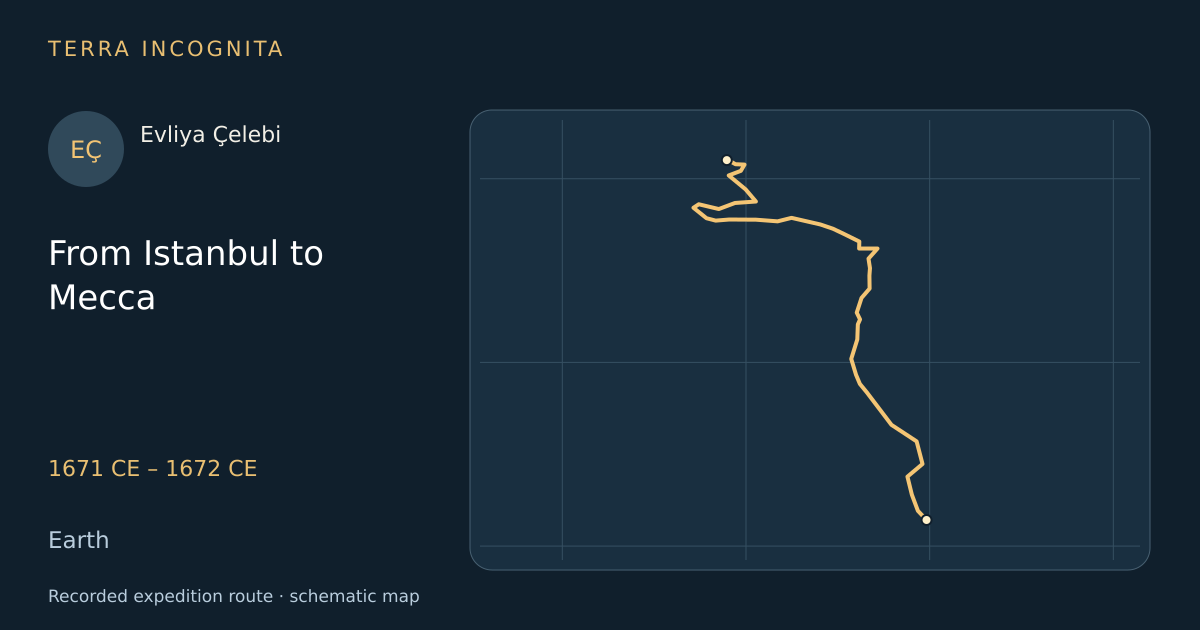
Perform the hajj at last, and describe every town, shrine and stage of the road on the way.
Historical context
The hajj was the best-organised journey of the seventeenth-century world: an imperial caravan left Damascus each year under a commander named by the sultan, carrying the mahmal and the surre, the sultan’s purse for the people of Mecca and Medina and for the Bedouin tribes who supplied the road and were paid to leave the pilgrims alone. Evliya had wanted to make the pilgrimage since his youth and finally made it at sixty, by a long road through western Anatolia, the Aegean islands and the Syrian coast. In 1672 the caravan also carried a political errand: its commander came to depose the Sharif of Mecca. The Seyahatname Evliya wrote afterwards in Cairo turns that road into an inventory of the Ottoman world, town by town.
The voyage, step by step
Leaving Istanbul
21 May 1671
At sixty, after three decades on the roads of the empire and beyond, he sets out at last for Mecca.
Bursa of the mosques
1671 CE
He spends a week as a guest in the first Ottoman capital, then rides into the robbers’ country of Mount Domaniç.
The Aegean detour
1671 CE
From Afyon, instead of going on east, he turns back west through Manisa to Izmir and the islands, gathering towns.
Aleppo of the caravans
1671 CE
In the great market city of northern Syria he paces the walls and counts khans, shops and coffeehouses.
Damascus and the caravan
February 1672
He joins the imperial pilgrim caravan forming under the governor of Damascus, Hüseyin Pasha.
The desert stages
March 1672
Nearly forty days from Damascus to Medina, marching by day and by torchlight between forts, pools and Bedouin camps.
Medina
March 1672
He visits the Prophet’s tomb, sweeps its floor beside the pasha and leaves a lamp of his own.
The hajj of 1672
April 1672
More than forty years after the dream that started him travelling, he completes the pilgrimage and sees the Sharif of Mecca deposed.
Outcome
Reached Mecca two days before the standing at Arafat in April 1672, saw Hüseyin Pasha depose the Sharif of Mecca, came to Cairo with the Egyptian caravan in June 1672 and wrote the ten volumes of the Seyahatname there.
Evliya Çelebi
Ottoman gentleman-traveller whose ten-volume Book of Travels records forty years on the roads of the empire and beyond, among them the pilgrimage to Mecca of 1672.
Sources
- Evliya Çelebi — Wikipedia
- An Ottoman Traveller: Selections from the Book of Travels of Evliya ÇelebiRobert Dankoff and Sooyong Kim · Eland Publishing, London · 2010
Continue exploring
- Down the Mississippi to the GulfRené-Robert Cavelier de La Salle · 1682 CE
- Up the Amazon to Quito and backPedro Teixeira · 1637 CE – 1639 CE
- Crossing the continentAlexander Mackenzie · 1789 CE – 1793 CE
- Search for the NigerMungo Park · 1795 CE – 1797 CE