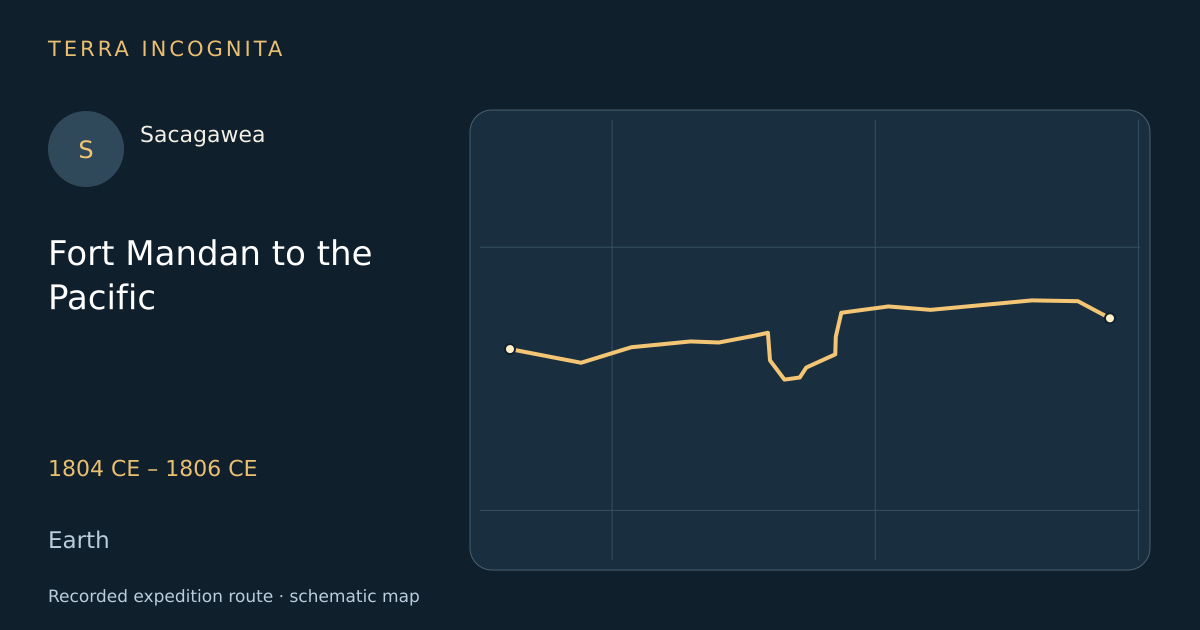
Fort Mandan to the Pacific
Sacagawea · 1804 CE – 1806 CE · Earth
Carry the expedition west as interpreter to the Shoshone, so that horses could be bought for the crossing of the Rocky Mountains.
Historical context
The Corps of Discovery, sent by the United States under Meriwether Lewis and William Clark to find a way to the Pacific, reached the Mandan and Hidatsa towns on the upper Missouri in October 1804. Beyond the plains lay the Rocky Mountains, and the captains expected to buy the horses for the crossing from the Shoshone, a people no one in the party could speak to. Sacagawea was hired in the person of her husband, the trader Toussaint Charbonneau, who spoke Hidatsa: Clark wrote that he was to take one of his two Shoshone wives to interpret. She spent the winter at Fort Mandan, gave birth there in February, and left in April with a son not yet two months old. The captains hired her as an interpreter, not a guide; she recognised the country of her childhood, and her presence with a baby, Clark wrote, told the nations along the rivers that the party was not a war party.
The voyage, step by step
Winter at Fort Mandan
1804 CE
A captive of about sixteen is hired, with her husband, because she speaks Shoshone.
The white pirogue, 14 May
14 May 1805
A squall lays the boat over, the man at the helm loses his head, and she catches what floats out.
The Great Falls portage
1805 CE
A month is lost hauling canoes twenty-eight kilometres round five waterfalls.
Three Forks
1805 CE
She recognises the place where she was taken captive, five years earlier by Lewis’s reckoning.
Camp Fortunate
1805 CE
Among the Shoshone waiting at the forks, the chief proves to be her own brother.
Over the divide
1805 CE
Shoshone women carry the baggage over the divide, and horses and an old guide are bought for the mountains beyond.
Down from the Lolo trail
1805 CE
A starving party comes out of the Bitterroots onto the Weippe prairie and is fed.
Fort Clatsop and the whale
1806 CE
A wet winter among the Clatsop, and an argument about who is allowed to see the ocean.
Outcome
The horses were bought from her brother Cameahwait’s band, at Camp Fortunate and beyond the divide; the party reached the Pacific in November 1805; she wintered at Fort Clatsop, returned east in 1806 and was left with her husband and son at the Mandan villages on 17 August 1806.
Sacagawea
Lemhi Shoshone woman who travelled from the Mandan villages to the Pacific and back with the Corps of Discovery as its Shoshone interpreter, carrying an infant son, and whose language and presence helped the party buy horses and pass as peaceful.
Sources
- Sacagawea — Wikipedia
- The Journals of the Lewis and Clark Expedition, thirteen volumesGary E. Moulton, editor · University of Nebraska Press, Lincoln · 1987
Continue exploring
- Corps of DiscoveryMeriwether Lewis · 1804 CE – 1806 CE
- To Timbuktu and across the SaharaRené Caillié · 1827 CE – 1828 CE
- Overland from Adelaide to King George’s SoundEdward John Eyre · 1840 CE – 1841 CE
- Moreton Bay to Port EssingtonLudwig Leichhardt · 1844 CE – 1845 CE