Overland from Adelaide to King George’s Sound
Edward John Eyre · 1840 CE – 1841 CE · Earth
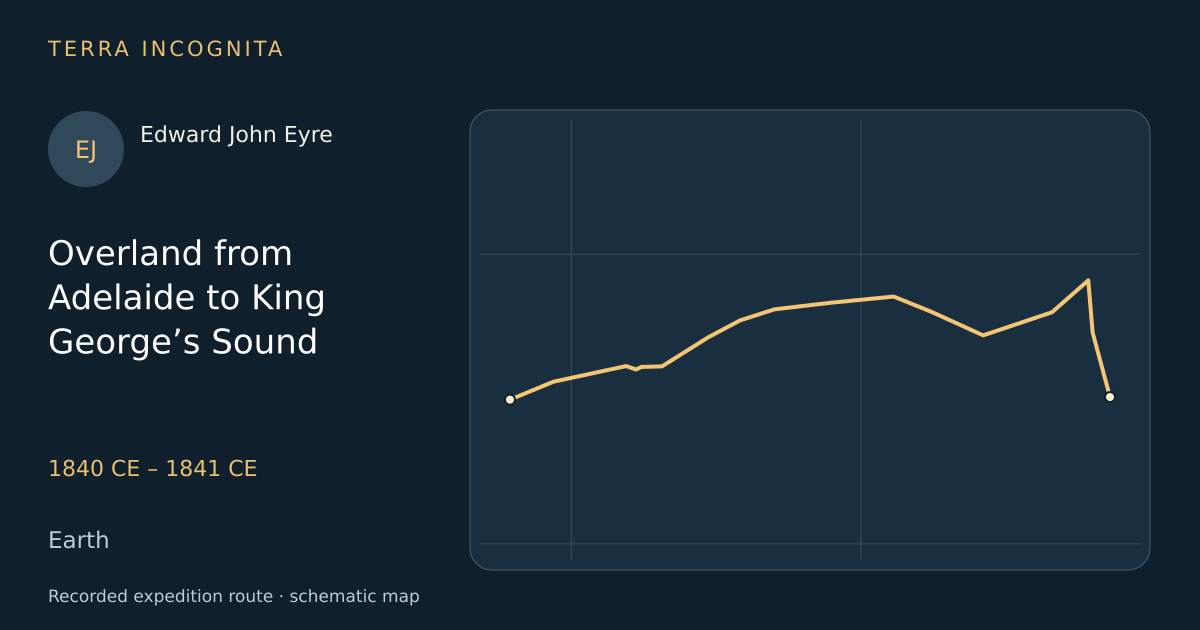
Force a way into the interior north of Adelaide and, failing that, explore the coast westward towards King George’s Sound.
Historical context
Adelaide paid for an expedition to find the good country everyone believed lay beyond the ranges to the north, and Eyre, who had turned the colony’s attention from the west to the north, led it and paid about half the cost. He found instead Lake Torrens and the salt lakes beyond it, which he took for one impassable basin. Rather than go home unsuccessful, he turned west along a coast where limestone cliffs drop into the Southern Ocean and no river reaches the sea. That crossing, from Fowlers Bay to King George Sound in 1841, was a march from one water to the next, and again and again the water was a well dug by the Wirangu, Mirning or Noongar people whose country it was, or shown to the travellers by them. Of the five who set out, two arrived: Eyre and Wylie, a young Menang Noongar man going home.
The voyage, step by step
Adelaide, 18 June 1840
18 June 1840
Colonists and government send Eyre north to find the good country believed to lie in the interior, with a silk Union Jack to plant at its centre.
The horseshoe of salt
1840 CE
Every route north ends in a bed of glittering salt too soft to carry a horse.
Fowlers Bay, the last depot
31 January 1841
Eyre sends most of his party home by sea and keeps four companions for the west.
The head of the Bight
1841 CE
For some 200 kilometres the plain ends in a wall of limestone dropping straight into the sea.
The treeless plain
1841 CE
Saltbush to the horizon in every direction, and a limestone floor with no surface water at all.
29 April 1841
29 April 1841
John Baxter is shot dead in the night; Eyre wrote that the two younger boys fired as Baxter woke to stop them taking the stores, and a Mirning account tells it otherwise.
A ship in an empty bay
2 June 1841
On 2 June, short of food, Eyre and Wylie see the masts of the French whaler Mississippi at anchor.
Albany, 7 July 1841
7 July 1841
Wylie comes home to King George Sound, and the settlement hears the shouting before it sees them.
Outcome
Turned back by the salt lakes, walked some 1,600 kilometres west from Fowlers Bay along the Bight and reached Albany on 7 July 1841 with Wylie; John Baxter was killed on the way.
Edward John Eyre
Sheep drover turned explorer who crossed the waterless coast of the Great Australian Bight from Fowlers Bay to Albany in 1841, the last ten weeks alone with a young Menang Noongar man, Wylie.
Sources
- Journals of Expeditions of Discovery into Central Australia, and Overland from Adelaide to King George’s Sound, in the Years 1840–1, volume 1Edward John Eyre · T. and W. Boone, London · 1845
- Journals of Expeditions of Discovery into Central Australia, and Overland from Adelaide to King George’s Sound, in the Years 1840–1, volume 2Edward John Eyre · T. and W. Boone, London · 1845
- Eyre, Edward John (1815–1901), Australian Dictionary of Biography, volume 1 (revised online)Geoffrey Dutton · Melbourne University Press · 1966
- Wylie (c. 1825–?), Australian Dictionary of Biography, volume 2 (revised online 2025)Wendy Birman · Melbourne University Press · 1967
- Cootachah (c. 1829–?), Joshuing and Neramberein, Australian Dictionary of Biography (online)Shino Konishi · National Centre of Biography, Australian National University · 2026
- Edward John Eyre — Wikipedia
- Journals of Expeditions of Discovery into Central Australia and Overland from Adelaide to King George’s SoundEdward John Eyre · T. and W. Boone, London · 1845
- Wylie (Australian explorer) — Wikipedia
Continue exploring
- Moreton Bay to Port EssingtonLudwig Leichhardt · 1844 CE – 1845 CE
- Six years in the Sahara and the SudanHeinrich Barth · 1849 CE – 1855 CE
- To Timbuktu and across the SaharaRené Caillié · 1827 CE – 1828 CE
- Crossing AfricaDavid Livingstone · 1853 CE – 1856 CE