To Timbuktu and across the Sahara
René Caillié · 1827 CE – 1828 CE · Earth
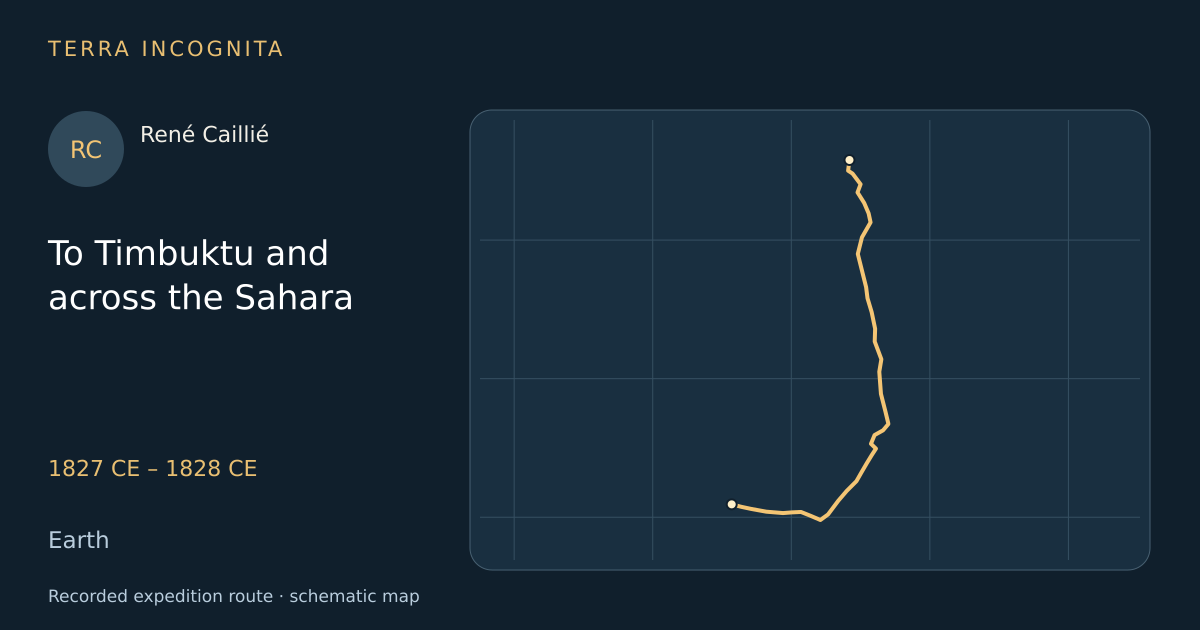
Reach Timbuktu in disguise and bring back a first-hand description of the city and the Niger.
Historical context
Timbuktu had become an obsession of European geography: Mungo Park drowned on the Niger, and the British officer Alexander Gordon Laing, who reached the city in August 1826, was killed in September, days after leaving it. The Société de Géographie offered a prize to the first traveller who reached it from Senegal and brought back exact observations. Caillié, refused backing for the journey, answered by learning Arabic, adopting a Muslim identity and walking there with African caravans on his own savings, without a single European companion.
The voyage, step by step
Kakondy, April 1827
April 1827
He joins a Mandinka caravan on the Rio Nuñez as Abdallahi, an Egyptian going home.
Kankan
1827 CE
The caravan reaches the great Malinké trading town on the Milo, two months inland.
Five months at Tiémé
January 1828
Scurvy and a foot ulcer halt him for five months in a Mandinka village south of Sambatikila.
Djenné
March 1828
In March he reaches the inland delta city and takes passage in a river boat for Timbuktu.
Timbuktu, 20 April 1828
20 April 1828
He walks into the city Laing had reached two years earlier, and stays a fortnight.
The Taoudenni road
1828 CE
He crosses the desert with 1,400 camels bound for Morocco by the Taoudenni salt pans.
Tangier and the prize
September 1828
In September he reaches the French consulate, drops the disguise and sails for Toulon.
Outcome
Entered Timbuktu in April 1828, crossed the desert with a caravan from Araouan and reached Tangier alive that September.
René Caillié
Poor French traveller who reached Timbuktu disguised, with African caravans and no European companion, and became the first European to return from it alive with an account.
Sources
- René Caillié — Wikipedia
- Journal d’un voyage à Temboctou et à Jenné, dans l’Afrique centraleRené Caillié · Imprimerie Royale, Paris · 1830
- René Caillié — Wikipédia (French)
- Seku Amadu — Wikipedia
- Caliphate of Hamdullahi (formerly Massina Empire) — Wikipedia
- Review of Caillié’s Journal d’un voyage à Temboctou et à Jenné (Art. VI), The Quarterly Review, vol. 42, no. 84, March 1830Unsigned · John Murray, London · 1830
Continue exploring
- Overland from Adelaide to King George’s SoundEdward John Eyre · 1840 CE – 1841 CE
- Moreton Bay to Port EssingtonLudwig Leichhardt · 1844 CE – 1845 CE
- Six years in the Sahara and the SudanHeinrich Barth · 1849 CE – 1855 CE
- Corps of DiscoveryMeriwether Lewis · 1804 CE – 1806 CE