Voyage to the North
Pytheas of Massalia · 325 BCE · Earth
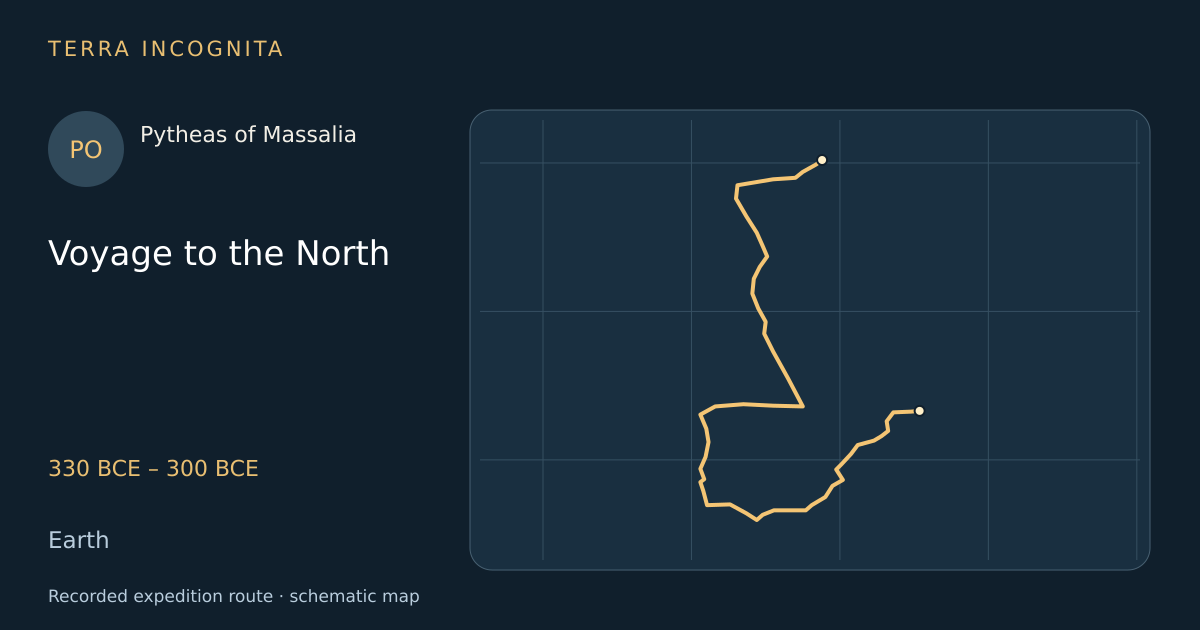
Sail into the Ocean beyond the Pillars of Hercules to Britain and the far north; his purpose is not recorded, though the tin of the north may have been one aim.
Historical context
In the fourth century BCE the Greeks knew Britain and the northern Ocean only vaguely, perhaps through the Phoenicians, as Bunbury and Beazley put it in 1911. Pytheas of Massalia, an astronomer as well as a traveller, went north and wrote On the Ocean. Polybius, who read it, called it fiction; only quotations survive, in Strabo, Pliny, Diodorus and others.
The voyage, step by step
Out of Massalia
325 BCE
Pytheas, a Greek of Massalia, sets out for the northern Ocean, a voyage he later describes in a book now lost.
Past Iberia
325 BCE
Pytheas’s route into the Ocean is uncertain; Gades and the Sacred Cape, the south-western tip of Iberia, are among the places Eratosthenes took from his account.
Britain measured
325 BCE
Pytheas reports travelling over Britain and gives its coast as more than 40,000 stades; from Belerion, its south-western cape, tin passes through merchants’ hands to Gaul.
The land of Thule
325 BCE
He tells of Thule, six days’ sail north of Britain near a frozen sea, where, he said, the sun does not set at midsummer, and says that on his return he visited the whole coast of Europe from Gades to the Tanais.
Outcome
Reported Britain, its circuit and its tin coast, the tides, a far northern land called Thule near a frozen sea, and an amber island; his book is lost, and Polybius and Strabo called it fiction.
Pytheas of Massalia
Greek astronomer and traveller who sailed into the northern Ocean, described Britain and reported a far northern land he called Thule.
Sources
- The Geography, books 1 and 2Strabo, translated by Horace Leonard Jones · Loeb Classical Library, volume 1; LacusCurtius · 1917
- The Geography, books 3 to 5Strabo, translated by Horace Leonard Jones · Loeb Classical Library, volume 2; LacusCurtius · 1923
- The Library of History, book 5, chapters 21–22 (Britain and its tin)Diodorus Siculus, translated by C. H. Oldfather · Loeb Classical Library, volume 3; LacusCurtius · 1939
- The Natural History, book 2, chapters 77 and 99, and book 4, chapter 30 (the passages on Pytheas, Thule and Britain)Pliny the Elder, translated by John Bostock and H. T. Riley · Taylor and Francis; Perseus Digital Library · 1855
- The Natural History, book 37, chapter 11 (amber)Pliny the Elder, translated by John Bostock and H. T. Riley · Taylor and Francis; Perseus Digital Library · 1855
- PytheasEdward Herbert Bunbury and Charles Raymond Beazley · Encyclopædia Britannica, 11th edition, volume 22; Wikisource · 1911
- Pytheas — Wikipedia
- Europe Between the Oceans: 9000 BC – AD 1000Barry Cunliffe · Yale University Press · 2008
Continue exploring
- Return from IndiaNearchus · 325 BCE – 324 BCE
- Voyage of the PeriplusHanno the Navigator · 500 BCE
- Settlement of GreenlandErik the Red · 982 CE – 986 CE
- Voyage to VinlandLeif Erikson · 1000 CE – 1001 CE