Voyage of the Periplus
Hanno the Navigator · 500 BCE · Earth
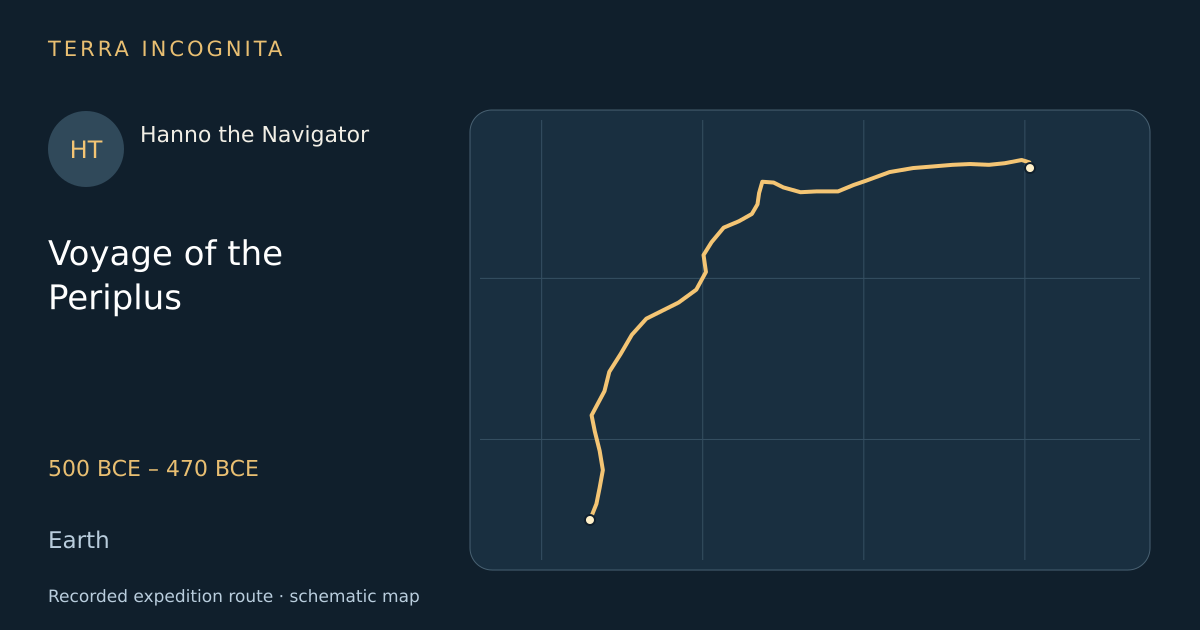
Sail beyond the Pillars of Hercules and found cities of the Libyphoenicians on the Atlantic coast of Africa.
Historical context
Carthage was the greatest maritime power of the western Mediterranean, planting colonies along its trade routes. Hanno's voyage pushed that expansion beyond the Pillars of Hercules into the Atlantic. His report, which he is said to have dedicated in a temple at Carthage, survives only in an abridged Greek translation and gives no date; scholars have proposed dates from about 570 to 470 BCE.
The voyage, step by step
Sailing from Carthage
500 BCE
A fleet of sixty ships carrying colonists and supplies leaves Carthage and passes the Pillars of Hercules.
Colonies on the Atlantic coast
500 BCE
Past a wooded cape where they raise an altar to Poseidon, the colonists found cities by the sea along the Moroccan shore, then make friends with the herders of the river Lixus.
The island of Cerne
500 BCE
Sailing south along a desert shore, the fleet settles a small island in a bay and names it Cerne, then reaches a river full of crocodiles and hippopotami before turning back to the island.
The Chariot of the Gods
500 BCE
Twelve more days south, past fires along the shore and a blazing mountain called the Chariot of the Gods, the fleet reaches the Horn of the South, where its provisions give out.
Outcome
Founded cities on the Moroccan coast and a settlement on the island of Cerne, then sailed south until provisions failed; how far the fleet went is disputed, and the report survives only in a Greek translation.
Hanno the Navigator
Carthaginian admiral who led a colonising fleet down the Atlantic coast of Africa and left the earliest surviving first-hand account of the region.
Sources
- The Periplus of Hanno: A Voyage of Discovery Down the West African Coast, by a Carthaginian Admiral of the Fifth Century B.C.Wilfred H. Schoff (translator) · The Commercial Museum, Philadelphia · 1912
- Hanno the Navigator (introduction, and text with commentary)Jona Lendering · Livius.org · 2020
- The Natural History, book 6, chapter 36 (31): Islands of the Aethiopian SeaPliny the Elder, translated by John Bostock and H. T. Riley · Taylor and Francis; Perseus Digital Library · 1855
- Notice of the External Characters and Habits of Troglodytes Gorilla, a New Species of Orang from the Gaboon River; Osteology of the SameThomas S. Savage and Jeffries Wyman · Boston Journal of Natural History 5 · 1847
- La navigation sur les côtes du Sahara pendant l’antiquitéRaymond Mauny · Revue des Études Anciennes 57 (1) · 1955
- Hanno the Navigator — Wikipedia
- Europe Between the Oceans: 9000 BC – AD 1000Barry Cunliffe · Yale University Press · 2008
Continue exploring
- Return from IndiaNearchus · 325 BCE – 324 BCE
- Voyage to the NorthPytheas of Massalia · 325 BCE
- Settlement of GreenlandErik the Red · 982 CE – 986 CE
- Expedition to PuntHannu · 2000 BCE