Return from India
Nearchus · 325 BCE – 324 BCE · Earth
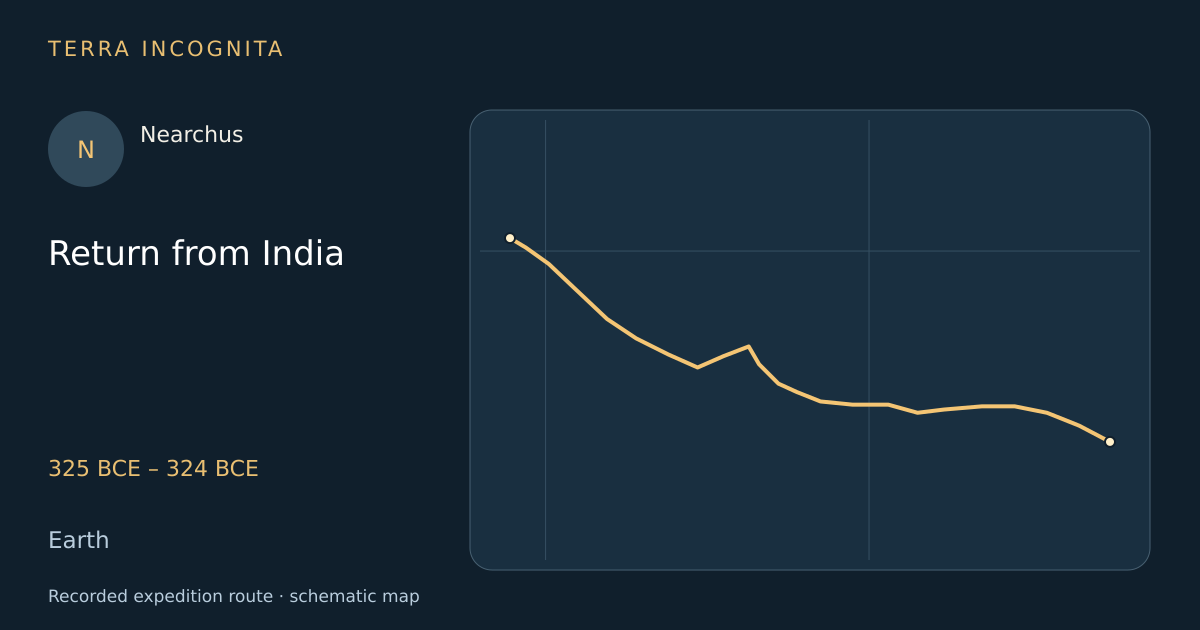
Bring Alexander’s fleet from the Indus to Persia and, in Nearchus’s words as Arrian gives them, learn the coast, its harbours, islands and bays, its towns, and whether the land was habitable or desert.
Historical context
Alexander, Nearchus wrote, longed to sail the whole sea from India to Persia but feared losing a fleet on a barren, harbourless coast. In 325 BCE he led his army west through the Gedrosian desert and sent the fleet along the shore, each meant to help the other. Nearchus’s own account is lost; Arrian’s Indica, written in the second century CE, follows it anchorage by anchorage.
The voyage, step by step
The fleet puts to sea
325 BCE
Nearchus takes Alexander’s fleet down the last reach of the Indus, cuts a channel through the bar at its mouth and waits out the gales in a harbour he names after the king.
The whales scattered
325 BCE
Past the coast of the Oreitai, a Gedrosian pilot joins the fleet; off Kyiza, spouting whales send the rowers into a panic until Nearchus turns the ships on them.
The Fish-Eaters
325 BCE
On the bay beyond Kyiza, Nearchus takes a walled town of the Fish-Eaters by a trick and carries off its fish meal and grain.
The Gedrosian coast
325 BCE
Beyond Talmena the food runs out; the crews cut down wild palms to eat, and Nearchus anchors offshore so that starving men cannot desert.
The narrows at Harmozeia
325 BCE
Refusing to steer for a cape of Arabia, Nearchus brings the fleet to the river Anamis in Harmozeia and goes inland to Alexander’s camp, five days’ march away.
Into the Persian Gulf
324 BCE
The fleet works up the shoals of the Persian coast to the mouth of the Euphrates, then up the Pasitigris to meet Alexander’s army at a bridge on the road to Susa.
Outcome
After hunger on the coast of the Fish-Eaters, the fleet met Alexander in Carmania, then reached the mouth of the Euphrates and sailed up the Pasitigris to rejoin the army near Susa in 324 BCE; Alexander crowned Nearchus with gold.
Nearchus
Admiral of Alexander the Great who brought the fleet from the Indus along the coasts of Gedrosia, Carmania and Persis to the head of the Persian Gulf.
Sources
- The Commerce and Navigation of the Erythraean Sea; and of Arrian’s Account of the Voyage of Nearkhos, from the Mouth of the Indus to the Head of the Persian GulfJ. W. McCrindle (translator) · Thacker, Spink and Co.; Project Gutenberg · 1879
- The Anabasis of AlexanderArrian, translated by E. J. Chinnock · Hodder and Stoughton; Project Gutenberg · 1884
- The Geography, book 15, chapter 2 (Ariana, Gedrosia and Carmania)Strabo, translated by Horace Leonard Jones · Loeb Classical Library, volume 7; LacusCurtius · 1930
- The Library of History, book 17, chapters 104–106, with the editor’s notesDiodorus Siculus, translated by C. Bradford Welles · Loeb Classical Library, volume 8; LacusCurtius · 1963
- NearchusJona Lendering · Livius.org · 2020
- Nearchus — Wikipedia
Continue exploring
- Voyage to the NorthPytheas of Massalia · 325 BCE
- Voyage of the PeriplusHanno the Navigator · 500 BCE
- Settlement of GreenlandErik the Red · 982 CE – 986 CE
- Voyage to VinlandLeif Erikson · 1000 CE – 1001 CE