First Central Asian expedition
Nikolai Przhevalsky · 1870 CE – 1873 CE · Earth
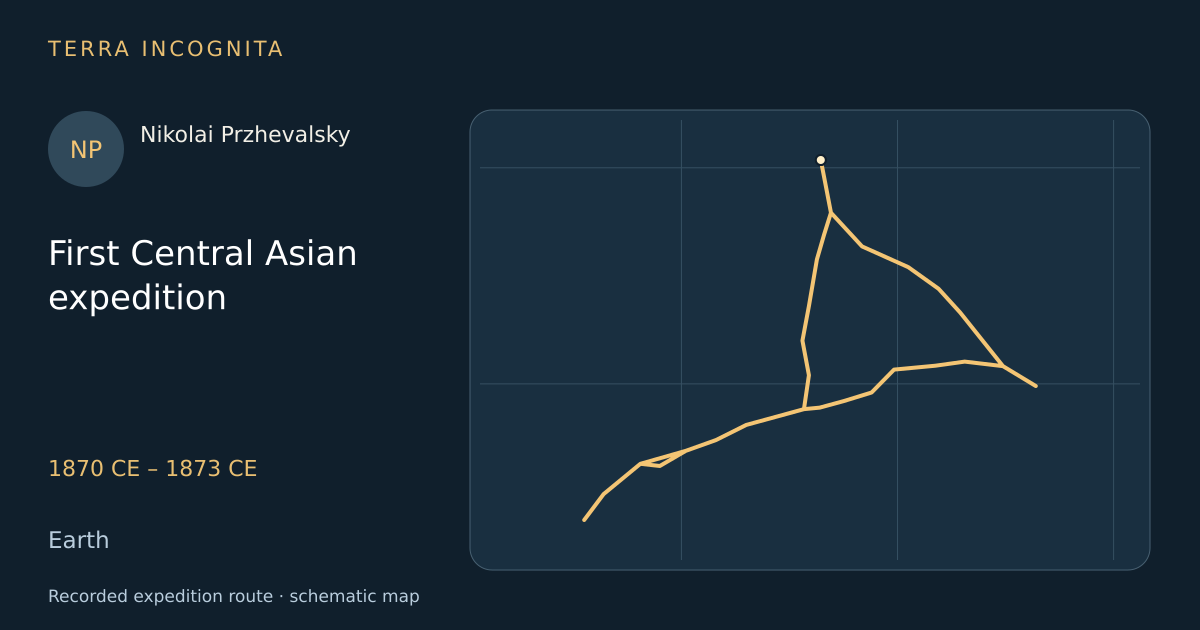
Survey a route from Kyakhta to Peking and southward to the Tibetan plateau, collecting plants and animals throughout.
Historical context
Inner Asia in 1870 was a blank between the Russian and Qing empires, crossed by caravans but unmeasured, and the Muslim revolt then tearing through Gansu and Xinjiang had cut even the old roads. The Geographical Society sent a young officer with four men and no diplomatic cover to see how far he could get. He got further than anyone expected, and his route surveys became the frame on which every later map of the Gobi and the Tibetan marches was hung.
The voyage, step by step
Four men leave Kyakhta
November 1870
In November the tea town on the Mongolian border sees off a very small expedition.
Urga
1870 CE
At the monastery city of the Bogd Gegeen the caravan is put together for the desert.
The first Gobi crossing
1871 CE
Forty days of gravel, wind and frozen wells bring them to the gate of the Great Wall at Kalgan.
The Ordos loop
1871 CE
He follows the Yellow River round its great northern bend, sand on one side, flood plain on the other.
Winter in the Alashan
1871 CE
Out of money and camels, the party winters at the oasis town under the Helan mountains.
Koko Nor
October 1872
In October the great blue salt lake appears, the first European survey of its shore.
The upper Yangtze
1873 CE
Beyond the Tsaidam he reaches the headwater river the Tibetans call the Dre Chu, and can go no further.
Back to Kyakhta
September 1873
In September, after eleven thousand kilometres, the four men come back across the border.
Outcome
Covered some 11,000 kilometres in three years, mapped the Ordos, the Alashan and Koko Nor, and reached the upper Yangtze before turning back for want of camels.
Nikolai Przhevalsky
Russian officer and naturalist whose four journeys into inner Asia mapped the Gobi, the Tsaidam and northern Tibet and brought back thousands of specimens from country no European had described.
Sources
- Nikolay Przhevalsky — Wikipedia
- Mongolia, the Tangut Country, and the Solitudes of Northern TibetNikolai Przhevalsky, translated by E. Delmar Morgan · Sampson Low, Marston, Searle & Rivington, London · 1876
Continue exploring
- Tibesti, Borku, Wadai and DarfurGustav Nachtigal · 1869 CE – 1874 CE
- The Green and the Colorado, 1869John Wesley Powell · 1869 CE
- Across Africa by the CongoHenry Morton Stanley · 1874 CE – 1877 CE
- The pundit’s route survey to LhasaNain Singh · 1865 CE – 1866 CE