Mariner 9 global survey
Mariner 9 · 1971 CE – 1972 CE · Mars
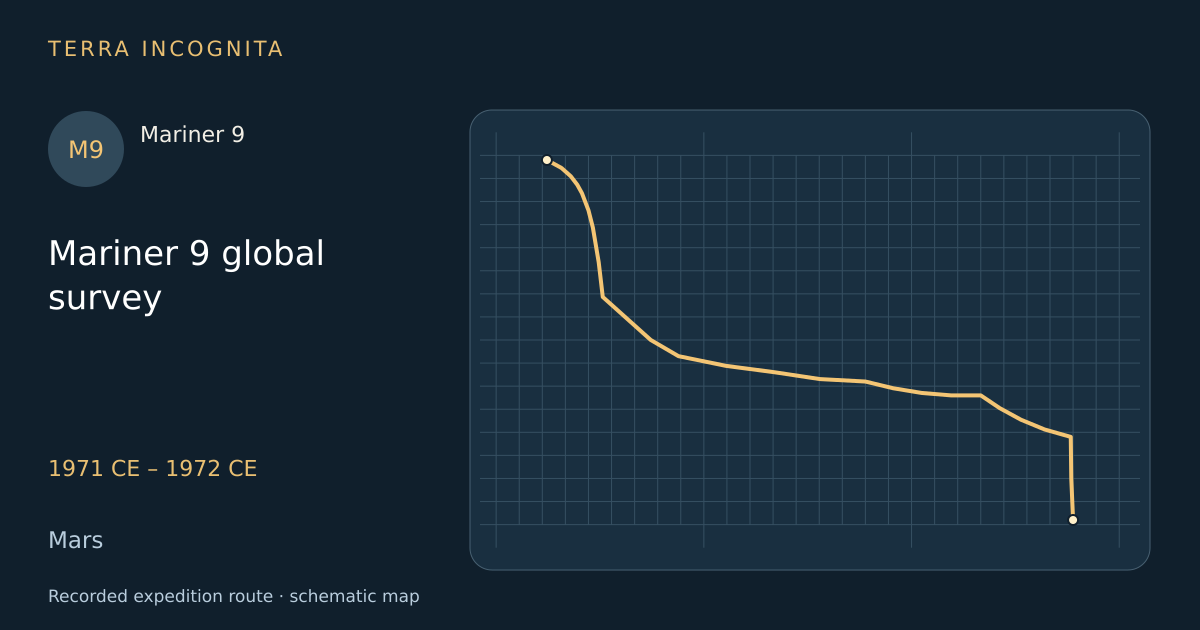
Enter orbit and map the whole surface of Mars from pole to pole.
Historical context
Mariner 4 had left a picture of a dead, Moon-like planet, and three more flybys had not changed it. Mariner 9 stayed, waited out a global dust storm and then mapped everything, which turned out to include the largest volcano and the deepest canyon in the solar system. The Mars we now argue about is the one it photographed.
The voyage, step by step
Arrival into a storm
14 November 1971
Mariner 9 reached orbit on 14 November 1971 to find the entire planet hidden under a global dust storm.
Hellas under the dust
1971 CE
The great southern basin, where the storm had been born, stayed featureless for weeks.
Two small moons
1972 CE
While the dust settled the orbiter turned its cameras on Phobos and Deimos, and resolved them for the first time as battered, irregular rocks.
A canyon four thousand kilometres long
1972 CE
As the air cleared, a gash appeared along the equator deep enough to swallow the Alps and long enough to cross the United States.
The labyrinth of night
1972 CE
West of the canyons the ground broke into a maze of intersecting troughs, cracked open where the Tharsis bulge had lifted the crust.
The largest volcano known
1972 CE
One of the four dark spots that had risen above the dust turned out to be a shield volcano twenty-two kilometres high and six hundred across.
The layered cap
27 October 1972
In the north the cameras found terraces of ice and dust stacked in fine layers, a climate record written into the pole.
Outcome
7,329 images covering about 85 per cent of the planet, and the discovery of its volcanoes and canyons.
Mariner 9
First spacecraft to orbit another planet, and the first to map the whole of Mars.
Sources
- Mariner 9 — Wikipedia
- NASA Space Science Data Coordinated Archive — Mars missionsNASA Goddard Space Flight Center
Continue exploring
- Viking 1 landing in Chryse PlanitiaViking 1 · 1976 CE – 1982 CE
- Viking 2 landing in Utopia PlanitiaViking 2 · 1976 CE – 1980 CE
- Mariner 4 flybyMariner 4 · 1965 CE
- Pathfinder and Sojourner at Ares VallisMars Pathfinder and Sojourner · 1997 CE