Expedition to the Americas
Alexander von Humboldt · 1799 CE – 1804 CE · Earth
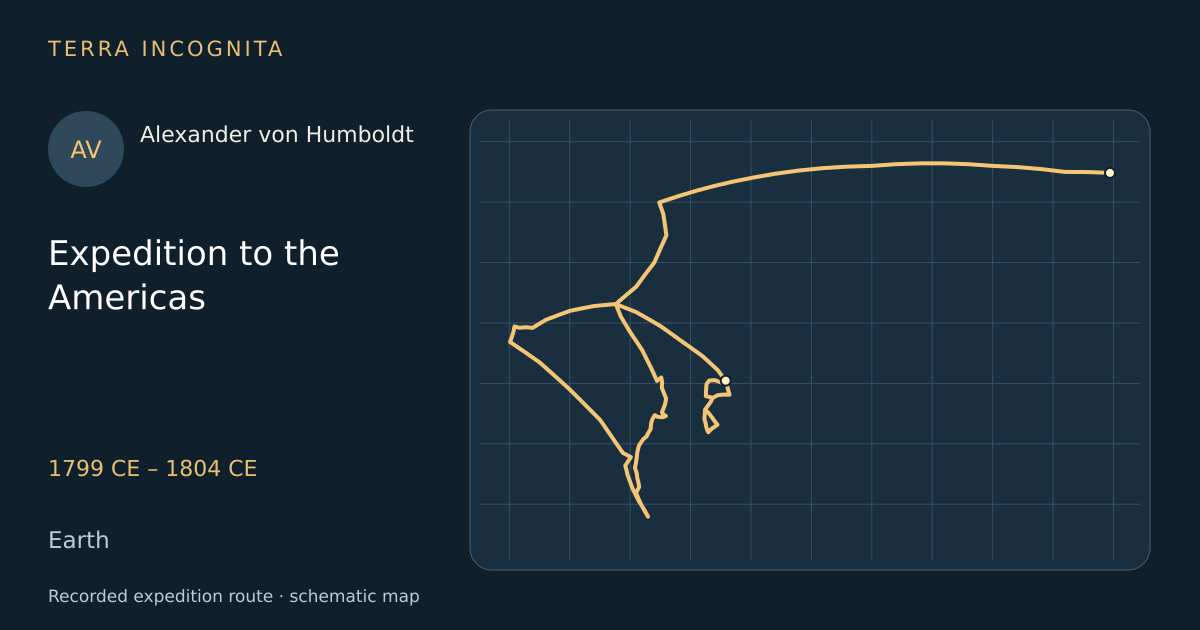
Study the natural world of the Americas.
Historical context
Humboldt set out to measure the natural world, not to conquer or trade. His instruments turned mountains, rivers and climate into connected systems and helped found modern geography.
The voyage, step by step
Landing in Venezuela
1799 CE
Humboldt and Bonpland begin five years of measurement and collection in the Americas.
Up the Orinoco
1800 CE
They trace the river's connection to the Amazon and study its peoples and wildlife.
Climbing Chimborazo
1802 CE
He reaches within a few hundred metres of a summit no one has climbed.
The Peruvian coast
1802 CE
He measures the cold current that later bears his name and studies the guano islands.
Mexico and home
1803 CE
He surveys New Spain and returns to Europe with a mountain of data.
Outcome
Crossed the Andes and transformed geography.
Alexander von Humboldt
German naturalist and explorer whose five-year expedition in the Americas founded modern geography and ecology.
Sources
Continue exploring
- Search for the NigerMungo Park · 1795 CE – 1797 CE
- Crossing the continentAlexander Mackenzie · 1789 CE – 1793 CE
- Down the Mississippi to the GulfRené-Robert Cavelier de La Salle · 1682 CE
- From Istanbul to MeccaEvliya Çelebi · 1671 CE – 1672 CE