Pilgrimage to India
Faxian · 399 CE – 412 CE · Earth
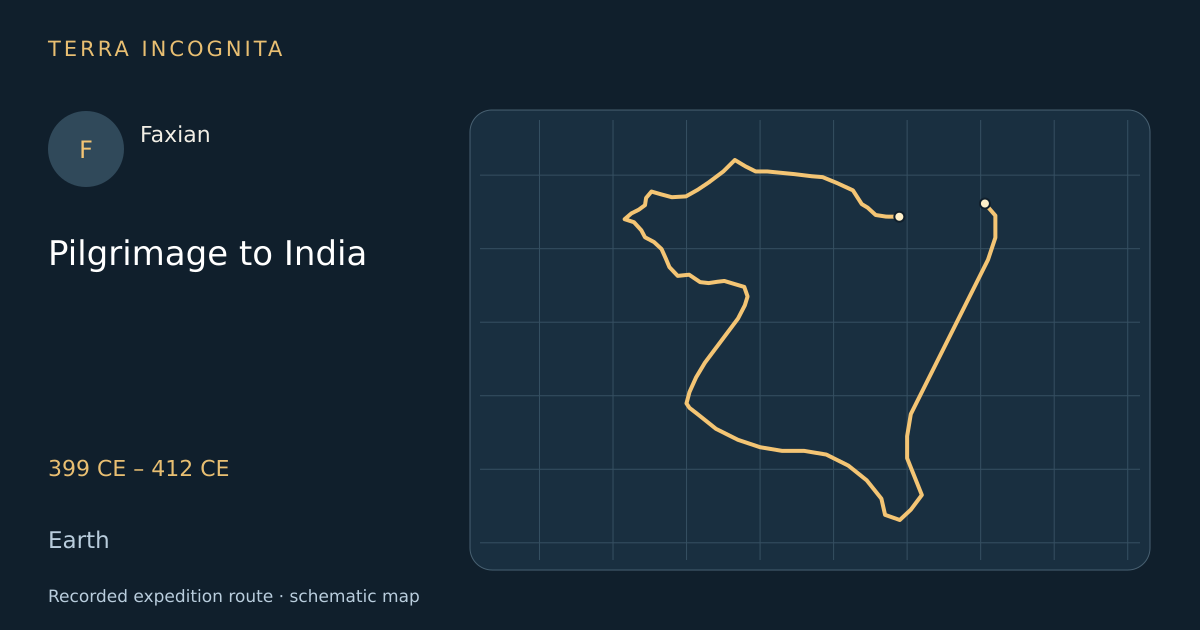
Seek in India complete copies of the Vinaya, the Buddhist monastic rules, which were incomplete in China.
Historical context
Around 400, Buddhism had spread through the oasis kingdoms of Central Asia into a China divided between northern states and the Eastern Jin in the south, but Chinese monasteries lacked a complete code of monastic rules. Faxian, a monk in his sixties, set out to find one in India. His Record of Buddhist Kingdoms, written in the third person and perhaps taken down from his telling, is the first eyewitness account in Chinese of the Buddhist sites of Central and South Asia, as Tansen Sen notes.
The voyage, step by step
Leaving China
399 CE
Faxian and four fellow monks leave Chang’an for India in search of Buddhist scriptures, above all a complete copy of the monastic rules.
Across Central Asia
400 CE
From Dunhuang the pilgrims cross the desert to Shanshan and go on to Wuyi, where three companions turn back, before striking south-west across the sands for Khotan.
Pilgrimage in India
405 CE
Over the Pamirs and down the Indus gorge, Faxian loses two companions, visits the sacred sites of the Ganges plain and spends three years at Pataliputra copying texts.
Sri Lanka and the sea road
409 CE
From the port of Tamralipti a merchant ship takes Faxian to Sri Lanka; after two years on the island he sails for China in a ship of more than two hundred people.
Home with the scriptures
412 CE
Blown far off its course for Guangzhou, a second ship lands Faxian on the Shandong coast south of Mount Lao, some fourteen years after he left Chang’an.
Outcome
Faxian copied the rules and other texts at Pataliputra and in Sri Lanka and returned by sea, by way of Yavadvipa, to the Shandong coast, some fourteen years after he set out; of his companions, some turned back, one went his own way, two died and one stayed in India.
Faxian
Chinese Buddhist monk who walked to India and returned by sea, recording the Buddhist kingdoms of Asia.
Sources
- A Record of Buddhistic Kingdoms: Being an Account by the Chinese Monk Fâ-Hien of his Travels in India and Ceylon (A.D. 399–414) in Search of the Buddhist Books of DisciplineFaxian, translated by James Legge · Clarendon Press; Project Gutenberg · 1886
- The Travels of Fa-hsien (399–414 A.D.), or Record of the Buddhistic KingdomsFaxian, translated by H. A. Giles · Cambridge University Press; Internet Archive · 1923
- Si-Yu-Ki: Buddhist Records of the Western World, volume 1 (with the Travels of Fa-hian)Samuel Beal (translator) · Trübner and Co.; Internet Archive · 1884
- Foguoji (Chinese text)Faxian · Chinese Wikisource
- The Travel Records of Chinese Pilgrims Faxian, Xuanzang, and Yijing: Sources for Cross-Cultural Encounters Between Ancient China and Ancient IndiaTansen Sen · Education About Asia, volume 11, number 3, pages 24–33 · 2006
- Calendar Differences Between the Northern and Southern Dynasties in 384–589Yuk Tung Liu
- Faxian — Wikipedia
Continue exploring
- Han mission to the WestZhang Qian · 138 BCE – 126 BCE
- Journey to the WestXuanzang · 629 CE – 645 CE
- Mission to the VolgaAhmad ibn Fadlan · 921 CE – 922 CE
- Pilgrimage from Granada to MeccaIbn Jubayr · 1183 CE – 1185 CE