On foot to Lhasa
Alexandra David-Néel · 1923 CE – 1924 CE · Earth
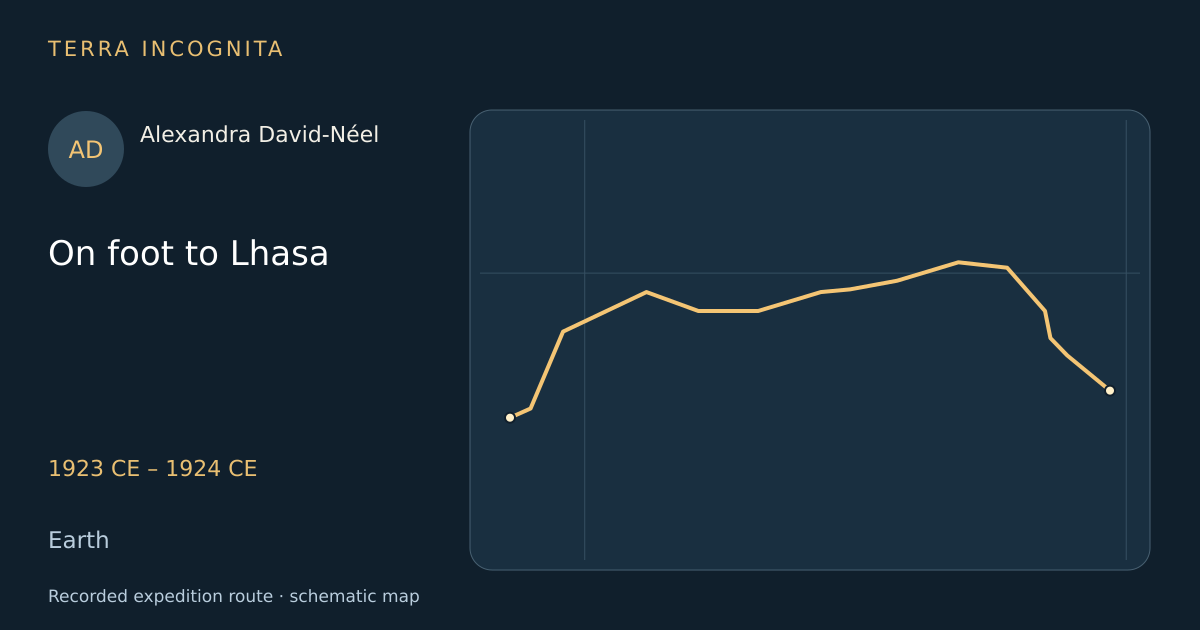
Cross eastern Tibet on foot as beggar pilgrims and reach Lhasa, closed to foreigners, in answer to the ban she called absurd, and show, in her words, what the will of a woman could achieve.
Historical context
After the British expedition of 1904, David-Néel wrote, no foreigner apart from political officers and their doctors had been allowed to go to Lhasa. The Tibetan government received no one who was not sent to it, and the Government of India refused permits, in accordance, its trade agent David Macdonald wrote, with the wishes of the Tibetan government. She had lived among Tibetans for a dozen years: as a hermit in Sikkim, as a guest of the Panchen Lama at Shigatse, and as a translator at the Kumbum monastery for more than two years. The British had expelled her from Sikkim in 1916, and Lhasa’s officials had turned her back in Kham. In the autumn of 1923 she set out from Yunnan with Aphur Yongden, as an old beggar pilgrim and her lama son, to reach Lhasa for the New Year by passes that, she believed, no foreigner had crossed.
The voyage, step by step
Setting out from Yunnan
October 1923
In October 1923 two walkers leave a mission house in Yunnan with two porters, telling everyone they are going to collect plants in the hills.
Over the frontier pass
1923 CE
They slip past Londre by night, climb the pilgrim road round Kha Karpo and cross the Dokar pass into Lhasa’s territory at nightfall.
The Salween gorges
November 1923
They follow the Salween and the Nu valley north through village country, begging, blessing and telling fortunes, and cross the upper Salween on a cable.
Through Po-yul
1924 CE
Over two snowbound passes in December and into the Po country, where they fast for six days, meet conspirators and robbers, and beg at the king’s gate on New Year’s day.
Down to the Tsangpo
January 1924
Past robbers, a toll post and a hermit who knows her, they come down to the Brahmaputra and turn up the Giamda river towards Lhasa.
Into Lhasa at Monlam
February 1924
After four months on foot they cross the Kyi river under a storm of dust and find a beggars’ lodging within sight of the Potala.
Two months in Lhasa
1924 CE
She climbs the Potala behind two villagers, is taken for a woman of Ladakh, and lives two months among the beggars of Lhasa.
Revealed at Gyantse
1924 CE
After a tour of Samye and the Yarlung valley, she walks into the British post at Gyantse and says who she is.
Outcome
After four months on foot from Yunnan, by the Salween, Po-yul and the Brahmaputra, she walked into Lhasa with Aphur Yongden for the New Year of 1924 and stayed two months, by her account unrecognised. She then toured Samye and the Yarlung valley, revealed herself to the British at Gyantse and went down to India through Sikkim.
Alexandra David-Néel
French orientalist, opera singer and Buddhist who walked into Lhasa in 1924 disguised as a beggar pilgrim, with the Sikkimese lama Aphur Yongden as her son; she wrote that no foreign woman had seen the city before her.
Sources
- My Journey to LhasaAlexandra David-Néel · Harper & Brothers, New York · 1927
- Voyage d’une Parisienne à Lhassa : à pied et en mendiant de la Chine à l’Inde à travers le Thibet (text of the Plon edition, read in a later reprint)Alexandra David-Néel · Plon, Paris · 1927
- Twenty Years in TibetDavid Macdonald · J. B. Lippincott, Philadelphia · 1932
- Alexandra David-Néel — Wikipedia
- Alexandra David-Néel — Wikipédia (français)
Continue exploring
- The last march towards ZPercy Fawcett · 1925 CE
- Imperial Trans-Antarctic expeditionErnest Shackleton · 1914 CE – 1916 CE
- Damascus to Ha’il and BaghdadGertrude Bell · 1913 CE – 1914 CE
- South Pole expeditionRoald Amundsen · 1910 CE – 1912 CE