South Pole expedition
Roald Amundsen · 1910 CE – 1912 CE · Earth
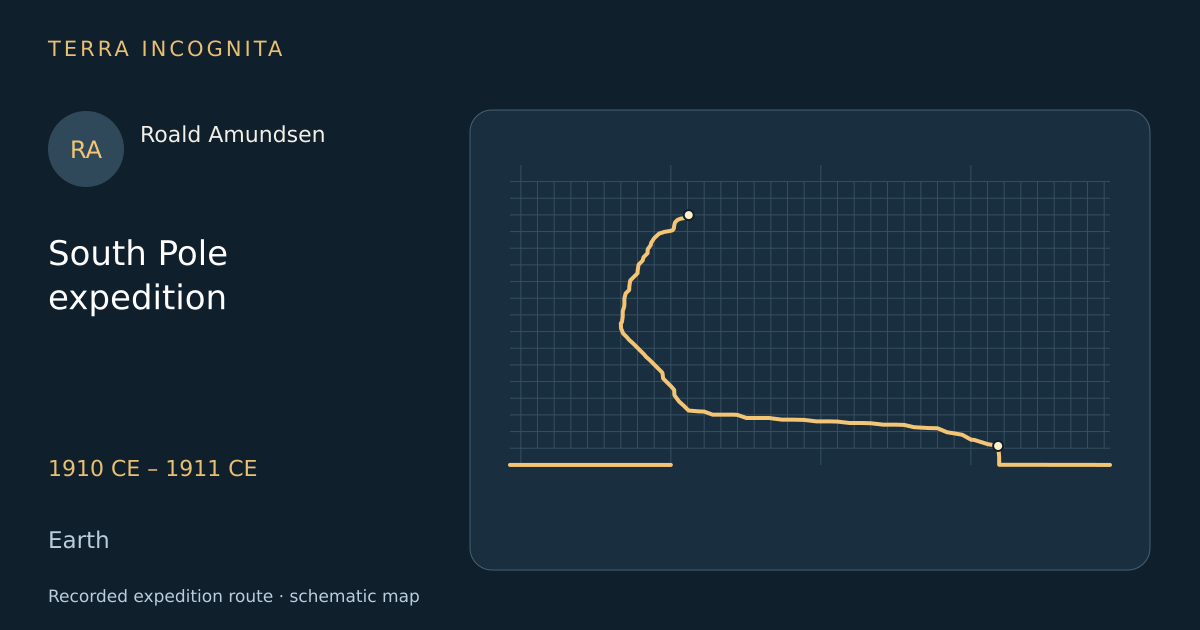
Be first to reach the South Pole.
Historical context
The race to the South Pole was a contest of national prestige fought in the press as much as on the ice. Amundsen chose dogs, skis and Inuit clothing, while Scott combined ponies, motor sledges and dogs, and planned to man-haul across the plateau.
The voyage, step by step
Departure from Norway
August 1910
The Fram leaves Christiania, now Oslo, in June 1910 and sails from Kristiansand on 9 August, with a crew who, except its officers, believe they are bound for the Arctic.
The secret revealed
1910 CE
At Madeira, on 9 September 1910, Amundsen tells the crew the true goal is the South Pole; all agree to continue.
Base at the Bay of Whales
1911 CE
The Fram enters the Bay of Whales on 14 January 1911; Framheim is built on the Ross Ice Shelf, closer to the pole than Scott's base.
Laying depots
February 1911
Depot laying begins in February; by mid-April three depots at 80°, 81° and 82° S hold about three tons of supplies, before the polar night closes in.
The Axel Heiberg ascent
1911 CE
The party climbs the glacier to the polar plateau with five men, four sledges and 42 dogs; at the top, 24 of the dogs are killed for food.
The South Pole
14 December 1911
On 14 December 1911 Amundsen and four companions reach the pole, 34 days before Scott.
Return to Framheim
1912 CE
The whole party returns safely to Framheim on 25 January 1912, with two sledges and eleven dogs, a feat of planning as much as endurance.
Outcome
Reached the pole on 14 December 1911, ahead of Scott.
Roald Amundsen
Norwegian polar explorer who led the first expedition to reach the South Pole and the first confirmed traverse of the Northwest Passage.
Sources
Continue exploring
- Northwest PassageRoald Amundsen · 1903 CE – 1906 CE
- Terra Nova expeditionRobert Falcon Scott · 1910 CE – 1913 CE
- North Pole expeditionMatthew Henson · 1908 CE – 1909 CE
- North Pole attemptRobert Peary · 1908 CE – 1909 CE