Six years in the Sahara and the Sudan
Heinrich Barth · 1849 CE – 1855 CE · Earth
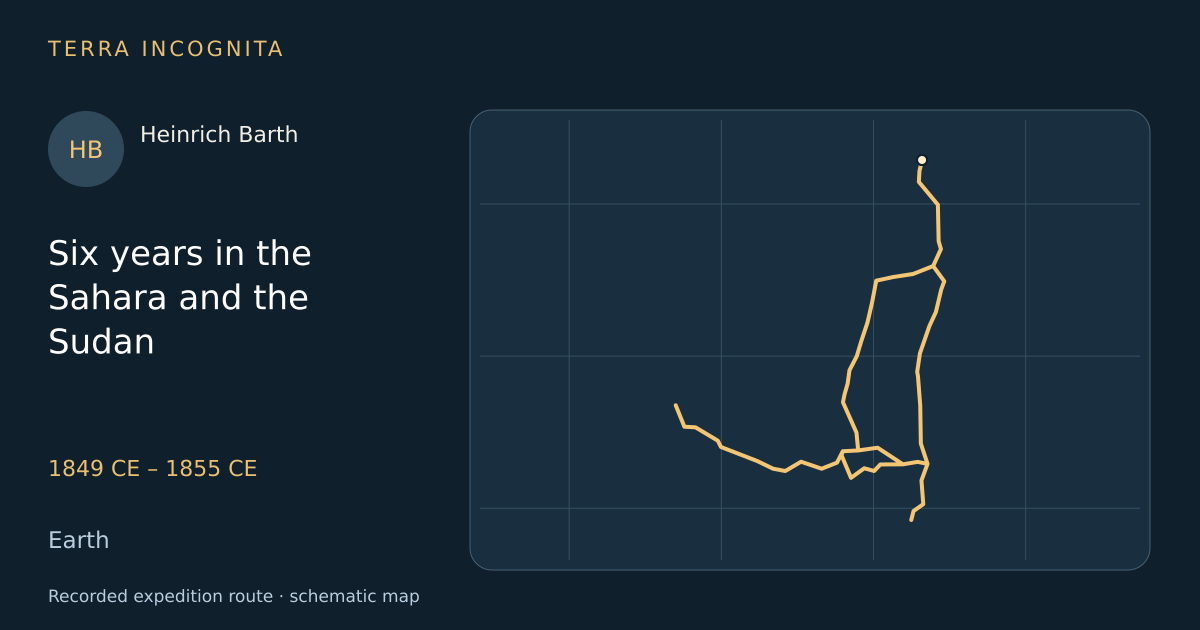
Open a route from Tripoli to Lake Chad, survey the central Sudan and report on its trade.
Historical context
Britain wanted a treaty route from Tripoli to Lake Chad that would undercut the Saharan slave trade by opening legitimate commerce, and let a young German philologist join the mission if he paid towards his own expenses. Richardson died in 1851 and Overweg in 1852; Barth, the last of the three, went on until 1855, speaking Arabic, Hausa and Kanuri and, as he put it, never moving on without leaving a sincere friend behind him. He brought home a map and an archive: the chronicles and histories of the central Sudan as its own scholars had written them.
The voyage, step by step
Tripoli, March 1850
March 1850
Barth, Richardson and Overweg leave the Ottoman port for Lake Chad.
Murzuk in the Fezzan
1850 CE
The caravan re-forms in the oasis capital before entering the open desert.
The Aïr massif
1850 CE
The mission becomes the first European party to enter the Aïr, and Barth maps its granite valleys.
Agadez
1850 CE
He spends nearly three weeks in the town, sees a new sultan installed and describes its clay minaret.
Kano
1851 CE
He reaches the greatest market of the central Sudan and stays to study its trade.
Kukawa and Lake Chad
1851 CE
News of Richardson’s death meets him on the road; he reaches the Bornu capital alone and takes charge of the mission.
The Benue at Yola
1851 CE
He crosses the upper Benue and concludes that it flows west to the Niger, not out of Lake Chad.
Eight months in Timbuktu
1853 CE
Sheikh al-Bakkay shelters him while factions demand the death of a Christian.
Outcome
Mapped the Aïr, Bornu, the Benue and the Niger bend, lived eight months in Timbuktu and returned to Tripoli in 1855, the only one of the mission’s three Europeans to come home.
Heinrich Barth
German scholar-traveller whose six years in the Sahara and the Sudan produced the most reliable European record of nineteenth-century West Africa.
Sources
- Heinrich Barth — Wikipedia
- Travels and Discoveries in North and Central AfricaHeinrich Barth · Longman, Brown, Green, Longmans & Roberts · 1857
Continue exploring
- Crossing AfricaDavid Livingstone · 1853 CE – 1856 CE
- Moreton Bay to Port EssingtonLudwig Leichhardt · 1844 CE – 1845 CE
- The East African ExpeditionRichard Francis Burton · 1857 CE – 1859 CE
- Overland from Adelaide to King George’s SoundEdward John Eyre · 1840 CE – 1841 CE