The Galápagos Rift hydrothermal expedition
Jack Corliss and the Alvin team · 1977 CE · Earth
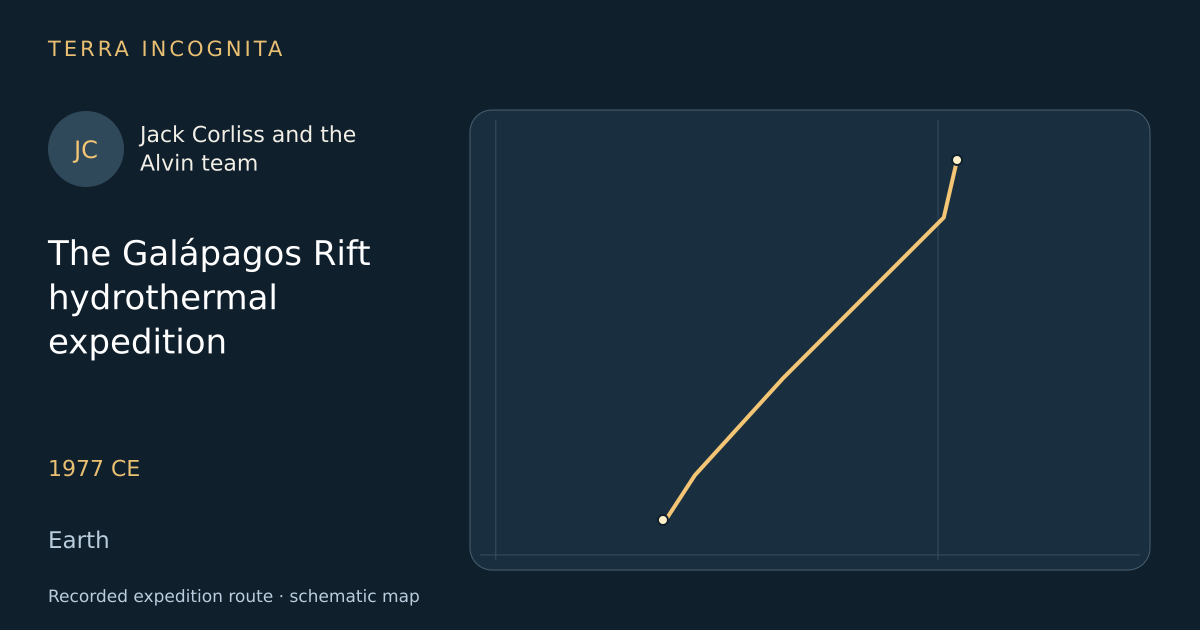
Dive on the temperature anomalies found the year before and prove that hot water circulates through the ridge.
Historical context
Geologists expected warm water on the mid-ocean ridges, because the chemistry of the whole ocean demanded it; nobody expected company. When Alvin settled beside a shimmering crack on the Galápagos Rift in February 1977, the scientists aboard found clams the size of dinner plates and worms taller than a man. A food chain that runs on sulphide instead of sunlight had been sitting there, undiscovered, for the whole history of biology.
The voyage, step by step
Sailing from Panama
1977 CE
The submersible Alvin, its tender and the survey ship leave Balboa for a spreading ridge 1,200 kilometres to the south-west.
Why the ridge should be hot
1977 CE
On passage, Corliss argues his doctoral case again: seawater must sink into the young crust, cook, and come back out somewhere.
The camera sled goes down
1977 CE
A towed sled of cameras and thermometers is flown back and forth a few metres above the rift until a temperature spike marks a target.
Alvin on the rift
17 February 1977
On 17 February 1977 Corliss, the geologist Tjeerd van Andel and pilot Jack Donnelly settle on fresh basalt at 2,500 metres.
Clambake
1977 CE
Around the warm cracks lie clams the size of dinner plates, white crabs and mats of bacteria, on a plain of lava that should be a desert.
The Garden of Eden
1977 CE
A second vent a little to the west carries clusters of white tubes a metre and a half tall, each tipped with a plume of blood-red gills.
Preserved in vodka
1977 CE
The ship carries no biological fixative, so the first vent animals ever collected are put up in the crew's spirits.
Outcome
Hot springs found at 2,500 metres, surrounded by a dense animal community that lives on chemistry instead of sunlight.
Jack Corliss and the Alvin team
Geochemist who went looking for hot springs on the Galápagos Rift in 1977 and found, instead of chemistry, an ecosystem that does not need the Sun.
Sources
- Jack Corliss — Wikipedia
- Submarine Thermal Springs on the Galápagos RiftJ. B. Corliss, J. Dymond, L. I. Gordon and others · Science, volume 203 · 1979
- Woods Hole Oceanographic Institution: Alvin dive records and ship logsWoods Hole Oceanographic Institution
Continue exploring
- The JIM walk off OahuSylvia Earle · 1979 CE
- Finding and diving the TitanicRobert Ballard · 1985 CE – 1986 CE
- The 1987 Titanic recovery divesNautile · 1987 CE
- The search for the BismarckArgo and Jason (Ballard's Bismarck search) · 1989 CE