The search for the Bismarck
Argo and Jason (Ballard's Bismarck search) · 1989 CE · Earth
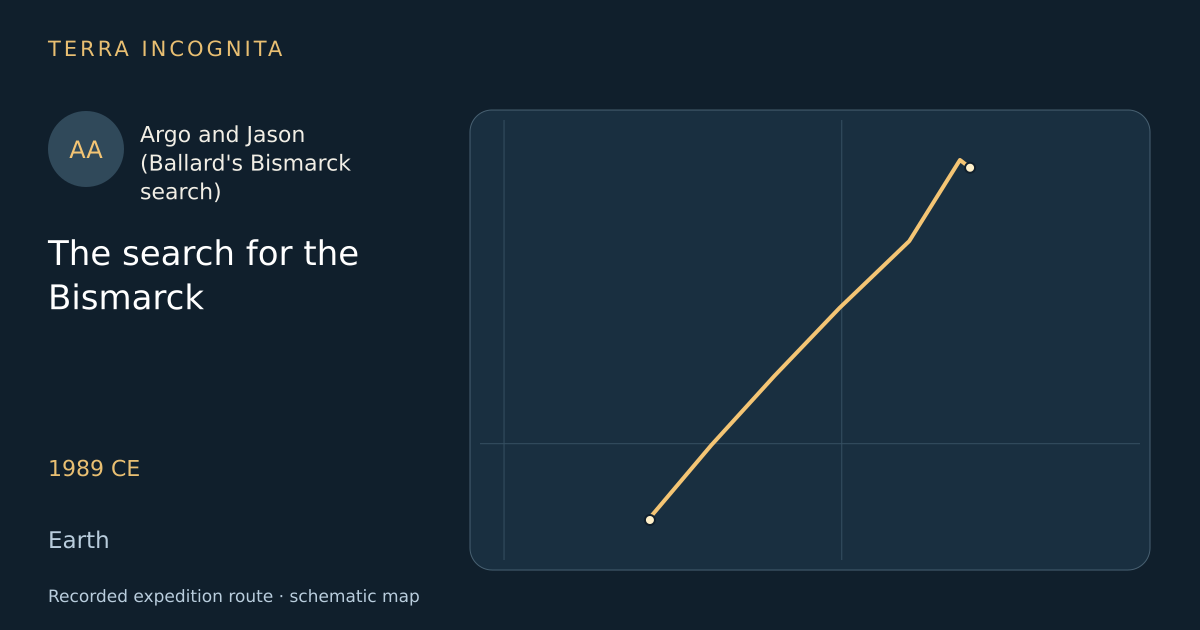
Find the wreck of the battleship Bismarck, sunk in 1941 far out in the Atlantic west of France, after a failed first search in 1988, and film it without disturbing it.
Historical context
The Bismarck sank on 27 May 1941, three days after she had destroyed HMS Hood, and more than 2,000 of her crew died with her; the positions recorded in 1941 disagreed. Robert Ballard of Woods Hole, who had led the American side of the 1985 search that found the Titanic with the towed camera sled Argo, searched first in 1988 from a converted trawler and found only an old sailing schooner. In 1989 he came back aboard the British supply ship Star Hercules, searched the volcanic slopes he had avoided, and on 8 June crossed the upright hull. He touched nothing, promised to keep the position secret except from West Germany, and said the ship's state suggested she had been scuttled, a question later expeditions argued over.
The voyage, step by step
Star Hercules leaves Cádiz
25 May 1989
On 25 May 1989, by Ballard's own account, the British offshore supply ship Star Hercules sails from Cádiz in the late afternoon and takes Woods Hole's towed camera sled Argo back to the waters where the Bismarck sank; the first logs of the Bismarck project in Woods Hole's archives open the same day.
Hours of mud
1989 CE
From 29 May, by Woods Hole's logs, Star Hercules lowers Argo and tows it back and forth across a new search box about six miles by five, some 10 by 8 kilometres, watched day and night by shifts that change every four hours.
A scar down a seamount
1989 CE
On the ninth day of the hunt, by the National Geographic film's account, Argo crosses wreckage that is plainly man-made: small debris, a boot, a lantern, then what looks like part of one of the Bismarck's main gun turrets.
Upright in the mud
8 June 1989
On 8 June 1989 Argo crosses the hull from starboard to port, right over the bridge: the Bismarck sits upright, sunk in sediment to about her waterline, her wooden deck and smaller guns still in place.
Reading the plating
1989 CE
In the following days Argo is towed slowly around the half-buried hull, filming shell marks, the empty turret holes and a faded swastika on the deck.
Nothing taken, nothing touched
1989 CE
The team touches nothing, takes nothing and sees no human remains; Ballard promises to keep the exact position secret from everyone but West Germany.
Outcome
The Bismarck found on 8 June 1989 at about 4,790 metres, upright and largely in one piece but for her fallen main turrets and part of her stern; Ballard read her state as a sign that she had been scuttled, a reading later expeditions disputed in part.
Argo and Jason (Ballard's Bismarck search)
Woods Hole's towed camera sled Argo, which found the Titanic in 1985 and the battleship Bismarck in 1989, and Jason, the free-swimming robot built to work alongside it.
Sources
- Search for the Battleship Bismarck (National Geographic Explorer film; soundtrack transcribed for this atlas)National Geographic Society; written by Patrick Prentice, produced by Christine Weber and Peter Schnall · National Geographic Society · 1989
- Utahn, Utah equipment helped find BismarckDeseret News · Deseret News (22 June 1989) · 1989
- Explorer finds Bismarck wreckageUnited Press International · UPI (12 June 1989) · 1989
- The Bismarck: 'It belongs to Germany'United Press International · UPI (23 June 1989) · 1989
- Son of explorer, another man killed in car crashUnited Press International · UPI (25 July 1989) · 1989
- Nazi Ship Bismarck Is Found in 'Good Shape'The New York Times · The New York Times (14 June 1989) · 1989
- Crew of Bismarck May Have Sunk HerAssociated Press · The New York Times (23 June 1989) · 1989
- Nazi crew, not British fire, sank the Bismarck, explorer believesChicago Tribune · Chicago Tribune (23 June 1989) · 1989
- Unlocking the Right Stuff in Young MindsRobert D. Ballard · Los Angeles Times (29 October 1989) · 1989
- The BismarckThe Washington Post · The Washington Post (29 October 1989) · 1989
- R/V Star Hercules, 1989–1991 (Logbook collection AC-66: JASPRO 89 and Bismarck 89 logs)Woods Hole Oceanographic Institution, Data Library and Archives · MBLWHOI Library Archives · 1989
- Star Hercules (IMO 7803566)Shipping and Shipbuilding Research Trust
- The JASON Remotely Operated Vehicle System (WHOI-93-34)Robert D. Ballard · Woods Hole Oceanographic Institution, technical report · 1993
- The Last Hours of the Bismarck (Purnell's History of the Second World War, 1967, as reproduced by KBismarck.com)Gerhard Junack · 1967
- Visiting Bismarck, Explorers Revise Its StoryWilliam J. Broad · The New York Times (3 December 2002) · 2002
- The Wreck of the BismarckKBismarck.com
- H.M.S. Hood Association — Battlecruiser HoodH.M.S. Hood Association
- German battleship Bismarck — Wikipedia
- Last battle of Bismarck — Wikipedia
- Argo (ROV) — Wikipedia
- The Discovery of the BismarckRobert D. Ballard · Warner Books · 1990
- Archaeological Oceanography (read only as archive.org full-text search snippets)Robert D. Ballard (ed.) · Princeton University Press · 2008
- Schiff Classic Extra 2021, Sonderheft Nr. 1: Die Bismarck (read only as archive.org full-text search snippets)Schiff Classic · 2021
Continue exploring
- The 1987 Titanic recovery divesNautile · 1987 CE
- Finding and diving the TitanicRobert Ballard · 1985 CE – 1986 CE
- The JIM walk off OahuSylvia Earle · 1979 CE
- The Galápagos Rift hydrothermal expeditionJack Corliss and the Alvin team · 1977 CE