Second voyage
James Cook · 1772 CE – 1775 CE · Earth
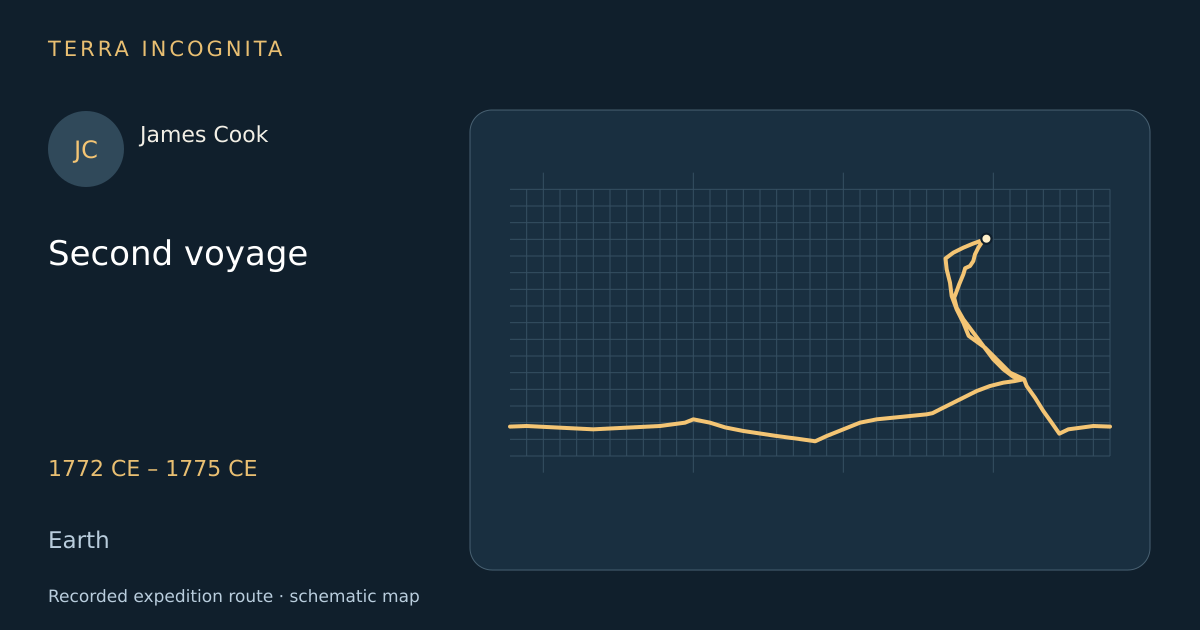
Settle whether a great southern continent exists in temperate latitudes, keeping as near the South Pole as possible while sailing round the globe.
Historical context
Cook’s first voyage had shown that New Zealand was not part of a great southern continent, but the theory survived in the unexplored ocean beyond. In 1772 the Admiralty sent him back with two Whitby colliers, the Resolution and the Adventure, under orders to keep in high latitudes and go as near the South Pole as possible while sailing round the globe, using New Zealand and the tropical islands to refresh the crews. With them sailed the naturalists Johann Reinhold and Georg Forster, the painter William Hodges, two astronomers, and a copy of John Harrison’s timekeeper. The voyage is known from Cook’s own account, published in 1777 with Furneaux’s narrative of the Adventure, and from Georg Forster’s A Voyage Round the World; the Māori, Rapa Nui, Tongan and Kanak sides of the meetings survive mostly as Cook and the Forsters recorded them.
The voyage, step by step
Departure from Plymouth
13 July 1772
On 13 July 1772 Cook sails from Plymouth Sound with the Resolution and the Adventure, to settle once and for all whether a southern continent exists.
Crossing the Antarctic Circle
17 January 1773
On 17 January 1773, between eleven and noon, the two ships cross the Antarctic Circle at 39°35′ east; by evening pack ice closed from east to west-south-west stops them at 67°15′ south.
The farthest south
30 January 1774
On 30 January 1774, at 71°10′ south and 106°54′ west, a field of ice with ninety-seven ice hills stops the Resolution, which has sailed alone since a gale parted her from the Adventure off New Zealand.
Homecoming
30 July 1775
On 30 July 1775 the Resolution anchors at Spithead after three years and eighteen days away; Cook has found no continent in the temperate south, and, by his own count, has lost only four of the Resolution’s men, one of them to sickness.
Outcome
Crossed the Antarctic Circle three times, reached 71°10′ south, found no temperate continent, and charted islands from Easter Island to New Caledonia and South Georgia; the Resolution lost four men in three years, and the Adventure ten at Grass Cove.
James Cook
British navigator who charted New Zealand and eastern Australia, crossed the Antarctic Circle and mapped much of the Pacific.
Sources
- A Voyage towards the South Pole, and Round the World, Performed in His Majesty’s Ships the Resolution and Adventure, in the Years 1772, 3, 4, and 5, vol. 1James Cook · W. Strahan and T. Cadell · 1777
- A Voyage towards the South Pole, and Round the World, Performed in His Majesty’s Ships the Resolution and Adventure, in the Years 1772, 3, 4, and 5, vol. 2James Cook · W. Strahan and T. Cadell · 1777
- A Voyage Round the World, in His Britannic Majesty’s Sloop, Resolution, Commanded by Capt. James Cook, during the Years 1772, 3, 4, and 5, vol. 1George Forster · 1777
- The Three Voyages of Captain Cook Round the World, vol. 5: Being the First of the Third VoyageJames Cook · Longman, Hurst, Rees, Orme, and Brown · 1821
- European discovery of New Zealand — Cook’s three voyages, Te Ara, the Encyclopedia of New ZealandJohn Wilson · Manatū Taonga, Ministry for Culture and Heritage · 2005
- James Cook — Wikipedia
Continue exploring
- First Pacific voyageJames Cook · 1768 CE – 1771 CE
- The first French naval voyage round the worldLouis-Antoine de Bougainville · 1766 CE – 1769 CE
- The voyage of the Boussole and the AstrolabeJean-François de La Pérouse · 1785 CE – 1788 CE
- The open-boat voyage to TimorWilliam Bligh · 1789 CE