First Pacific voyage
James Cook · 1768 CE – 1771 CE · Earth
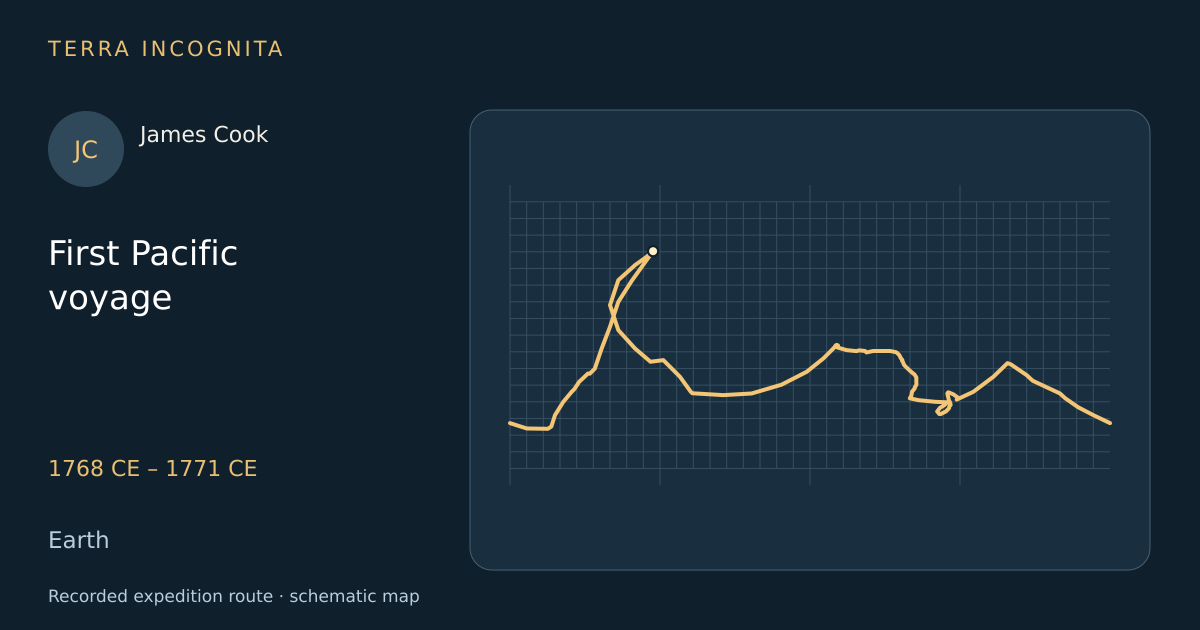
Observe the transit of Venus and search for the southern continent.
Historical context
The Royal Society needed a Pacific station to observe the 1769 transit of Venus, and the Admiralty had a hidden second aim: to find the southern continent. Cook combined the two into a voyage of measurement and discovery.
The voyage, step by step
Departure from Plymouth
26 August 1768
HMS Endeavour sails on 26 August 1768 to observe the transit of Venus from Tahiti.
Transit of Venus at Tahiti
June 1769
In June 1769 the astronomers observe the transit, and Tupaia joins the ship as pilot.
Charting New Zealand
October 1769
In October 1769 the Endeavour reaches New Zealand and spends six months charting both islands.
Botany Bay
April 1770
In April 1770 the ship anchors at a bay whose plants give it the name Botany Bay; the east coast is claimed for Britain.
Grounding on the Great Barrier Reef
11 June 1770
On 11 June 1770 the Endeavour strikes coral and nearly sinks; the crew jettison guns and stores to float her off.
Batavia
1770 CE
The ship is repaired at Batavia, but malaria and dysentery kill many of the crew before the voyage home.
Homecoming
July 1771
The Endeavour returns to England in July 1771, having charted thousands of kilometres of Pacific coastline.
Outcome
Charted New Zealand and eastern Australia, guided by Tupaia.
James Cook
British navigator who charted New Zealand and eastern Australia, crossed the Antarctic Circle and mapped much of the Pacific.
Sources
- James Cook — Wikipedia
- Tupaia (navigator) — Wikipedia
- Pathfinders: A Global History of ExplorationFelipe Fernández-Armesto · Oxford University Press · 2006
Continue exploring
- Second voyageJames Cook · 1772 CE – 1775 CE
- The first French circumnavigationLouis-Antoine de Bougainville · 1766 CE – 1769 CE
- The voyage of the Boussole and the AstrolabeJean-François de La Pérouse · 1785 CE – 1788 CE
- The open-boat voyage to TimorWilliam Bligh · 1789 CE