The East African Expedition
Richard Francis Burton · 1857 CE – 1859 CE · Earth
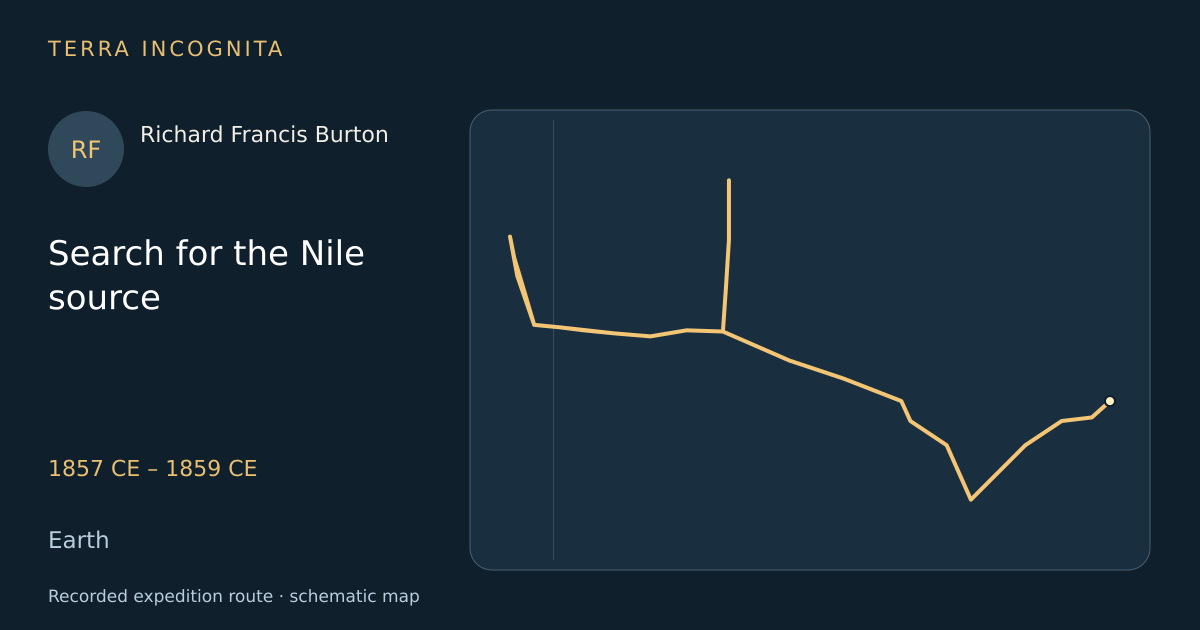
Find the limits of the “Sea of Ujiji” described by Arab traders, and report on the produce and peoples of the interior; the public expected the source of the Nile.
Historical context
Arab and Swahili caravans had long traded to the great lakes, and their reports of a “Sea of Ujiji” reached Europe as rumour. The Royal Geographical Society sent Burton to find its limits, but the source of the Nile was the riddle the public cared about, and the claim to it ended Burton and Speke’s partnership in one of exploration’s bitterest quarrels.
The voyage, step by step
From Zanzibar
1857 CE
In June 1857 Burton and Speke sail from Zanzibar for the mainland with Sidi Mubarak Bombay, Mabruki, two Goan servants and eight Baloch guards lent by Sultan Majid.
Onto the mainland road
27 June 1857
On 27 June 1857 the caravan marches out of Kaole, the village port just south of Bagamoyo, onto the trade road west through the country of the Zaramo.
Halt at Kazeh
7 November 1857
On 7 November 1857, the 134th day from the coast, the caravan enters Kazeh, the Arab trading settlement in the heart of Unyamwezi, and rests among its merchants.
The last river
4 February 1858
On 4 February 1858 the caravan crosses the Malagarasi in bark canoes, after paying Mzogera, lord of the river, for leave and his ferryman for the boats.
First sight of the water
13 February 1858
On 13 February 1858 a guide leads the caravan up a stony hill above Ukaranga, a few miles south of Ujiji, and Sidi Mubarak Bombay points out a streak of water below.
Lake Tanganyika
26 April 1858
In April 1858 Burton and Speke paddle north in two canoes hired from Kannena and reach Uvira, the farthest market the lake traders were allowed to visit.
Speke goes north without Burton
3 August 1858
Back at Kazeh, Burton stays behind, still unable to walk far, while Speke marches north with Bombay and reaches a far greater lake on 3 August 1858.
Two accounts, one coast
4 March 1859
They land at Zanzibar on 4 March 1859 and sail together for Aden, from where Speke goes on to London ahead of his commander.
Outcome
Burton and Speke reached Lake Tanganyika in February 1858; in August Speke, without Burton, reached the lake its peoples called Nyanza, named it Victoria and claimed it as the Nile’s source, which Burton disputed.
Richard Francis Burton
British explorer, linguist and writer who reached Lake Tanganyika and travelled to Mecca in disguise.
Sources
- The Lake Regions of Central Africa: A Picture of Exploration, Vol. 1Richard F. Burton · Longman, Green, Longman, and Roberts, London; Project Gutenberg text · 1860
- The Lake Regions of Central Africa: A Picture of Exploration, Vol. 2Richard F. Burton · Longman, Green, Longman, and Roberts, London; Project Gutenberg text · 1860
- What Led to the Discovery of the Source of the NileJohn Hanning Speke · William Blackwood and Sons, Edinburgh and London; Project Gutenberg text · 1864
- Richard Francis Burton — Wikipedia
Continue exploring
- Victorian Exploring ExpeditionBurke and Wills · 1860 CE – 1861 CE
- The source of the Nile with GrantJohn Hanning Speke · 1860 CE – 1863 CE
- Up the White Nile to Lake AlbertSamuel and Florence Baker · 1861 CE – 1865 CE
- Crossing AfricaDavid Livingstone · 1853 CE – 1856 CE