Peking to Kashmir by the Mustagh Pass
Francis Younghusband · 1887 CE · Earth
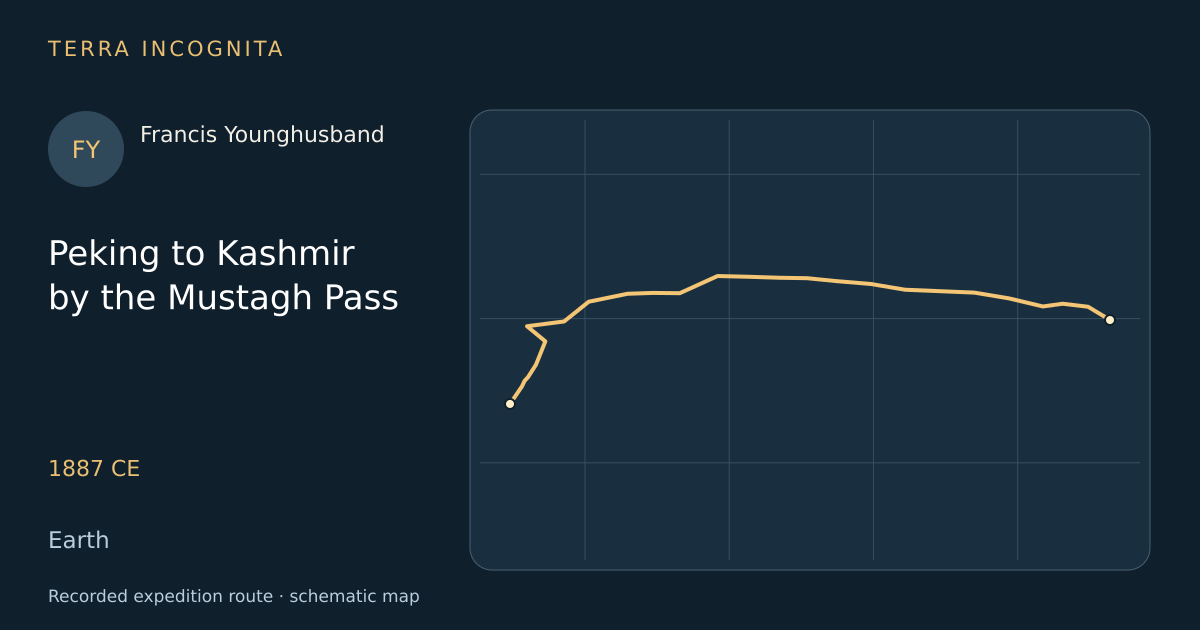
Go back to India overland from Peking by the direct Gobi track to Hami, the length of Chinese Turkestan and a crossing of the Himalayas, joining up what was known of Central Asia from China and from India.
Historical context
In 1887 what Europeans knew of Central Asia came in two halves that did not meet: what had been learned from India since Robert Shaw and Hayward first reached Yarkand, and what had been learned from China. Chinese Turkestan had only lately been reconquered by the Chinese, and it lay between the Russian empire and British India; Younghusband, near the end of his paper to the Royal Geographical Society, described its military state: a country almost denuded of troops, which could not resist an invasion. Shaw’s nephew, a lieutenant of twenty-three on leave, set out to join the two halves with one Chinese servant, hired caravan men and, at the end, five Baltis, and came back with a pass no European had crossed.
The voyage, step by step
Leave to go home
4 April 1887
A lieutenant of twenty-three has his leave extended to go back to India overland, and on 4 April 1887 rides out of Peking with the Chinese servant who will go with him all the way.
Seventy days of Gobi
1887 CE
With eight camels, a Chinese camel-man as guide and a Mongol helper, he crosses the desert from Kwei-hwa-cheng to Hami, marching into the night.
Hami
4 July 1887
After seventy days on camels he reaches a small oasis town of Chinese, Mongols, Kalmaks and Turkis, and learns that Colonel Bell went through three weeks before.
Turfan below sea level
1887 CE
A string of oases leads to Turfan, where people escape the heat in rooms under the ground and his barometer puts the town below the level of the sea.
Yarkand and the choice of pass
29 August 1887
At Yarkand a letter from Colonel Bell points him to the unexplored Mustagh Pass, and Wali, a Balti of Askole, agrees to guide him on one condition.
The Mustagh Pass
1887 CE
Without ice axes or proper boots, the party follows Wali down an ice slope and a rock precipice on steps cut with an ordinary pickaxe.
Down the Baltoro to Askole
1887 CE
Three days down the ice on worn-out boots bring them to Askole, Wali’s own village, whose people are not glad to learn that the northern way is open.
Srinagar to Rawalpindi
4 November 1887
Taken for a Yarkandi in Srinagar, he shaves, rests one day and races down to Rawalpindi, arriving on 4 November, seven months to the day after Peking.
Outcome
Reached Rawalpindi on 4 November 1887, seven months after leaving Peking and close to four thousand miles (some 6,400 km) by his own figures, having crossed the Gobi by a track no European had used, found the Aghil range and the Shaksgam river, and made the first crossing of the Mustagh Pass by a European.
Francis Younghusband
British officer who crossed Asia from Peking to India in 1887, at twenty-three and twenty-four, by the Gobi and the unused Mustagh Pass, and who in 1903 led the armed British mission into Tibet.
Sources
- Francis Younghusband — Wikipedia
- The Heart of a ContinentFrancis Younghusband · John Murray, London · 1896
- A Journey across Central Asia, from Manchuria and Peking to Kashmir, over the Mustagh Pass (with the discussion), Proceedings of the Royal Geographical Society, new series, vol. 10, pp. 485–518Francis Younghusband · Royal Geographical Society, London · 1888
- The Anniversary Meeting, June 16th, 1890: presentation of the Royal Medals, Proceedings of the Royal Geographical Society, new series, vol. 12, pp. 471–476Royal Geographical Society, London · 1890
- Mustagh Pass — Wikipedia
- British expedition to Tibet — Wikipedia
Continue exploring
- Travels in West AfricaMary Kingsley · 1893 CE – 1895 CE
- Fram driftFridtjof Nansen · 1893 CE – 1896 CE
- Two years in Arabia DesertaCharles Doughty · 1876 CE – 1878 CE
- The Tarim, Lop Nur and northern TibetSven Hedin · 1899 CE – 1902 CE