The Tarim, Lop Nur and northern Tibet
Sven Hedin · 1899 CE – 1902 CE · Earth
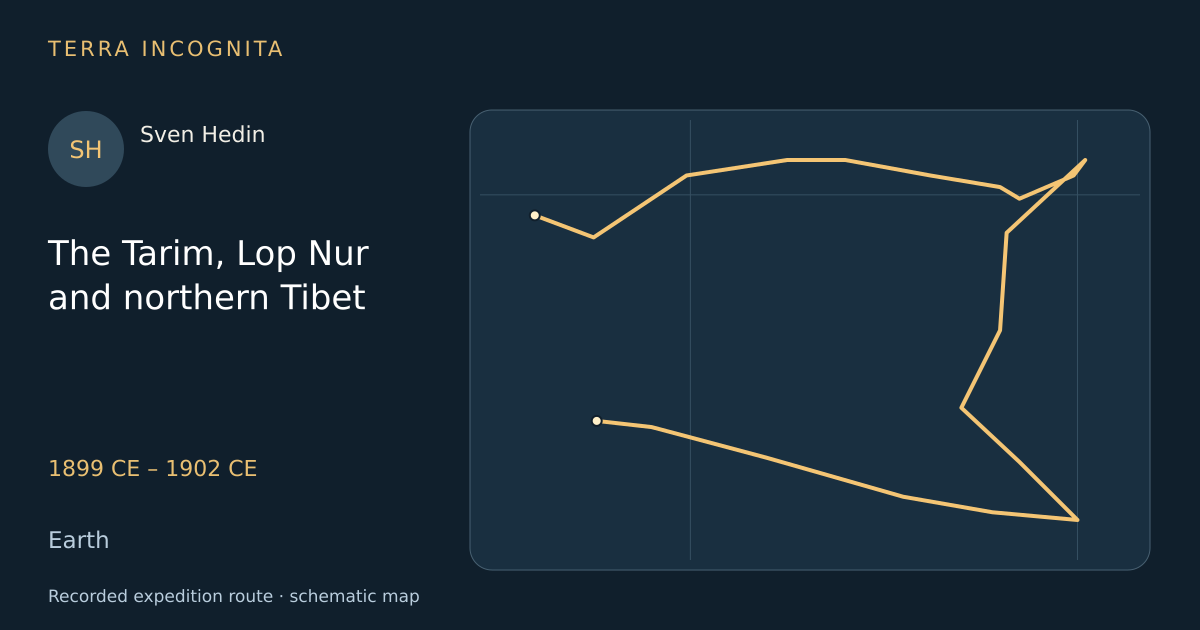
Map the Tarim from a boat, find where Lop Nur had lain and why it moved, and cross Tibet, reaching Lhasa in disguise if he could.
Historical context
Since Przhevalsky had reached the reed lakes at the end of the Tarim in 1876 and 1877 and taken them for Lop Nur, geographers had argued: the Chinese maps put the lake farther north, and Ferdinand von Richthofen, under whom Hedin had studied in Berlin, suggested that the river had changed its course. Hedin had seen the lakes in 1896 and believed that Lop Nur migrated. In 1899, with King Oscar’s help and Emanuel Nobel’s backing, he went back for three years: to map the Tarim from a boat, to find the old lake bed, and then to cross Tibet. The work was done with caravan men from Osh and Kashgar, boatmen of Lailik, Loplik fishermen and guides, and four Cossacks lent by the Tsar, and his maps carry the names these men gave him for banks, fords and springs.
The voyage, step by step
Kashgar
1899 CE
He leaves Stockholm on midsummer day 1899 and fits out at Kashgar, where the Russian consul-general turns his money into Chinese silver.
A ferry rebuilt at Lailik
17 September 1899
Across the Yarkand-daria from Merket, where his desert crossing of 1895 began, he fits out a ferry-boat, and on 17 September 1899 he casts off with a map sheet on his work-table.
Down the Tarim
1899 CE
Through October and November the ferry drifts down the Yarkand-daria and the Tarim, past river arms abandoned within living memory, until the ice stops it on 7 December 1899.
The wandering lake
April 1900
In April 1900 Lop fishermen take him by canoe through the reed channels of the Kara-koshun, a marsh that has changed shape in the four years since his last visit.
The ruins of Loulan
March 1901
He returns with spades to the ruins Ördek found by accident the year before, digs out the papers of a Chinese outpost of the third century, and levels the dry bed of the old lake.
The lake country
1901 CE
In June and July 1901, south of the Arka-tagh, the largest caravan he ever led loses camels at every pass on a high plateau of salt and fresh lakes.
Stopped short of Lhasa
August 1901
Shaven, painted and dressed as a Mongol pilgrim, he is stopped in August 1901 at Jallokk and turned back by Kamba Bombo, the governor of Nakchu.
Out at Leh
20 December 1901
After a long march west across Tibet that costs two men, he rides into Leh on 20 December 1901; the caravan follows on Christmas Day with nine camels left of thirty-nine.
Outcome
Mapped the Yarkand-daria and the Tarim from a ferry-boat in 1899, found the ruins of Loulan in 1900 and dug out their documents in 1901, levelled the dry bed of the old Lop Nur, was turned back on the road to Lhasa in August 1901 and reached Leh on 20 December 1901, going home in 1902.
Sven Hedin
Swedish geographer who mapped the Tarim from a ferry-boat, found the ruins of Loulan, argued that Lop Nur wandered between two basins and crossed Tibet, and whose later support for Germany damaged his name.
Sources
- Sven Hedin — Wikipedia
- Central Asia and Tibet: Towards the Holy City of LassaSven Hedin · Hurst and Blackett, London · 1903
- Central Asia and Tibet: Towards the Holy City of Lassa, vol. 1Sven Hedin · Hurst and Blackett, London · 1903
- Central Asia and Tibet: Towards the Holy City of Lassa, vol. 2Sven Hedin · Hurst and Blackett, London · 1903
- Through Asia, vol. 1Sven Hedin, translated by J. T. Bealby · Methuen, London · 1898
- Dr. Sven Hedin’s Latest Journey in Central Asia, 1899–1902, Bulletin of the American Geographical Society 34 (1902), pp. 445–448Sven Hedin, summarised by the Bulletin · 1902
- Scientific Results of a Journey in Central Asia 1899–1902, vol. IV: Central and West TibetSven Hedin · Kungl. Boktryckeriet P. A. Norstedt & Söner, Stockholm · 1907
- Lop Nur — Wikipedia
Continue exploring
- Travels in West AfricaMary Kingsley · 1893 CE – 1895 CE
- Fram driftFridtjof Nansen · 1893 CE – 1896 CE
- Peking to Kashmir by the Mustagh PassFrancis Younghusband · 1887 CE
- Two years in Arabia DesertaCharles Doughty · 1876 CE – 1878 CE