Terra Nova expedition
Robert Falcon Scott · 1910 CE – 1913 CE · Earth
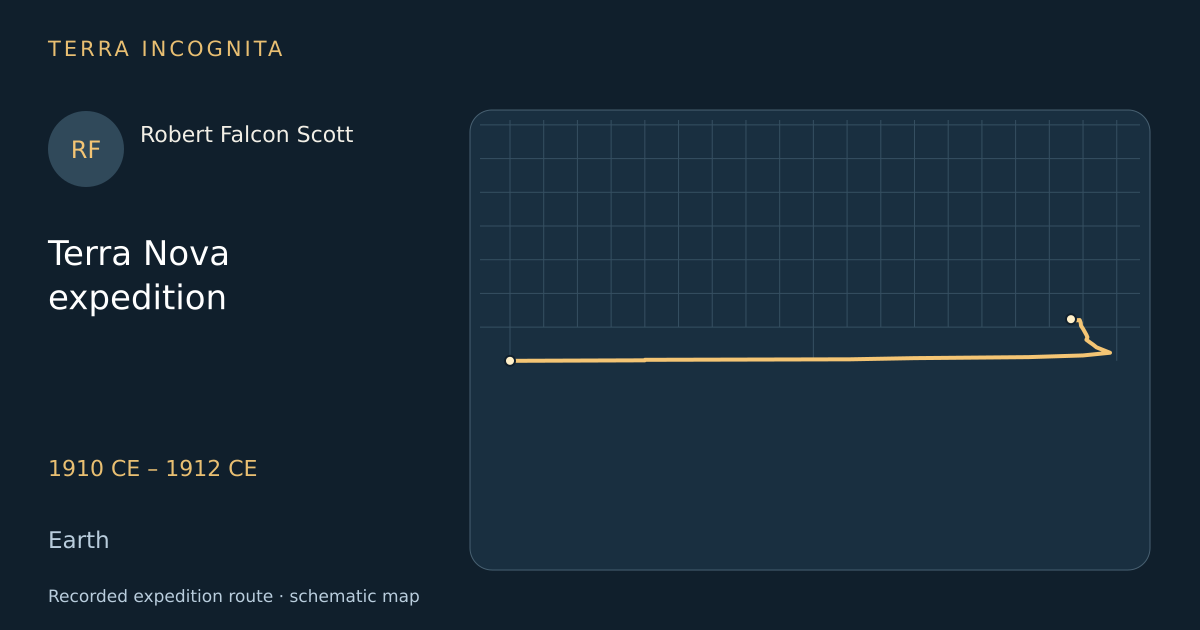
“To reach the South Pole, and to secure for the British Empire the honour of this achievement,” in the words of Scott’s appeal, while carrying out a broad programme of geology, biology and meteorology from a base in McMurdo Sound.
Historical context
Scott's appeal named the pole as the expedition's main object, for the British Empire, but Edward Wilson, chief of the scientific staff, wanted the science to make “the bagging of the Pole merely an item in the results”. At Melbourne in October 1910 Scott learned that Amundsen was going south too. The diaries found in the tent, and the long arguments over dogs, weather and Scott's decisions, have shaped the expedition's memory ever since.
The voyage, step by step
Base at Cape Evans
4 January 1911
On 4 January 1911 Scott chooses a cape on Ross Island for his base and renames it Cape Evans after his second-in-command, Edward Evans.
Laying One Ton Depot
17 February 1911
On 17 February 1911 the depot party leaves more than a ton of stores at 79° 29′ south, more than thirty miles short of the 80th parallel, because the ponies are failing.
Across the Barrier
1911 CE
From 1 November 1911 men, ponies and dogs cross four hundred miles of floating ice shelf toward the Beardmore Glacier, in soft snow and thick weather.
Up the Beardmore Glacier
11 December 1911
On 11 December 1911 Meares and Dimitri turn back with the dogs, and twelve men in three teams haul their sledges up the Beardmore Glacier toward the plateau.
The last party turns back
4 January 1912
On 4 January 1912, near 87° 32′ south, Scott sends the last support team home and takes five men on instead of the four he had planned for.
The pole — and Amundsen's flag
17 January 1912
On 17 January 1912 they reach the pole, the day after finding Amundsen’s black flag; the Norwegians had been there five weeks earlier.
Eleven miles short
19 March 1912
On 19 March 1912 Scott, Wilson and Bowers camp eleven miles short of One Ton Depot; a nine-day blizzard pins the last three men in their tent.
Outcome
Scott, Wilson, Oates, Bowers and Edgar Evans reached the South Pole on 17 January 1912, 34 days after Amundsen, and all five died on the return; Scott, Wilson and Bowers were found in their tent, eleven miles short of One Ton Depot, on 12 November 1912. Campbell’s Northern Party survived a winter in a snow cave, and the scientists brought home fossils of Glossopteris, emperor penguin embryos and a long record of the weather.
Robert Falcon Scott
British naval officer who reached the South Pole in 1912, only to find Amundsen had beaten him, and died on the return.
Sources
- Scott’s Last Expedition, Volume I: Being the Journals of Captain R. F. ScottRobert Falcon Scott, arranged by Leonard Huxley · Smith, Elder & Co., London; Project Gutenberg text · 1913
- Scott’s Last Expedition, Volume II: Reports of the Journeys and the Scientific WorkLeonard Huxley (arranger); narrative of the Northern Party by Victor Campbell · Smith, Elder & Co., London; Internet Archive scan · 1913
- The Worst Journey in the WorldApsley Cherry-Garrard · Constable · 1922
- The Great White South: Being an Account of Experiences with Captain Scott’s South Pole Expedition and of the Nature Life of the AntarcticHerbert G. Ponting · Duckworth & Co., London (second edition, 1922; Internet Archive scan) · 1921
- Terra Nova Expedition — Wikipedia
- Controversies surrounding Robert Falcon Scott — Wikipedia
- On the role of the weather in the deaths of R. F. Scott and his companions (abstract)Susan Solomon and Charles R. Stearns · Proceedings of the National Academy of Sciences 96 (23): 13012–13016 · 1999
- Susan Solomon — Wikipedia
- Could Captain Scott have been saved? Revisiting Scott’s last expedition (abstract)Karen May · Polar Record 49 (2013): 72–90 · 2012
- Could Captain Scott have been saved? Cecil Meares and the ‘second journey’ that failed (abstract)Karen May and Sarah Airriess · Polar Record 51 (2015): 260–273 · 2014
- Lawrence Oates — Wikipedia
- Омельченко, Антон Лукич — Wikipedia (Russian)
- Гирев, Дмитрий Семёнович — Wikipedia (Russian)
- К истории Антарктиды: от открытия к исследованиям (On the history of Antarctica: from discovery to research)I. A. Melnikov · Okeanologicheskie issledovaniya (Journal of Oceanological Research) 48 (1): 142–156 · 2020
- Robert Falcon Scott — Wikipedia
Continue exploring
- South Pole expeditionRoald Amundsen · 1910 CE – 1912 CE
- North Pole expeditionMatthew Henson · 1908 CE – 1909 CE
- North Pole attemptRobert Peary · 1908 CE – 1909 CE
- Damascus to Ha’il and BaghdadGertrude Bell · 1913 CE – 1914 CE