Luna 3 flyby
Luna 3 · 1959 CE · The Moon
Photograph the far side of the Moon.
Historical context
After Luna 2 struck the Moon, Korolev's OKB-1 sent a probe around it to photograph the hemisphere no one had seen. It needed the first Soviet attitude control system, a camera that developed its own film, and a path that would bring it back over the Crimea to send the pictures home. Boris Chertok, one of its designers, put the odds of success at 20 to 30 per cent.
The voyage, step by step
Outward to the far side
4 October 1959
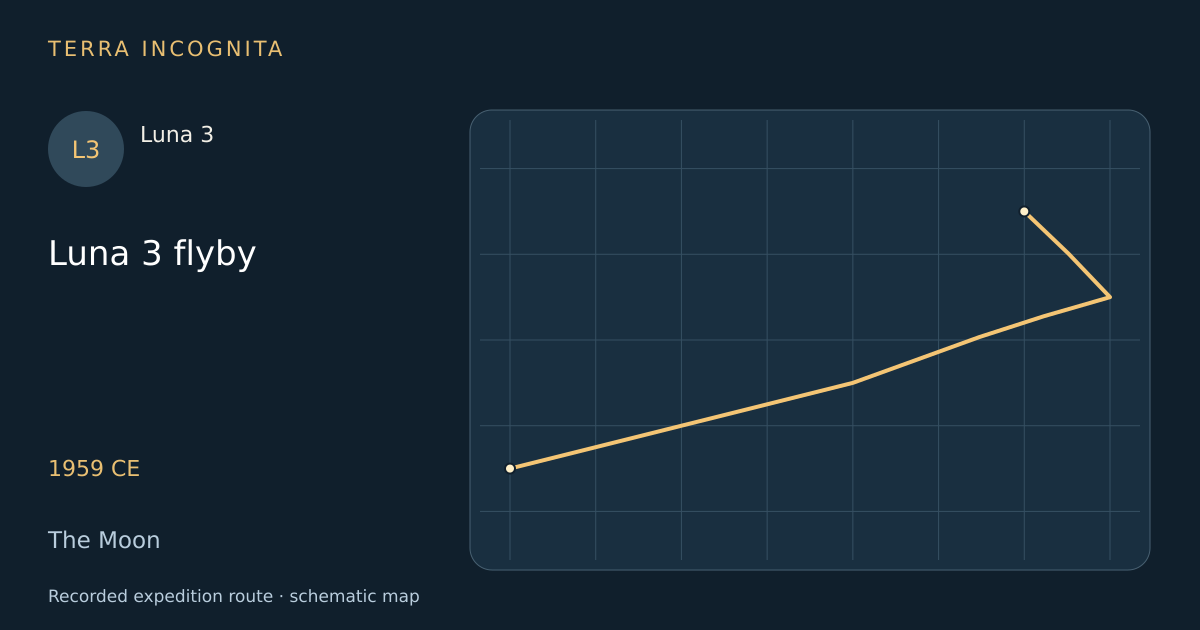
At 00:43 UTC on 4 October 1959, 03:43 Moscow time, the third Soviet cosmic rocket lifts off from Tyuratam, two years to the day after Sputnik, carrying the Automatic Interplanetary Station towards the Moon.
Around the limb
6 October 1959
At 14:16 UTC on 6 October the probe passes over the Moon's south polar region, about 6,200 kilometres above the surface, and the Moon's gravity bends its path back towards the Earth without any engine firing.
Forty minutes of film
7 October 1959
At 03:30 UTC on 7 October, 06:30 Moscow time, the twin-lens camera starts taking twenty-nine pictures of the sunlit far side in a session of about forty minutes; the film is then developed, fixed and dried on board.
First photographs of the far side
1959 CE
The pictures come down to Mount Koshka, faint at first; by 18 October NASA's archive counts seventeen resolvable frames, the photographs that Siddiqi's chronicle lists as the first of the Moon's far side.
Naming a new world
1959 CE
The Soviet atlas of 1960 maps the new names: the Sea of Moscow, the Sea of Dreams and the craters Tsiolkovsky, Lomonosov, Jules Verne and Giordano Bruno.
The last signals
22 October 1959
Contact is lost on 22 October; the probe goes on circling the Earth until, by most accounts, it burns up in the atmosphere in the spring of 1960.
Outcome
Photographed about 70 per cent of the far side on 7 October 1959, the first pictures of it in Siddiqi's chronicle.
Luna 3
Soviet probe that returned the first photographs of the far side of the Moon in October 1959.
Sources
- Beyond Earth: A Chronicle of Deep Space Exploration, 1958–2016 (NASA SP-2018-4041)Asif A. Siddiqi · NASA History Division · 2018
- Luna 3 — NSSDCA Master Catalog (read in the Wayback Machine copy)NASA Space Science Data Coordinated Archive
- Rockets and People, Volume II: Creating a Rocket Industry (NASA SP-2006-4110), chapter 29, “Ye-2 Flies to the Moon and We Fly to Koshka”Boris Chertok · NASA History Division · 2006
- Atlas of the Far Side of the Moon (Academy of Sciences of the USSR, Moscow, 1960), eds N. P. Barabashov, A. A. Mikhailov and Yu. N. Lipsky, translated by Nadya Winkels, University of Michigan report 2914-1-TAcademy of Sciences of the USSR · University of Michigan Radiation Laboratory, for NASA · 1961
- Jodrell Bank's role in early space tracking activities — Part 1Sven Grahn · Jodrell Bank Centre for Astrophysics, University of Manchester · 2008
- Luna 3 — Wikipedia
Continue exploring
- Luna 1 flybyLuna 1 · 1959 CE
- Luna 2 impactLuna 2 · 1959 CE
- Ranger 7 impactRanger 7 · 1964 CE
- Luna 9 landingLuna 9 · 1966 CE