Luna 2 impact
Luna 2 · 1959 CE · The Moon
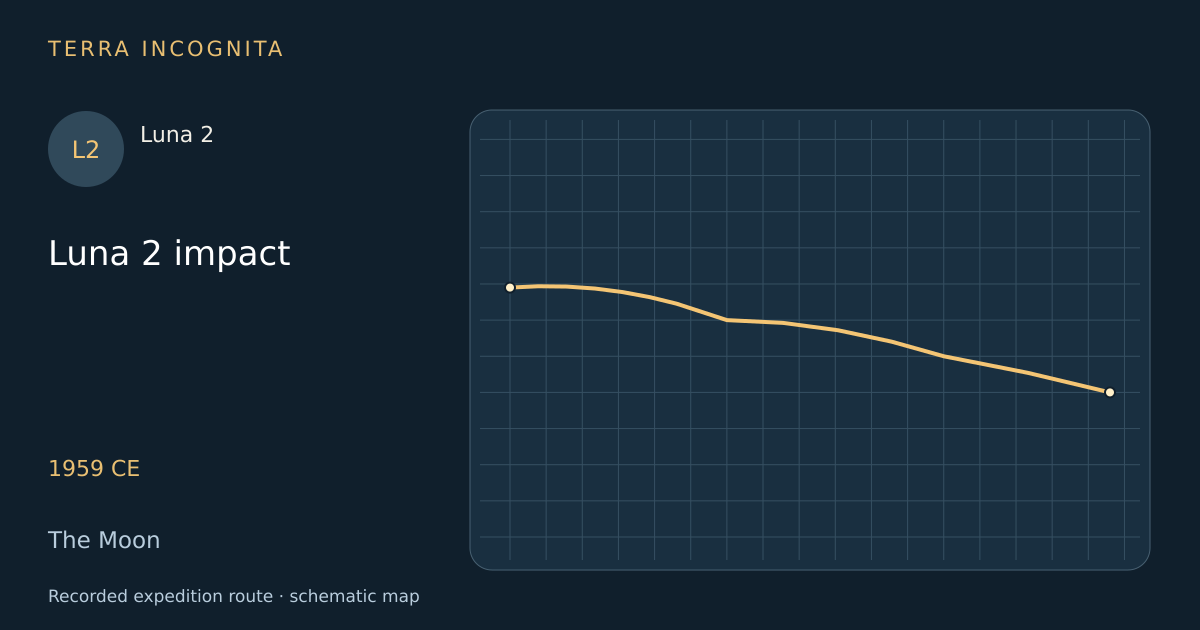
Strike the Moon with Soviet pennants aboard.
Historical context
After three failures in 1958, a miss in January and another failure in June 1959, Korolev's team launched its sixth moon rocket in September 1959, with Soviet pennants aboard. It struck the Moon on the eve of Khrushchev's visit to the United States, and Moscow had the British observatory at Jodrell Bank witness the impact.
The voyage, step by step
Aimed at the Moon
12 September 1959
At 06:39 UTC on 12 September 1959, 09:39 Moscow time, the Second Cosmic Rocket lifts off from Tyuratam on a direct path to the Moon.
Thirty-eight hours to the Moon
12 September 1959
The probe and its spent third stage coast for a little over a day and a half, and at 18:42 UTC on 12 September the stage releases its sodium cloud.
Witnessed from Cheshire
13 September 1959
At Jodrell Bank, Bernard Lovell's great dish follows the probe through the evening of 13 September and hears its signal stop at 21:02:23 UTC.
Into the Marsh of Decay
13 September 1959
At 21:02 UTC on 13 September, 00:02 Moscow time on 14 September, the probe strikes the Moon between the craters Archimedes and Autolycus; Siddiqi counts it the first object of human origin to make contact with another celestial body.
A gift in Washington
15 September 1959
On 15 September Khrushchev arrives in Washington and gives Eisenhower a replica of the pennant sphere, in a wooden case lined with light blue velvet.
Outcome
Struck the Moon on 13 September 1959 (UTC): by Siddiqi's account, the first object of human origin to make contact with another celestial body.
Luna 2
Soviet probe that struck the Moon on 13 September 1959 (UTC): in Siddiqi's words, the first object of human origin to make contact with another celestial body.
Sources
- Luna 2 — NSSDCA Master Catalog, with its trajectory page (read in the Wayback Machine copies)NASA Space Science Data Coordinated Archive
- Beyond Earth: A Chronicle of Deep Space Exploration, 1958–2016 (NASA SP-2018-4041)Asif A. Siddiqi · NASA History Division · 2018
- Rockets and People, Volume II: Creating a Rocket Industry (NASA SP-2006-4110), chapter 25, “Lunar Assault”Boris Chertok · NASA History Division · 2006
- Jodrell Bank's role in early space tracking activities — Part 1Sven Grahn · Jodrell Bank Centre for Astrophysics, University of Manchester · 2008
- Soviet Rocket Hits Moon After 35 Hours; Arrival Is Calculated Within 84 Seconds; Signals Received Till Moment of Impact (The New York Times, 14 September 1959, p. 1)Max Frankel · The New York Times · 1959
- Изучение межпланетного ионизованного газа, энергичных электронов и корпускулярного излучения Солнца при помощи трехэлектродных ловушек заряженных частиц на второй советской космической ракете, Doklady Akademii Nauk SSSR 131 (6), 1301–1304K. I. Gringauz, V. V. Bezrukikh, V. D. Ozerov and R. E. Rybchinsky · Academy of Sciences of the USSR (Math-Net.Ru copy) · 1960
- Искусственная натриевая комета (The artificial sodium comet), Sem iskusstv no. 7 (134)Vladimir Kurt · 2021
- Lunar ImpactDon P. Mitchell · Mental Landscape · 2008
- 60 Years Ago: Luna 2 Makes Impact in Moon RaceJohn Uri · NASA · 2019
- Luna 2 — Wikipedia
Continue exploring
- Luna 3 flybyLuna 3 · 1959 CE
- Luna 1 flybyLuna 1 · 1959 CE
- Ranger 7 impactRanger 7 · 1964 CE
- Luna 9 landingLuna 9 · 1966 CE