Calypso in the Red Sea and Indian Ocean
Jacques Cousteau · 1955 CE · Earth
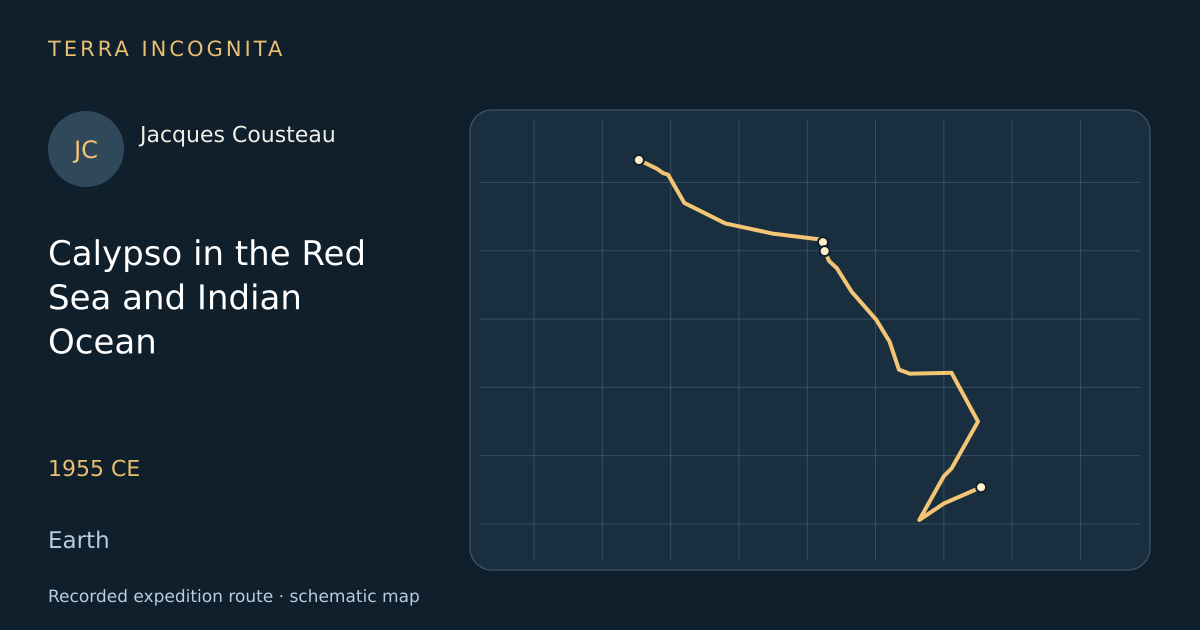
Film the underwater world in colour, at depth, along a route from Marseille to the Seychelles.
Historical context
The aqualung had made the first thirty metres of the sea accessible to anyone, but almost nobody had seen them in colour. Cousteau fitted Calypso with lights, watertight cameras and an observation chamber in the bow, and sailed from Marseille to the Seychelles filming as he went. The result made the underwater world popular, and its worst scenes later made his own case against him.
The voyage, step by step
Calypso leaves Marseille
1955 CE
A wooden minesweeper with an observation chamber cut into her bow sails for the Red Sea with three tonnes of film stock aboard.
Through the canal
1955 CE
At Port Said the ship enters the ditch that carries her out of the Mediterranean, a hundred and sixty kilometres of still water between two deserts.
Reefs in colour
1955 CE
Divers with battery lamps film coral walls in colour at thirty and forty metres, where every earlier camera had returned nothing but blue.
The Farasan Bank
1955 CE
In the shallow maze of the Farasan Bank the divers work daily on coral heads that no scientific party has ever surveyed.
Out through the Gate of Tears
1955 CE
Calypso passes the narrows at the foot of the Red Sea and turns east into the monsoon swell of the Indian Ocean.
The lagoon at Aldabra
1955 CE
A ring of raised coral three hundred kilometres from anywhere encloses a lagoon that empties and fills twice a day through four narrow channels.
Landfall at Mahé
1955 CE
The granite peaks of the Seychelles mark the far end of the filming voyage, twenty-five kilometres of exposed film behind the ship.
Home to a Palme d'or
1955 CE
Calypso returns to Marseille with the material that becomes Le Monde du silence, shown at Cannes the following spring.
Outcome
Le Monde du silence, winner of the Palme d'or in 1956 and of an Academy Award in 1957, and a generation persuaded that the sea was worth looking at.
Jacques Cousteau
Naval officer and film-maker who co-invented the aqualung and turned a converted minesweeper into a floating laboratory and film studio.
Sources
- Jacques Cousteau — Wikipedia
- The Silent World: A Story of Undersea Discovery and AdventureJacques-Yves Cousteau with Frédéric Dumas · Harper and Brothers · 1953
Continue exploring
- Trieste's first deep divesAuguste Piccard · 1953 CE
- Challenger Deep diveJacques Piccard · 1960 CE
- The search for USS ThresherTrieste (the Thresher search) · 1963 CE
- The Galápagos Rift hydrothermal expeditionJack Corliss and the Alvin team · 1977 CE