The long walk from Malhado
Álvar Núñez Cabeza de Vaca · 1528 CE – 1536 CE · Earth
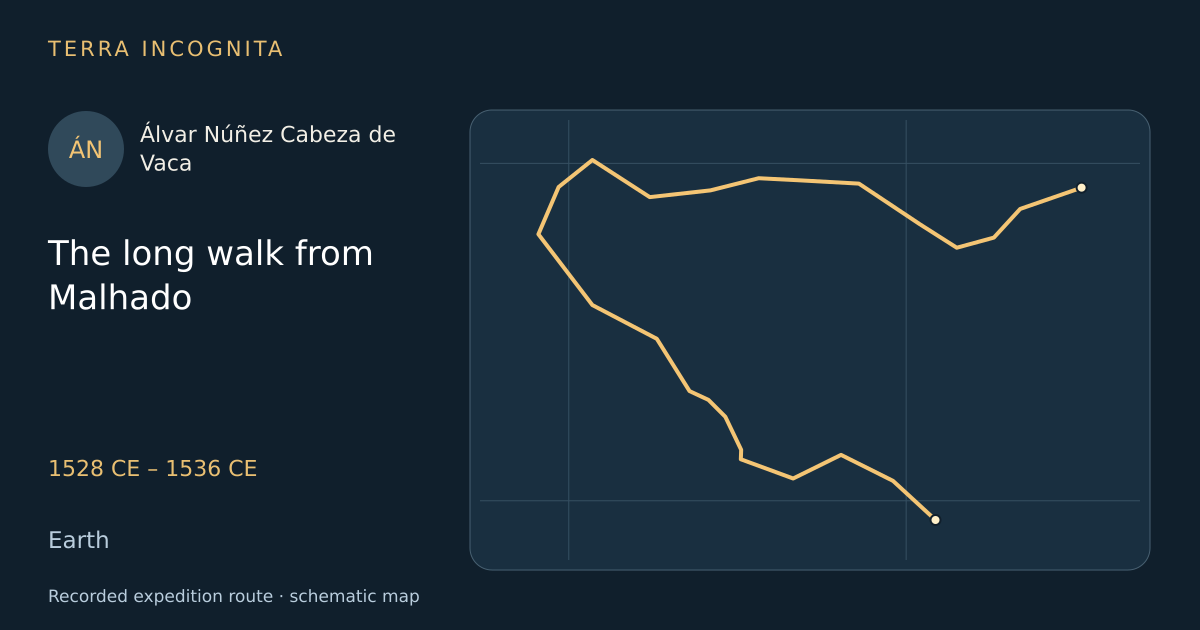
Reach a Spanish settlement alive, from a beach on the Gulf coast with no ships, no horses and no idea of the distance.
Historical context
Narváez sailed in 1527 with a royal grant to conquer the coast from the Río de las Palmas to the cape of Florida, and lost his six hundred men to storms, swamps, hunger and Apalachee arrows within eighteen months. The men who came ashore in Texas in makeshift boats caulked with palmetto fibre were not explorers but castaways, and the walk that followed was made on the terms of the peoples who owned the country. What Cabeza de Vaca brought back was not a conquest but a book, and an argument that the Crown lost no time in ignoring.
The voyage, step by step
Malhado, the isle of ill fortune
November 1528
A makeshift boat caulked with palmetto fibre is thrown ashore on a low Texas island in November, carrying survivors of six hundred men.
Among the Karankawa
1529 CE
The islanders feed the strangers out of their own winter stores and then set them to work.
From trader to slave of the Mariames
1533 CE
After almost six years trading along the coast, he joins Dorantes as a slave of the Mariames and waits for the prickly-pear season.
Four men turn west
September 1534
In September the survivors slip away together and begin walking towards a coast they have to hope is there.
The junction of the rivers
1535 CE
Beyond the mountains they reach the first real houses of the journey, most often placed at La Junta de los Ríos, among people who grow beans and squash.
The Village of Hearts
1536 CE
In a farming town of Sonora they are given more than six hundred deer hearts, and told of the way to the South Sea.
Meeting the slave-raiders
1536 CE
In Sinaloa, some thirty leagues short of Culiacán, they come on mounted Spaniards hunting people, and a quarrel soon follows.
Mexico City, July 1536
July 1536
Four survivors walk into the viceroy’s capital nine years after sailing from Spain.
Outcome
Four men of six hundred came out at Culiacán in 1536 after eight years, and the Relación of 1542 gave Europe its first account of the interior of North America.
Álvar Núñez Cabeza de Vaca
Treasurer of a wrecked Spanish invasion who walked for eight years from the Texas coast to the Pacific slope of Mexico, and wrote the first European description of the interior of North America.
Sources
- Álvar Núñez Cabeza de Vaca — Wikipedia
- La relación que dio Álvar Núñez Cabeza de Vaca de lo acaescido en las IndiasÁlvar Núñez Cabeza de Vaca · Agustín de Paz y Juan Picardo, Zamora · 1542
Continue exploring
- Ahead of Fray Marcos, to CíbolaEstevanico · 1539 CE
- The entrada to Cíbola and QuiviraFrancisco Vázquez de Coronado · 1540 CE – 1542 CE
- Over the Urals into SibirYermak Timofeyevich · 1582 CE – 1585 CE
- Up the Amazon to Quito and backPedro Teixeira · 1637 CE – 1639 CE