Victorian Exploring Expedition
Burke and Wills · 1860 CE – 1861 CE · Earth
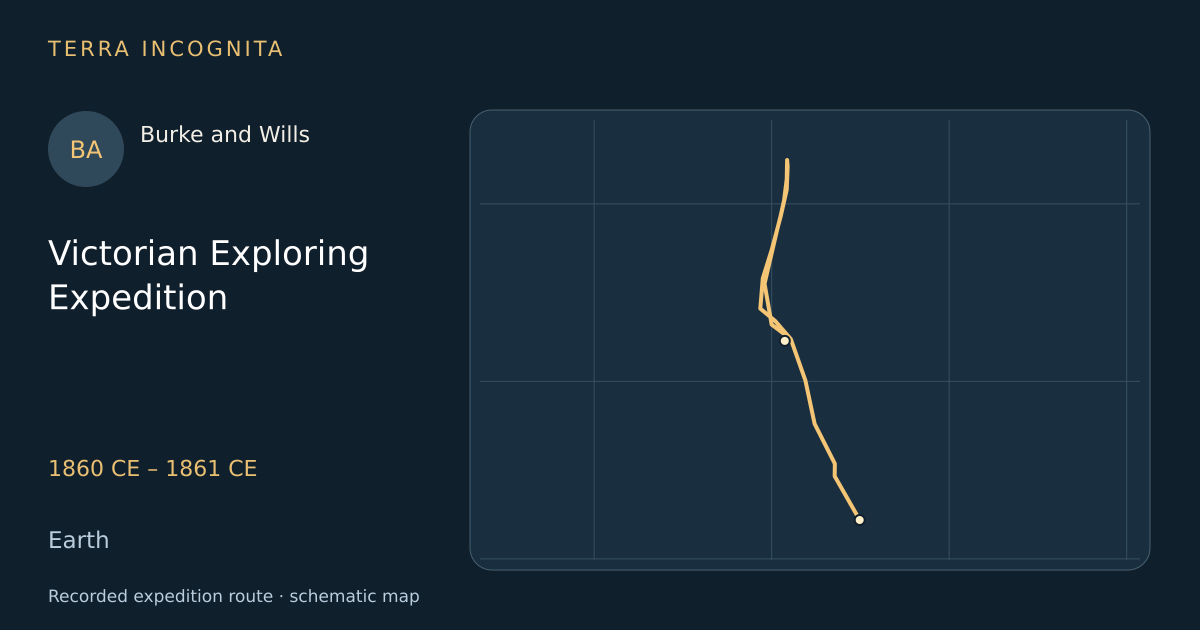
Cross the continent from Melbourne to the northern coast before South Australia could, and report on the country and a telegraph route.
Historical context
Gold had made Victoria one of the richest places in the British Empire, and its Royal Society wanted the honour of the first crossing from south to north while John McDouall Stuart was trying the same from South Australia. The money bought camels from Karachi, a scientific staff and some twenty tonnes of stores, but the leader it chose, Robert O’Hara Burke, had never been outside the settled districts. The royal commission of 1861 found that he divided his party “most injudiciously” and showed “a far greater amount of zeal than prudence”; on Cooper Creek it was the Yandruwandha, living well on fish and nardoo, who kept the explorers alive for weeks and sheltered the one survivor.
The voyage, step by step
Royal Park, 20 August 1860
20 August 1860
Some fifteen thousand people watch nineteen men, twenty-seven camels, twenty-three horses and six wagons leave Melbourne.
Menindee, October 1860
October 1860
At the last town on the Darling, Burke splits his expedition and leaves half of it behind.
Camp LXV on Cooper Creek
16 December 1860
A stockade is built on the waterhole, and on 16 December four men ride north into the summer.
The stony desert
23 December 1860
The four men cross the stony plains that Charles Sturt had named, and find them easier going than they had feared.
Up the Diamantina
December 1860
A Christmas rest on the Diamantina, then the long push north towards the ranges and the Gulf.
The mangroves of the Flinders, February 1861
9 February 1861
Burke and Wills push through tidal mud to salt water, and never see the open sea.
Nine hours too late
21 April 1861
On the evening of 21 April the three survivors walk into a depot abandoned that morning.
Nardoo on the Cooper
May 1861
Living on ground fern spores, Burke and Wills starve on a creek where a whole people is well fed.
Outcome
Reached tidal water in the Flinders delta in February 1861; seven men died, among them Gray, Burke and Wills on the return, and John King, the only one of the four who went north to come home, survived with the Yandruwandha.
Burke and Wills
Leaders of a lavishly equipped Victorian expedition that crossed the continent to the Gulf of Carpentaria and starved to death on Cooper Creek on the way home.
Sources
- Burke and Wills expedition — Wikipedia
- Report of the Commissioners appointed to enquire into and report upon the circumstances connected with the sufferings and death of Robert O’Hara Burke and William John Wills, the Victorian explorers (Parliamentary Paper No. 97, 1861–62), with the minutes of evidenceVictoria. Burke and Wills Commission · John Ferres, Government Printer, Melbourne · 1862
- A Successful Exploration through the Interior of Australia, from Melbourne to the Gulf of Carpentaria, from the journals and letters of William John WillsWilliam Wills (ed.) · Richard Bentley, London · 1863
- Burke & Wills Web: a brief history of the expedition, and biographies of its membersDave Phoenix · Burke & Wills Web, the digital research archive of expedition records
Continue exploring
- The source of the Nile with GrantJohn Hanning Speke · 1860 CE – 1863 CE
- Up the White Nile to Lake AlbertSamuel and Florence Baker · 1861 CE – 1865 CE
- Sixth expedition: Adelaide to the northern seaJohn McDouall Stuart · 1861 CE – 1862 CE
- The East African ExpeditionRichard Francis Burton · 1857 CE – 1859 CE